
Mapa mental
Evolution
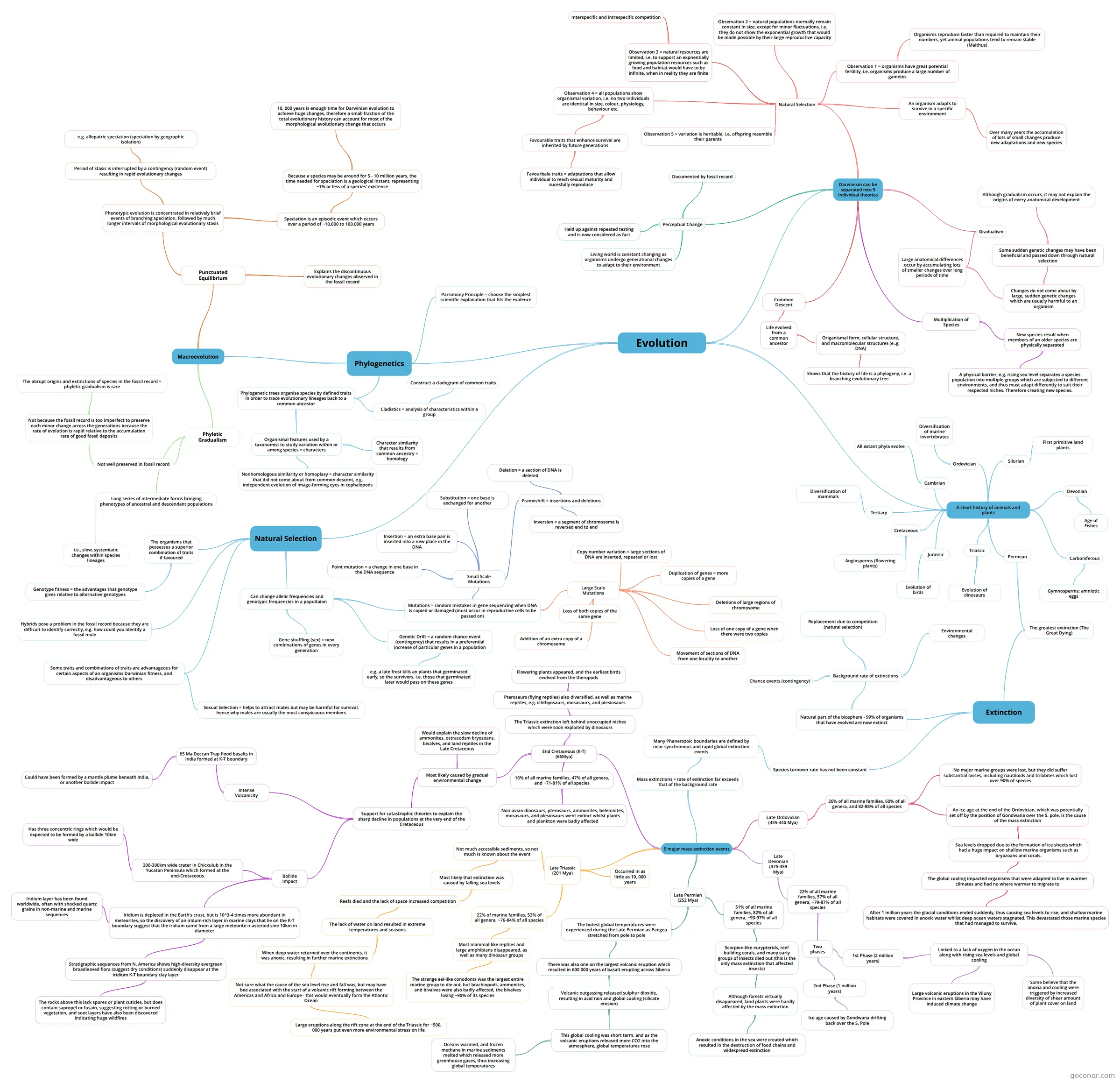
Mind map: Evolution
Conteúdo do mapa
Evolution
Darwinism can be separated into 5 individual theories
- Perceptual Change
- Living world is constant changing as organisms undergo generational changes to adapt to their environment
- Held up against repeated testing and is now considered as fact
- Documented by fossil record
- Common Descent
- Life evolved from a common ancestor
- Origanismal form, cellular structure, and macromolecular structures (e..g. DNA)
- Shows that the history of life is a phylogeny, i.e. a branching evolutionary tree
- Origanismal form, cellular structure, and macromolecular structures (e..g. DNA)
- Life evolved from a common ancestor
- Multiplication of Species
- New species result when members of an older species are physically separated
- A physical barrier, e.g. rising sea level separates a species population into multiple groups which are subjected to different environments, and thus must adapt differently to suit their respected niches. Therefore creating new species.
- New species result when members of an older species are physically separated
- Gradualism
- Large anatomical differences occur by accumulating lots of smaller changes over long periods of time
- Changes do not come about by large, sudden genetic changes which are usua;ly harmful to an organism
- Some sudden genetic changes may have been beneficial and passed down through natural selection
- Although gradualism occurs, it may not explain the origins of every anatomical development
- Some sudden genetic changes may have been beneficial and passed down through natural selection
- Changes do not come about by large, sudden genetic changes which are usua;ly harmful to an organism
- Large anatomical differences occur by accumulating lots of smaller changes over long periods of time
- Natural Selection
- An organism adapts to survive in a specific environment
- Over many years the accumulation of lots of small changes produce new adaptations and new species
- Observation 1 = organisms have great potential fertility, i.e. organisms produce a large number of gametes
- Organisms reproduce faster than required to maintain their numbers, yet animal populations tend to remain stable (Malthus)
- Observation 2 = natural populations normally remain constant in size, except for minor fluctuations, i.e. they do not show the exponential growth that would be made possible by their large reproductive capacity
- Observation 3 = natural resources are limited, i.e. to support an expnentially growing population resources such as food and habitat would have to be infinite, when in reality they are finite
- Interspecific and intraspecific competition
- Observation 4 = all populations show organismal variation, i.e. no two individuals are identical in size, colour, physiology, behaviour etc.
- Favourable traits that enhance survival are inherited by future generations
- Favourbale traits = adaptations that allow individual to reach sexual maturity and sucesfully reproduce
- Favourable traits that enhance survival are inherited by future generations
- Observation 5 = variation is heritable, i.e. offspring resemble their parents
- An organism adapts to survive in a specific environment
- Perceptual Change
Natural Selection
- Can change allelic frequencies and genotypic frequencies in a popultaion
- Mutations = random mistakes in gene sequencing when DNA is copied or damaged (must occur in reproductive cells to be passed on)
- Small Scale Mutations
- Substitution = one base is exchanged for another
- Insertion = an extra base pair is inserted into a new place in the DNA
- Frameshift = insertions and deletions
- Deletion = a section of DNA is deleted
- Inversion = a segment of chromosome is reversed end to end
- Point mutation = a change in one base in the DNA sequence
- Large Scale Mutations
- Copy number variation = large sections of DNA are inserted, repeated or lost
- Duplication of genes = more copies of a gene
- Deletions of large regions of chromosome
- Loss of one copy of a gene when there were two copies
- Loss of both copies of the same gene
- Movement of sections of DNA from one locality to another
- Addition of an extra copy of a chromosome
- Small Scale Mutations
- Genetic Drift = a random chance event (contingency) that results in a preferential increase of particular genes in a population
- e.g. a late frost kills an plants that germinated early, so the survivors, i.e. those that germinated later would pass on these genes
- Gene shuffling (sex) = new combinations of genes in every generation
- Mutations = random mistakes in gene sequencing when DNA is copied or damaged (must occur in reproductive cells to be passed on)
- The organisms that possesses a superior combination of traits if favoured
- Genotype fitness = the advantages that genotype gives relative to alternative genotypes
- Some traits and combinations of traits are advantageous for certain aspects of an organisms Darwinian fitness, and disadvantageous to others
- Sexual Selection = helps to attract mates but may be harmful for survival, hence why males are usually the most conspicuous members
- Hybrids pose a problem in the fossil record because they are difficult to identify correctly, e.g. how could you identify a fossil mule
- Can change allelic frequencies and genotypic frequencies in a popultaion
Phylogenetics
- Phylogenetic trees organise species by defined traits in order to trace evolutionary lineages back to a common ancestor
- Cladistics = analysis of characteristics within a group
- Construct a cladogram of common traits
- Organismal features used by a taxonomist to study variation within or among species = characters
- Character similarity that results from common ancestry = homology
- Nonhomologous similarity or homoplasy = character similarity that did not come about from common descent, e.g. independent evolution of image-forming eyes in cephalopods
- Cladistics = analysis of characteristics within a group
- Parsimony Principle = choose the simplest scientific explanation that fits the evidence
- Macroevolution
- Phyletic Gradualism
- Long series of intermediate forms bringing phenotypes of ancestral and descendant populations
- i.e., slow, systemiatic changes within species lineages
- Not well preserved in fossil record
- Not because the fossil record is too imperfect to preserve each minor change across the generations because the rate of evolution is rapid relative to the accumulation rate of good fossil deposits
- The abrupt origins and extinctions of species in the fossil record = phyletic gradualism is rare
- Not because the fossil record is too imperfect to preserve each minor change across the generations because the rate of evolution is rapid relative to the accumulation rate of good fossil deposits
- Long series of intermediate forms bringing phenotypes of ancestral and descendant populations
- Punctuated Equilibrium
- Explains the discontinuous evolutionary changes observed in the fossil record
- Phenotypic evolution is concentrated in relatively brief events of branching speciation, followed by much longer intervals of morphological evolutionary stasis
- Speciation is an episodic event which occurs over a period of ~10,000 to 100,000 years
- Because a species may be around for 5 - 10 million years, the time needed for speciation is a geological instant, representing ~1% or less of a species' existence
- 10, 000 years is enough time for Darwinian evolution to achieve huge changes, therefore a small fraction of the total evolutionary history can account for most of the morphological evolutionary change that occurs
- Because a species may be around for 5 - 10 million years, the time needed for speciation is a geological instant, representing ~1% or less of a species' existence
- Period of stasis is interrupted by a contingency (random event) resulting in rapid evolutionary changes
- e.g. allopatric speciation (speciation by geographic isolation)
- Speciation is an episodic event which occurs over a period of ~10,000 to 100,000 years
- Phyletic Gradualism
- Phylogenetic trees organise species by defined traits in order to trace evolutionary lineages back to a common ancestor
A short history of animals and plants
- Cambrian
- All extant phyla evolve
- Ordovician
- Diversification of marine invertebrates
- Silurian
- First primitive land plants
- Devonian
- Age of Fishes
- Carboniferous
- Gymnosperms; amniotic eggs
- Permean
- The greatest extinction (The Great Dying)
- Extinction
- Natural part of the biosphere - 99% of organisms that have evolved are now extinct
- Background rate of extinctions
- Chance events (contingency)
- Replacement due to competition (natural selection)
- Environmental changes
- Background rate of extinctions
- Species turnover rate has not been constant
- Many Phanerozoic boundaries are defined by near-synchronous and rapid global extinction events
- Mass extinctions = rate of extinction far exceeds that of the background rate
- 5 major mass extinction events
- Late Ordovician (455-440 Mya)
- 26% of all marine families, 60% of all genera, and 82-88% of all species
- No major marine groups were lost, but they did suffer substantial losses, including nautiloids and trilobites which lost over 90% of species
- An ice age at the end of the Ordovician, which was potentially set off by the position of Gondwana over the S. pole, is the cause of the mass extinction
- Sea levels dropped due to the formation of ice sheets which had a huge impact on shallow marine organisms such as bryozoans and corals.
- The global cooling impacted organisms that were adapted to live in warmer climates and had no where warmer to migrate to
- After 1 million years the glacial conditions ended suddenly, thus causing sea levels to rise, and shallow marine habitats were covered in anoxic water whilst deep ocean waters stagnated. This devastated those marine species that had managed to survive.
- The global cooling impacted organisms that were adapted to live in warmer climates and had no where warmer to migrate to
- Sea levels dropped due to the formation of ice sheets which had a huge impact on shallow marine organisms such as bryozoans and corals.
- 26% of all marine families, 60% of all genera, and 82-88% of all species
- Late Devonian (375-359 Mya)
- 22% of all marine families, 57% of all genera, ~79-87% of all species
- Two phases
- 1st Phase (2 million years)
- Linked to a lack of oxygen in the ocean along with rising sea levels and global cooling
- Some believe that the anoxia and cooling were triggered by increased diversity of shear amount of plant cover on land
- Large volcanic eruptions in the Viluny Province in eastern Siberia may have induced climate change
- Linked to a lack of oxygen in the ocean along with rising sea levels and global cooling
- 2nd Phase (1 million years)
- Ice age caused by Gondwana drifting back over the S. Pole
- 1st Phase (2 million years)
- Two phases
- 22% of all marine families, 57% of all genera, ~79-87% of all species
- Late Permian (252 Mya)
- 51% of all marine families, 82% of all genera, ~93-97% of all species
- Scorpion-like eurypterids, reef building corals, and many early groups of insects died out (this is the only mass extinction that affected insects)
- Although forests virtually disappeared, land plants were hardly affected by the mass extinction
- Anoxic conditions in the sea were created which resulted in the destruction of food chains and widespread extinction
- Although forests virtually disappeared, land plants were hardly affected by the mass extinction
- Scorpion-like eurypterids, reef building corals, and many early groups of insects died out (this is the only mass extinction that affected insects)
- The hotest global temperatures were experienced during the Late Permian as Pangea stretched from pole to pole
- There was also one on the largest volcanic eruption which resulted in 600 000 years of basalt erupting across Siberia
- Volcanic outgassing released sulphur dioxide, resulting in acid rain and global cooling (silicate erosion)
- This global cooling was short term, and as the volcanic eruptions released more CO2 into the atmosphere, global temperatures rose
- Oceans warmed, and frozen methane in marine sediments melted which released more greenhouse gases, thus increasing global temperatures
- This global cooling was short term, and as the volcanic eruptions released more CO2 into the atmosphere, global temperatures rose
- Volcanic outgassing released sulphur dioxide, resulting in acid rain and global cooling (silicate erosion)
- There was also one on the largest volcanic eruption which resulted in 600 000 years of basalt erupting across Siberia
- 51% of all marine families, 82% of all genera, ~93-97% of all species
- Late Triassic (201 Mya)
- Occurred in as little as 10, 000 years
- 22% of marine families, 53% of all genera, ~76-84% of all species
- Most mammal-like reptiles and large amphibians disappeared, as well as many dinosaur groups
- The strange eel-like conodonts was the largest entire marine group to die out, but brachiopods, ammonites, and bivalves were also badly affected, the bivalves losing ~90% of its species
- Most mammal-like reptiles and large amphibians disappeared, as well as many dinosaur groups
- Not much accessible sediments, so not much is known about the event
- Most likely that extinction was caused by falling sea levels
- Reefs died and the lack of space increased competition
- The lack of water on land resulted in extreme temperatures and seasons
- When deep water returned over the continents, it was anoxic, resulting in further marine extinctions
- Not sure what the cause of the sea level rise and fall was, but may have bee associated with the start of a volcanic rift forming between the Americas and Africa and Europe - this would eventually form the Atlantic Ocean
- Large eruptions along the rift zone at the end of the Triassic for ~500, 000 years put even more environmental stress on life
- Not sure what the cause of the sea level rise and fall was, but may have bee associated with the start of a volcanic rift forming between the Americas and Africa and Europe - this would eventually form the Atlantic Ocean
- When deep water returned over the continents, it was anoxic, resulting in further marine extinctions
- The lack of water on land resulted in extreme temperatures and seasons
- Reefs died and the lack of space increased competition
- Most likely that extinction was caused by falling sea levels
- End Cretaceous (K-T) (66Mya)
- The Triassic extinction left behind unoccupied niches which were soon exploited by dinosaurs
- Pterosaurs (flying reptiles) also diversified, as well as marine reptiles, e.g. ichthyosaurs, mosasaurs, and plesiosaurs
- Flowering plants appeared, and the earliest birds evolved from the theropods
- Pterosaurs (flying reptiles) also diversified, as well as marine reptiles, e.g. ichthyosaurs, mosasaurs, and plesiosaurs
- 16% of all marine families, 47% of all genera, and ~71-81% of all species
- Non-avian dinosaurs, pterosaurs, ammonites, belemnites, mosasaurs, and plesiosaurs went extinct whilst plants and plankton were badly affected
- Most likely caused by gradual environmental change
- Would explain the slow decline of ammonites, ostracodsm bryozoans, bivalves, and land reptiles in the Late Cretaceous
- Support for catastrophic theories to explain the sharp decline in populations at the very end of the Cretaceous
- Bollide Impact
- Iridium is depleted in the Earth's crust, but is 10^3-4 times more abundant in meteorites, so the discovery of an iridum-rich layer in marine clays that lie on the K-T boundary suggest that the iridium came from a large meteorite ir asteroid sine 10km in diameter
- Iridium layer has been found worldwide, often with shocked quartz grains in non-marine and marine sequences
- Stratigraphic sequences from N. America shows high-diversity evergreen broadleaved flora (suggest dry conditions) suddenly disappear at the iridium K-T boundary clay layer
- The rocks above this lack spores or plant cuticles, but does contain sapropel or fusain, suggesting rotting or burned vegetation, and soot layers have also been discovered indicating huge wildfires
- 200-300km wide crater in Chicxulub in the Yucatan Peninsula which formed at the end-Cretaceous
- Has three concentric rings which would be expected to be formed by a bollide 10km wide
- Iridium is depleted in the Earth's crust, but is 10^3-4 times more abundant in meteorites, so the discovery of an iridum-rich layer in marine clays that lie on the K-T boundary suggest that the iridium came from a large meteorite ir asteroid sine 10km in diameter
- Intense Vulcanicity
- 65 Ma Deccan Trap flood basalts in India formed at K-T boundary
- Could have been formed by a mantle plume beneath India, or another bollide impact
- 65 Ma Deccan Trap flood basalts in India formed at K-T boundary
- Bollide Impact
- The Triassic extinction left behind unoccupied niches which were soon exploited by dinosaurs
- Late Ordovician (455-440 Mya)
- 5 major mass extinction events
- Mass extinctions = rate of extinction far exceeds that of the background rate
- Many Phanerozoic boundaries are defined by near-synchronous and rapid global extinction events
- Natural part of the biosphere - 99% of organisms that have evolved are now extinct
- Extinction
- The greatest extinction (The Great Dying)
- Triassic
- Evolution of dinosaurs
- Jurassic
- Evolution of birds
- Cretaceous
- Angiosperms (flowering plants)
- Tertiary
- Diversification of mammals
- Cambrian
Informações
- Descrição
- Mapa Mental sobre Evolution, criado por kimj em 10-07-2015.
- Criado por
- kimj
- Visualizações
- 3
- Avaliação