
Mapa mental
Evolution
Conteúdo do mapa
Evolution
- Depends on variation of a trait. Differential repoduction will carry the varying trait across generations.
Community Living
- Co-Evolution
- Commensalism
- One species benefits the other is not harmed or helped
- Parasitism
- One species benefits and the other is harmed
- Mutualism
- Both species benefits
- Commensalism
- Communication
- Signals
- Cues
- Mimicry
- Mullerian
- Batesian
- Colouration
- Alturism
- Relatedness
- Eusocially
- Quasisocial
- Social
- Niche
- Kin Selection
- Reciprocal Altruism
- Co-Evolution
Extinction
- The loss of all living members of a species. -3 species go extinct per million years -5 families go extinct per million years
- Mass Extinction
- Rapid loss of a large , diverse array of organisms. -observed as major biostratigraphic changes -period boundries defined by mass extinction of marine invertebrates -boundaries of eras represent very large mass extinctions
- Ordovician
- -occurs 450mya -second most severe -caused by Gondwanaland glaciation -25% of families went extinct
- Devonian
- -occurred 385-359mya -caused by drastic global cooling and ocean chemistry change -e.t impact -20% of animal families went extinct
- Permian
- -occurred 250mya -most severe -comet/asteroid impact -volcanic activity -90-95% of all species went extinct
- Triassic
- Cretaceous
- -65mya -all dinosaurs except birds went extinct -16% of marine species went extinct -climate change -asteroid impact -volcanic eruption
- Quaternary
- -40-90% of larger species have gone extinct -climate change -human impact
- Hypothesis one
- -hunted to extinction -did not adapt to aridity -slow reproduces hardest hit
- Hypothesis two
- Increased aridity caused extinction. -climate getting drier -many species gone before humans arrived -not enough people to cause extinction
- Hypothesis three
- Landscape firing caused extinction. -firestick farming
- Hypothesis four
- A complex of factor caused extinction
- Cretaceous
- Local Extinction
- No individuals in one area
- Extinct in Wild
- Individual remain only in captivity
- Ecologically Extinct
- Still persists, but so rare it's negligible
- Pseudo Extinction
- Species evolved but ancestor is extinct
- Causes
- Competition
- -predation -disease -competition for resources
- Change of Environment
- -rainfall -temperature -salinity -atmosphere composition
- Chance Events
- -meteors
- Competition
- Deterministic Traits
- Traits that make species more or less vulnerable
- Geographic Range
- Rarity
- Specialisation
- Population Variability
- Trophic Status
- Intrinsic Rate of Population Increase
- Extinction Vortex
- -occurs with reduced populations -loss of genetic diversity -lower reproduction/high mortality -low populations
Tree of life
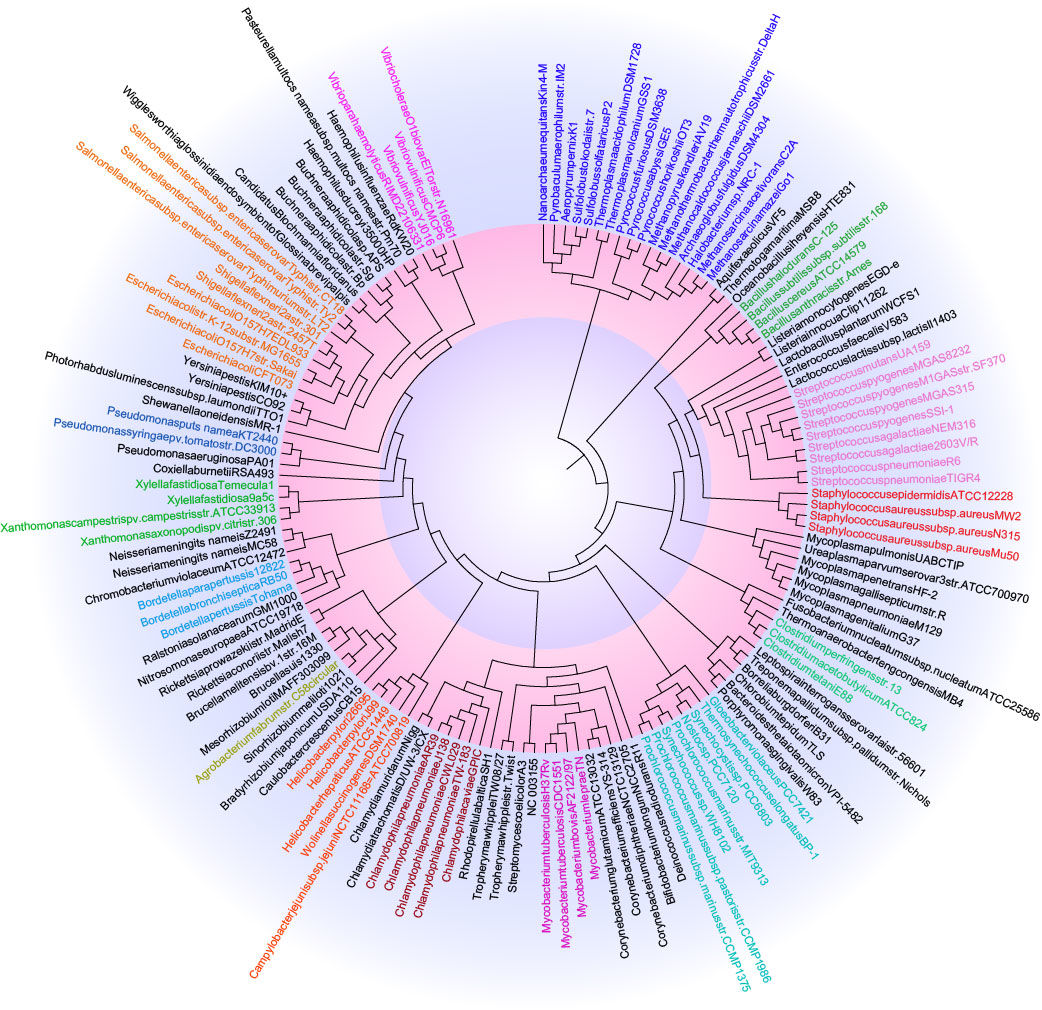
- A hypothesis about evolutionary relationships among individuals or group organisims. Visual representation of evolution. Includes living and extinct life. One common ancestor for all living things
- Taxonomy
- Method and principals of classifying species. Rules for naming organisms. Originally classification on morphology.
- Classification
- Domain
- -Archaea -Bacteria -Eukarya
- Kingdom
- -Animalia -Plantae -Fungi -Protista -Chromista
- Phylum
- Class
- Order
- Family
- Genus
- Species
- Genus
- Family
- Order
- Class
- Morphology
- Domain
- Cladogram
- Parts of the tree
- Taxa
- Sister taxa
- Nodes
- Clades
- Origin of Life
- Ways to find out the age of the Earth -Stratigraphic -Gravitational -Ocean Accumulation -Historic (e.g Bible)
- Dating and Discovery
- Fossils
- Data collected helps construct the tree of life.
- Stromatolites
- These are preserved bacterial colonies
- Isotope Fractionation
- Fossil Record
- Clear pattern of fossil morphology that shows succession.
- Palaeontology
- 99.9% of species that ever existed are extinct.
- Relative and Absolute Dating
- Radioactive decay is absolute dating Stratigraphic is relative dating
- Relative Dating
- -order sediment laid down -biocorrelation
- Nicolaus Steno
- 3 principles -superposition -original horizontality -lateral continuity
- Superposition
- James Hutton
- Uniformitarianism
- William Smith
- -distinguished strata -biocorrelation -key concepts of palaeontology
- Biostratigraphy
- Principle of Faunal Succession. -distribution of organisms -estimating ages of rocks
- Absolute Dating
- Fossils
- Age of Earth
- The earth is estimated to be 4.54 billion years old The oldest rock was found in WA
- Diversity
- 8.74 +/- 1.3 million species exist
- Biodiversity
- This includes ecosystems, genetic and cultural.
- Descriptive Analysis
- Genes
- DNA
- Amino Acids
- 23 amino acids make up DNA
- Nucleotides
- 4 that make up the amino acids
- Polypeptides
- Amino Acids
- Phenotypes
- The physical expression of genes
- DNA
- Cells
- Prokaryotes
- -These lived approx. 1.5 by alone -Was the cause of the bubonic plague -can be benign or beneficial -bacteria and archaera are branches from these
- Plants
- Reproduction
- Haploid
- One copy of genes
- Diploid
- Two copies of genes
- Gametophyte
- Produces sperm and eggs
- Zygote
- Sporophyte
- Progymnosperms
- -looked like trees -used spores to reporduce
- Haploid
- Vascular Plants
- Habitat
- -live in broad range of environments -earliest didn't produce seeds
- Vascular System
- -lining of vessel walls -cellulose in cell walls -transport nutrients
- Habitat
- Reproduction
- Animals
- Human
- Evolutionary Significant Animals
- Fish
- Osteichlhyes (Bony)
- Actinoperygi (Ray-FInned)
- Sarcopterygi (Lobe-Finned)
- Osteichlhyes (Bony)
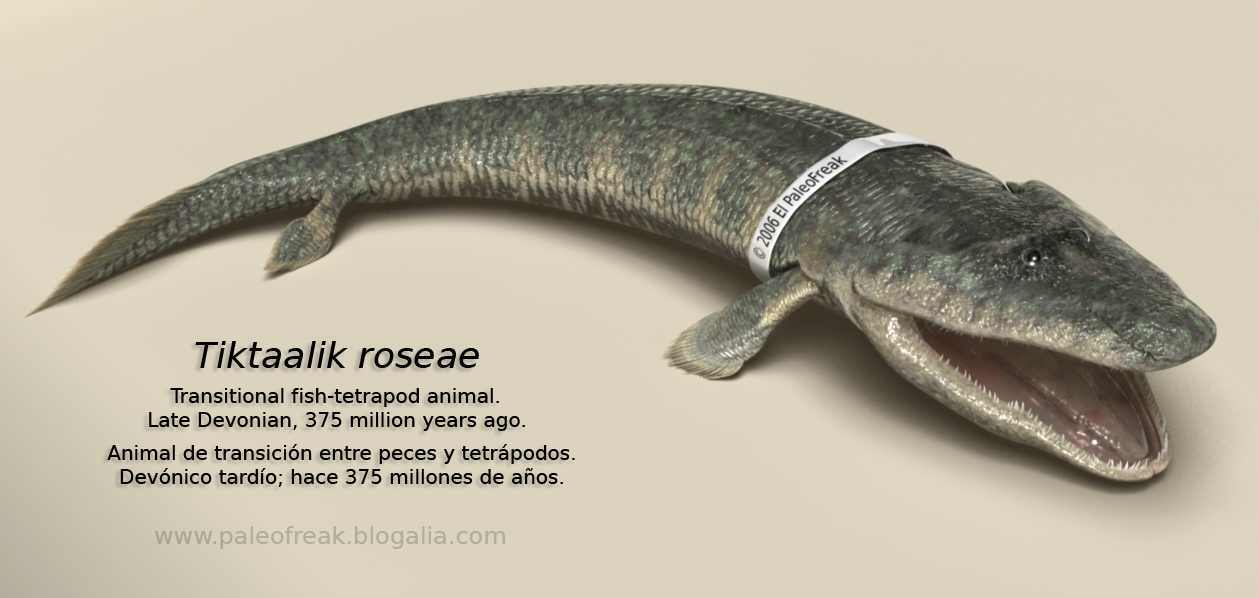
- Tiktaalik
- -technically a fish -gills, scales, unusual fins -evolutionary transition from water to land
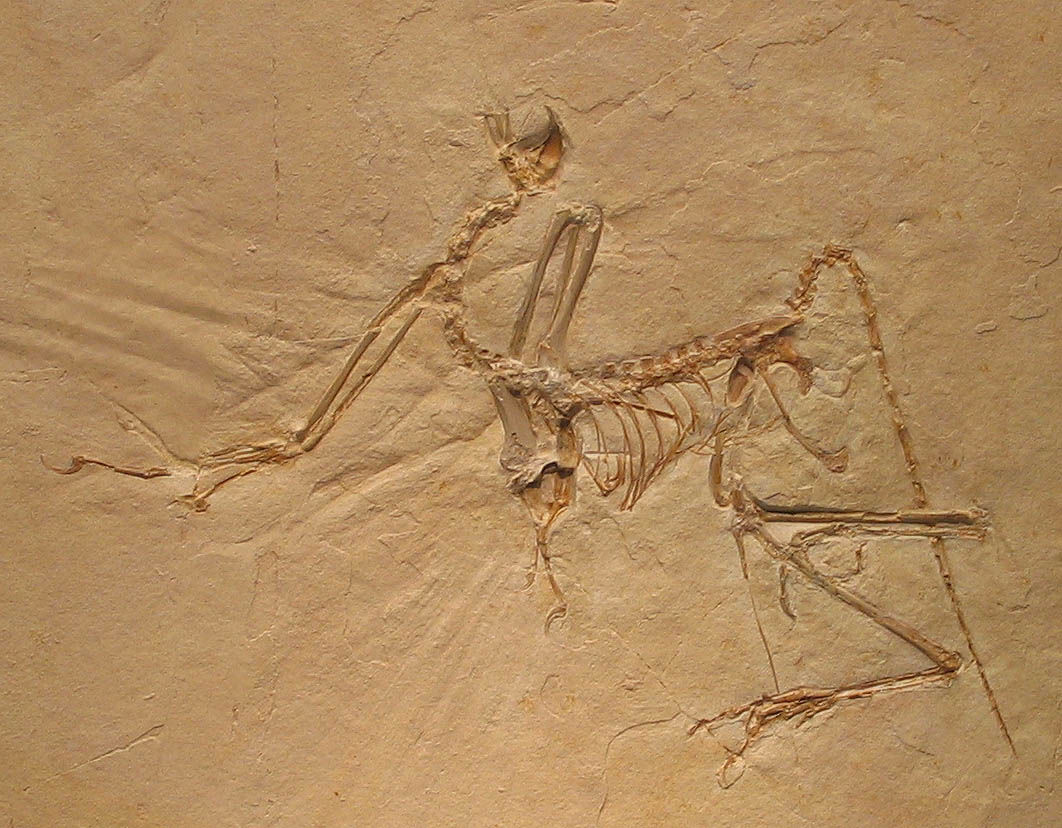
- Archaeopteryx
- -feathers, hollow bones, cloaca, beak, wings -walked, perched -jaw bones were reptilian feature -
- Fish
- Reptiles
- -cold blooded -scales -bones in tail -amniotic egg -ear holes -scent glands on tounge -cloaca
- Prokaryotes
- Misconceptions
- Phylogenies should represent evolutionary progress and increasing complexity. Non-primitive or advanced organisms are somehow better and more complex. Phylogenies should show increased diversity with time.
Basic of Evolution
- What effects Evolution?
- Biosphere
- State shift
- biological systems on scales can shift rapidly from an existing state to a radically different state (e.g. change to glaciation)
- State shift
- Mutations
- Biosphere
- Misconceptions
- Evolution does not allows occur to become more complex.
- Types of Evolution
- Divergent
- Homologous
- Same plan, different function
- Homologous
- Convergent
- Similarity due to the same environment.
- Analogus
- Different plan, same function
- Parallel
- Divergent
- Transitions of Evolution
- 1. Replicating molecules to molecules in compartments. 2. Independent replicators to chromosomes. 3. RNA as genes and enzymes to DNA as genes. 4. Prokaryotes to eukaryotes. 5. Asexual clones to sexual populations. 6. Protists to multicellular organisms. 7. Solitary individual to colonies with non reproductive casts. 8. Primate society to language
- Major Evolutionary Changes
- Animals
- Bilateral Symmetry
- -higher mobility -compartementalisation of body parts -cephalization (development of the head including sensory, neural etc.) -did it facilitate major complexity increase
- Nervous System
- Coelom
- Main cavity of multicellular animals
- Moving from Water to Land
- Challanges
- Advantages
- Evolutionary Innovation
- Tissue
- Bilateral Symmetry/N.S
- Through Gut
- Body Cavity
- Segmentation
- Mineralised Skeleton
- Segmentation
- Body Cavity
- Through Gut
- Bilateral Symmetry/N.S
- Tissue
- Bilateral Symmetry
- Plants
- Vascular Tissue
- Allowed structure and high stems
- Non-vascular Plants
- -small, restricted to moist areas -tissue undifferentiated -attached by rhizoids (these are not roots)
- Cuticule
- -waterproof layer (made of insoluble polymers) -prevents water loss
- Stomata
- Allowed the exchange of gases
- Xylem
- Phloem
- Leaves
- -light gathering -photosythesis
- Stems
- -Support -position leaves correctly -transports nutrients
- Roots
- -anchor to ground -obtain nutrients
- Moving from Water to Land
- Challanges
- -access to water -maintaining water balance -greater structural support -reproductive stratagies
- Advantages
- -unfiltered light -abundant CO2 -abundant soil nutrients -no herbivores or pathogens at first
- Challanges
- Vascular Tissue
- Animals
- What effects Evolution?
Darwin's Theory
- Natural Selection
- -acts on heritable traits -always operating, but the traits favored depends on environment pressures
- Hardy-Weinburg
- Allele Frequency
- The hardy-weinburg principle only works when there is no natural selection, gene flow, genetic drift.
- Equation
- p+q=1 p^2 +2pq + q^2 = 1
- Allele Frequency
- Genetics
- Genetic Drift
- Is due to small population sizes can also become very important if populations through 'population bottlenecks'.
- Heterozygote Advantage
- This is a case where heterozygote have a higher fitness than honozygotes.
- Reproduction
- Allele
- Locus
- Dominance
- Dominant
- Co-dominant
- Both alleles are equally expressed (e.g. blood type AB)
- Recessive
- Only appear under conditions were both alleles are rescessive
- Incomplete Dominance
- Also called additivity.
- Genetic Drift
- Types of selection
- Directional
- Directional selection reduces genetic variation, one allele is selected for, the other is selected against. The end result is a loss in genetic diversity.
- Sexual Directional
- Bet Hedging
- Games Theory
- Cooperation is something that occurs in some species but is absent in most. Yet, one might think it should provide many advantages.
- Frequency Dependent selection
- The rarer an allele is, the higher the fitness of its carrier; the more common it is, the lower the fitness.
- Directional
- Competition
- Species
- Speciation
- Definition of species: -no breeding can occur -no fertile offspring can be produced Can be human directed.
- Allopatric
- When species are separated geographically.
- Sympatric
- Parapatric
- Biological Species Concept
- -independent genetic system which is reproductivity isolated from other co-exisiting species
- Reproductive Isolating Mechanisims
- Pre-mating Isolating Mechanisms
- -prevent individuals from mating
- Mechanical
- -physical nature of reproductive organs prevent successful mating
- Temporal
- -different population may mate at the same place, but very different times
- Ecological
- may mate at the same time in the same geographic isolation but have different habitats
- Ethological
- individuals of two species may contact when reproductively receptive, but fail to mate because each species has unique signals
- Acoustic
- Olfactory
- Visual
- Pre-mating Isolating Mechanisms
- Morphological Species Concept
- Genotype-Environement Interaction
- Seasonal Polymorphism
- Sexual Dimorphisim
- Different morphological appearance of males and females
- Polymorphisms
- Developmental (e.g. caterpillar to butterfly) Morphological (e.g. castes of social insects)
- Genotype-Environement Interaction
- Speciation
- Inference one
- Not everyone survives This is from 3 observations -species produce so many offspring that if all survived the population would increase exponentially -however, populations remain stable -environmental resources are limited
- Inference two
- individuals whose inherited traits best suited to the environment are most likely to survive and produce offspring -population vary extensively and no two individuals are alike -much of this variation is heritable
- Inference three
- unequal ability of individuals to survive and reproduce will lead to a gradual change in population, with favorable characteristics accumulating over generations
- Artificial Selection
- Human caused
- An example is the selected breeding of dogs
- Human caused
- Natural Selection
Biological Species Concept
Welfare and Ethics
Types of Evolution
- Macroevolution
- Occurs over large periods of time
- Punctuated Equilibrium
- Evolution may proceed in a punctuated mode or long periods of stasis followed by rapid evolutionary change.
- Gradualism
- Evolution proceeded in a slow, gradual manner.
- Microevolution
- Change bought about by changes in allele and genotype frequencies due to Natural selection
- Fitness
- A measure of relative genetic contribution of an individual carrying a particular genotype to the next generation. It is a combination of expected survival and reproduction.
- Selection Coefficient
- The proportional amount by which fitness is reduced for a particular genotype relative to the population
- Adaptedness
- A measure of how well a genotype or individual is able to cope with its environemnt.
- Teleological
- Relating to final outcome, purposeful. Evolution is a non-teleological process, it has no aim for the future.
- Selection Pressure
- The proportional amount by which fitness is reduced for a genotype, relative to the most fit genotype. s=1-w(fitness)
- Macroevolution
Imagens e arquivos do mapa
Informações
- Descrição
- Mapa Mental sobre Evolution, criado por Jessica Kruger9956 em 05-11-2015.
- Criado por
- Jessica Kruger9956
- Visualizações
- 0
- Avaliação