
Mapa mental
ENZYMES
Conteúdo do mapa
ENZYMES
ACTION
- Metabolism - Anabolic and Catabolic reactions
- Mechanism: Enzymes reduce activation energy needed for the reaction too happen
- Lock and Key hypothesis: Active site, complimentary to substrate, substrate enzyme complex, enzyme product complex, products released and enzyme is unchanged
- active site holds substrate in right place so atom groups are close enough to react, r group interactions, temporary bonds which also strain bonds within subtstrate
- Induced fit: Interaction between enzyme and substrate is weak at first but these interactions induce changes in tertiary structure which strain the molecule which can weaken or strengthen bonds
TYPES
- Intracellular
- Synthesis of polymers (polysaccharides)
- Catalase breaks down H2O2
- Extracellular
- Nutrients such as proteins and polysaccharides need to be catabolised before entering cells (digestion)
- This process is carried out by both single celled and multicellular organisms
- Digestion of starch
- Initially broken down into maltose by amylase which is found in salivary glands and pancreas (released in small intestine)
- Maltose is then broken down into glucose by maltase in the small intestine
- Initially broken down into maltose by amylase which is found in salivary glands and pancreas (released in small intestine)
- Digestion of proteins
- Proteins are broken down into peptides by trypsin a protease.
- Trypsin is produced in the pancreas which is released into the small intestine. The amino acids produced get absorbed into the bloodstream
- Proteins are broken down into peptides by trypsin a protease.
- Nutrients such as proteins and polysaccharides need to be catabolised before entering cells (digestion)
- Intracellular
FACTORS AFFECTING ENZYMES
- Temperature
- Kinetic energy of molecules increases, increasing the amount of successful collisions
- Q10(temp coefficient) is a measure of how much the rate of reaction increases with a 10 degree rise in temperature (with enzymes this should double)
- An increase beyond optimum temperature can denature the enzymes
- The bonds in the tertiary structure of the active site can break with too much kinetic energy
- Active site no longer complimentary to substrate
- The bonds in the tertiary structure of the active site can break with too much kinetic energy
- Optimum temp: highest rate of activity and varies between enzymes, once denatured above optimum temp the decrease in rate of reaction is rapid
- Q10 does not apply
- Extremes
- Different environments: deep oceans, high altitudes - enzymes in organisms are adapted to the cold with more flexible structures makes them less stable and small temp changes denatures
- Thermophiles are organisms adapted to hot environments - due to increased bonds in enzymes they are more stable (like H bonds and disulphide bonds)
- Different environments: deep oceans, high altitudes - enzymes in organisms are adapted to the cold with more flexible structures makes them less stable and small temp changes denatures
- PH
- H bonds, ionic between r groups holds active site in precise shape
- Change in PH refers to a change in hydrogen ion concentration (more is low ph, less is high ph)
- Optimum PH
- Change in PH: The structure of the enzyme and active site is irreversibly altered - active site no longer complimentary, denatured
- Hydrogen ions interact with polar and charged R groups, change in H ion concentration changes the degree of this interaction as well as R-R group interactions
- More H ions (low PH)
- Less R groups are able to interact, bonds are broken, enzyme changes shape
- Less H ions (High PH)
- More R groups interact, bonds are made, enzyme changes shape
- H bonds, ionic between r groups holds active site in precise shape
- Concentration
- Increased substrate particles causes a higher collision rate with active sites + increased rate of reaction
- Increased enzyme concentration increases active sites available over a particular volume, increasing rate of reaction
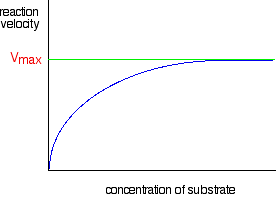
- Vmax
- All of the active sites are occupied by substrate particles and no more complexes can be formed until products are released
- Only way to increase rate would be toad more enzyme or increase the temp
- All of the active sites are occupied by substrate particles and no more complexes can be formed until products are released
- Limiting factors
- Increased substrate particles causes a higher collision rate with active sites + increased rate of reaction
- Temperature
INHIBITORS
- Controlling enzyme activity during reaction pathway regulates the rate and quantity of product formation (do not want fast reactions and build up of waste products)
- Competitive
- Similar shape as substrate and can fit active site
- Substate is blocked from entering the active site
- Enzyme is inhibited
- Substate is blocked from entering the active site
- Number of substrate molecules binding is reduced
- Most reversably bind
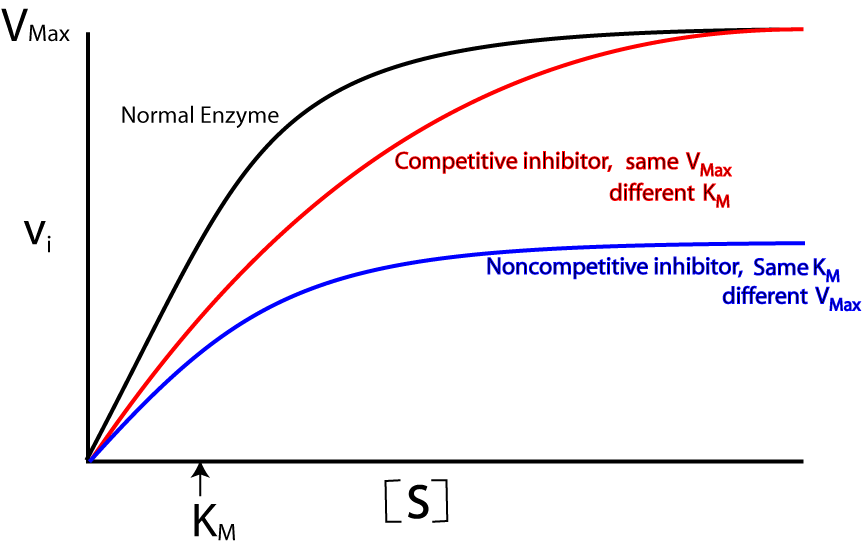
- reduces rate of reaction, does not change the Vmax
- Example: statins, inhibit enzyme of cholesterol synthesis and therefore reducing blood cholesterol concentration
- Example: aspirin irreversibly inhibits the active site of COX enzymes preventing synthesis of chemical responsible for pain and fever
- Similar shape as substrate and can fit active site
- Non competitive
- Binds to location other than the active site - ALLOSTERIC SITE
- Tertiary structure of enzyme changes once bound to allosteric site and the active site is no longer complimentary - enzyme is inhibited
- Increasing Enzyme/substrate conc does not overcome effect of non competitive inhibitor. Increasing conc of inhibitor decreases rate of reaction further
- Example: Chemicals used in insecticides/herbicides irreversibly inhibit the enzyme needed for nerve impulse transmission which can lead to muscle cramps, paralysis, death
- Proton pump inhibitors for indigestion irreversibly block the enzyme that secretes hydrogen ions in stomach, this reduces excess acid (which leads to stomach ulcers)
- end product inhibition
- when the product of a reaction inhibits the enzyme that produces it - negative feedback control mechanism
- Excess products are not made and resources are not wasted
- Non competitive reversable inhibition
Cofactors and Prosthetic Groups
Imagens e arquivos do mapa
Informações
- Descrição
- GOD Biology Mapa Mental sobre ENZYMES, criado por Sophie Cooper em 03-02-2016.
- Criado por
- Sophie Cooper
- Visualizações
- 0
- Avaliação