
Mapa mental
Chemistry Unit 1
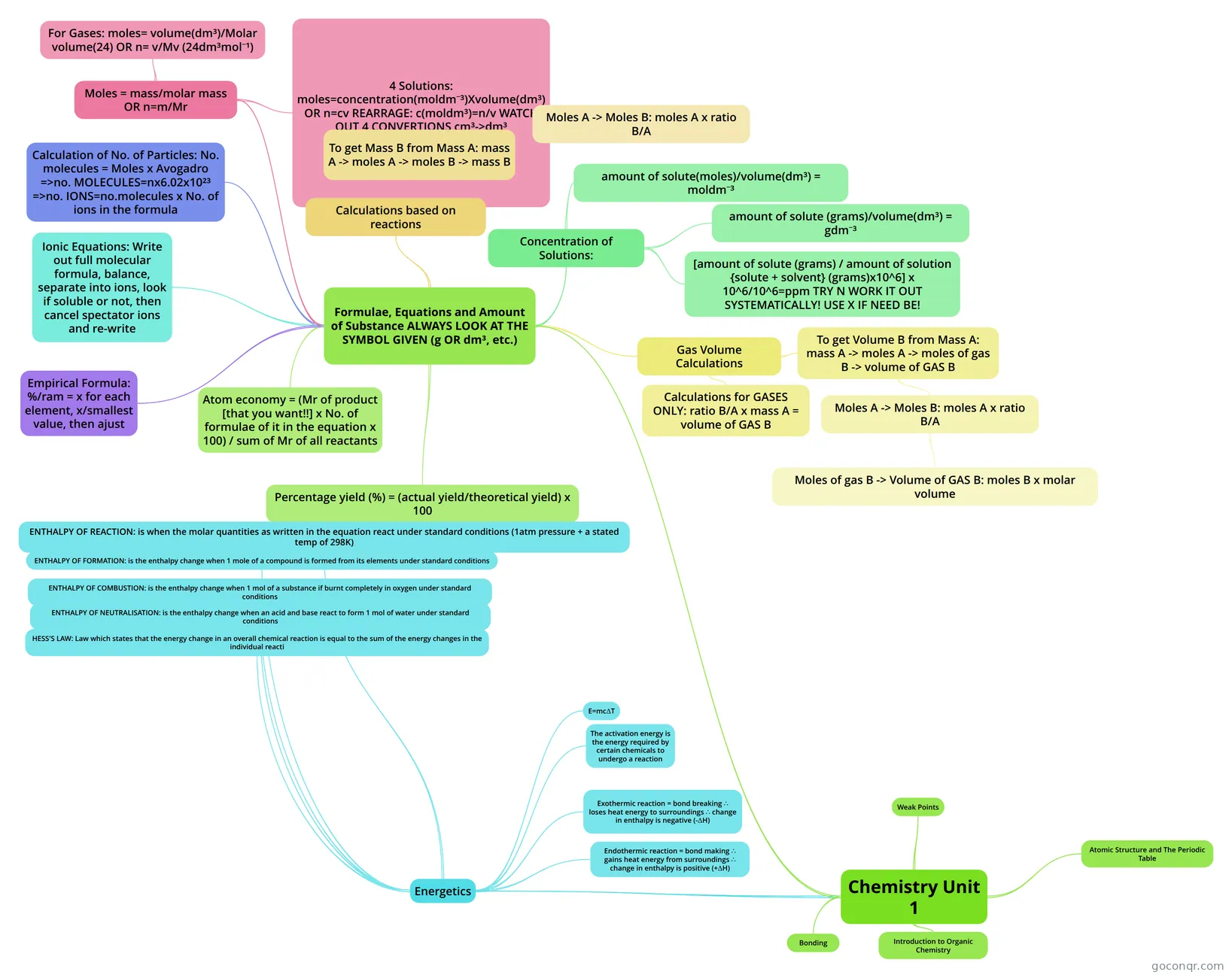
Mind map: Chemistry unit 1
Conteúdo do mapa
Chemistry Unit 1
Formulae, Equations and Amount of Substance ALWAYS LOOK AT THE SYMBOL GIVEN (g OR dm³, etc.)
- Empirical Formula: %/ram = x for each element, x/smallest value, then ajust
- Ionic Equations: Write out full molecular formula, balance, separate into ions, look if soluble or not, then cancel spectator ions and re-write
- Moles = mass/molar mass OR n=m/Mr
- For Gases: moles= volume(dm³)/Molar volume(24) OR n= v/Mv (24dm³molˉ¹)
- 4 Solutions: moles=concentration(moldmˉ³)Xvolume(dm³) OR n=cv REARRAGE: c(moldm³)=n/v WATCH OUT 4 CONVERTIONS cm³->dm³ 1cm³->0.001dm³ 1dm³->1000g
- Calculations based on reactions
- To get Mass B from Mass A: mass A -> moles A -> moles B -> mass B
- Moles A -> Moles B: moles A x ratio B/A
- To get Mass B from Mass A: mass A -> moles A -> moles B -> mass B
- Calculation of No. of Particles: No. molecules = Moles x Avogadro =>no. MOLECULES=nx6.02x10²³ =>no. IONS=no.molecules x No. of ions in the formula
- Concentration of Solutions:
- amount of solute(moles)/volume(dm³) = moldmˉ³
- amount of solute (grams)/volume(dm³) = gdmˉ³
- [amount of solute (grams) / amount of solution {solute + solvent} (grams)x10^6] x 10^6/10^6=ppm TRY N WORK IT OUT SYSTEMATICALLY! USE X IF NEED BE!
- video with explaining ppm in greater depth: http://www.youtube.com/watch?v=d6MxhXPmyes
- Gas Volume Calculations
- To get Volume B from Mass A: mass A -> moles A -> moles of gas B -> volume of GAS B
- Moles A -> Moles B: moles A x ratio B/A
- Moles of gas B -> Volume of GAS B: moles B x molar volume
- Moles A -> Moles B: moles A x ratio B/A
- Calculations for GASES ONLY: ratio B/A x mass A = volume of GAS B
- For Calculations involving gases only, you can skip using the molar mass or volume because you divide and then multiply the same number. So: ratio B/A x Mass A = volume of gas Bis all the working that is needed!
- To get Volume B from Mass A: mass A -> moles A -> moles of gas B -> volume of GAS B
- Percentage yield (%) = (actual yield/theoretical yield) x 100
- Atom economy = (Mr of product [that you want!!] x No. of formulae of it in the equation x 100) / sum of Mr of all reactants
Introduction to Organic Chemistry
Atomic Structure and The Periodic Table
Energetics
- Exothermic reaction = bond breaking ∴ loses heat energy to surroundings ∴ change in enthalpy is negative (-ΔH)
- Endothermic reaction = bond making ∴ gains heat energy from surroundings ∴ change in enthalpy is positive (+ΔH)
- The activation energy is the energy required by certain chemicals to undergo a reaction
- E=mcΔT
- E=mcΔT E- Energy transfered m- mass c- specific heat capacity ΔT- change in temperature (Specific Heat Capacity- The energy in joules (j) needed to raise the temperature of 1Kg of a substance by 1 Kelvin)
- ENTHALPY OF REACTION: is when the molar quantities as written in the equation react under standard conditions (1atm pressure + a stated temp of 298K)
- ENTHALPY OF FORMATION: is the enthalpy change when 1 mole of a compound is formed from its elements under standard conditions
- ENTHALPY OF COMBUSTION: is the enthalpy change when 1 mol of a substance if burnt completely in oxygen under standard conditions
- ENTHALPY OF NEUTRALISATION: is the enthalpy change when an acid and base react to form 1 mol of water under standard conditions
- HESS'S LAW: Law which states that the energy change in an overall chemical reaction is equal to the sum of the energy changes in the individual reacti
Bonding
Weak Points
Informações
- Descrição
- Exam is on the 23rd of May
- Criado por
- Omar Amura
- Visualizações
- 395
- Tags
- Avaliação