
Mapa mental
BIOLOGY - CHAPTER 7
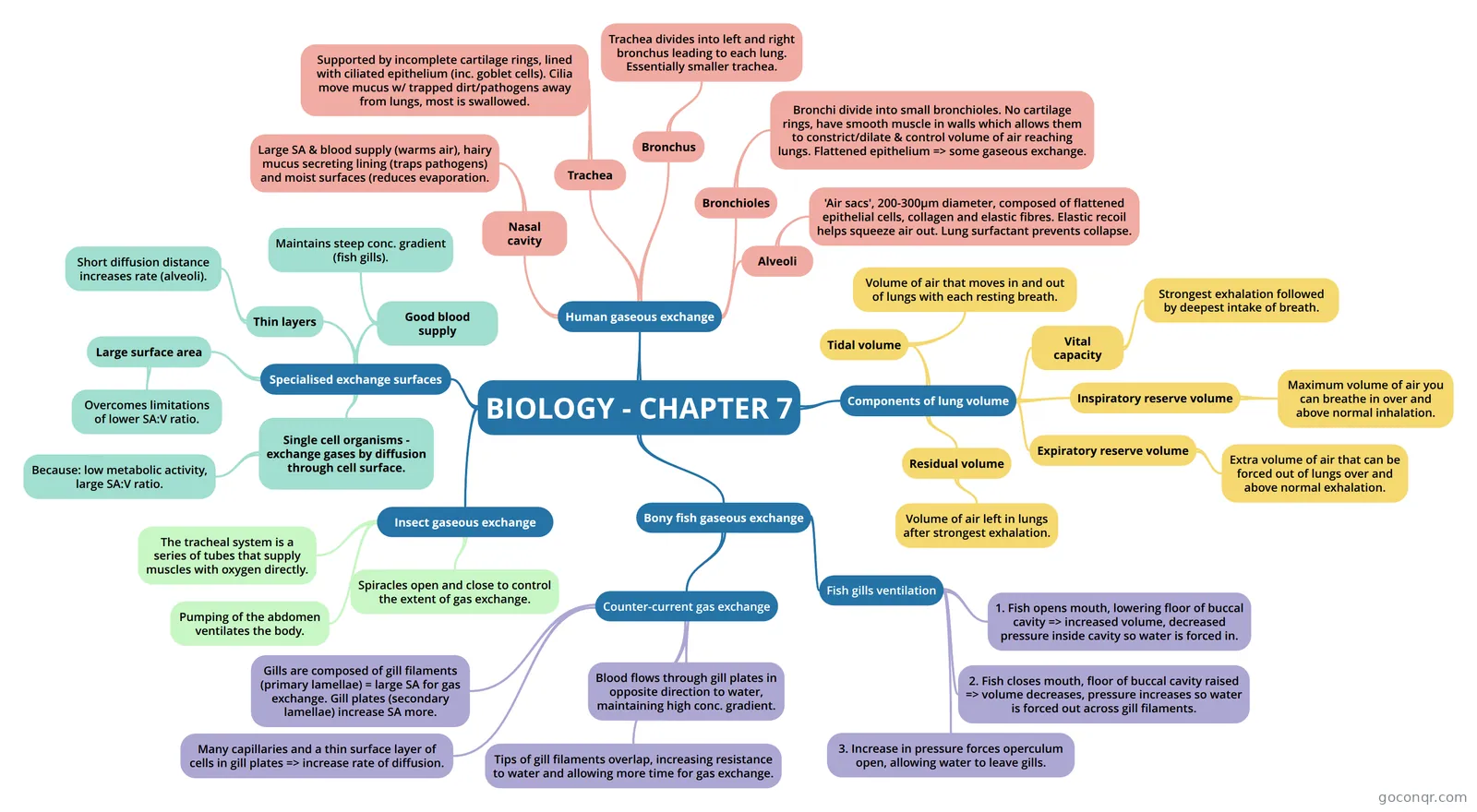
Mind map: biology chapter 7 gaseous exchange
Conteúdo do mapa
BIOLOGY - CHAPTER 7
Specialised exchange surfaces
- Single cell organisms - exchange gases by diffusion through cell surface.
- Because: low metabolic activity, large SA:V ratio.
- Large surface area
- Overcomes limitations of lower SA:V ratio.
- Thin layers
- Short diffusion distance increases rate (alveoli).
- Good blood supply
- Maintains steep conc. gradient (fish gills).
- Single cell organisms - exchange gases by diffusion through cell surface.
Human gaseous exchange
- Nasal cavity
- Large SA & blood supply (warms air), hairy mucus secreting lining (traps pathogens) and moist surfaces (reduces evaporation.
- Trachea
- Supported by incomplete cartilage rings, lined with ciliated epithelium (inc. goblet cells). Cilia move mucus w/ trapped dirt/pathogens away from lungs, most is swallowed.
- Bronchus
- Trachea divides into left and right bronchus leading to each lung. Essentially smaller trachea.
- Bronchioles
- Bronchi divide into small bronchioles. No cartilage rings, have smooth muscle in walls which allows them to constrict/dilate & control volume of air reaching lungs. Flattened epithelium => some gaseous exchange.
- Alveoli
- 'Air sacs', 200-300µm diameter, composed of flattened epithelial cells, collagen and elastic fibres. Elastic recoil helps squeeze air out. Lung surfactant prevents collapse.
- Nasal cavity
Components of lung volume
- Tidal volume
- Volume of air that moves in and out of lungs with each resting breath.
- Vital capacity
- Strongest exhalation followed by deepest intake of breath.
- Inspiratory reserve volume
- Maximum volume of air you can breathe in over and above normal inhalation.
- Expiratory reserve volume
- Extra volume of air that can be forced out of lungs over and above normal exhalation.
- Residual volume
- Volume of air left in lungs after strongest exhalation.
- Tidal volume
Insect gaseous exchange
- The tracheal system is a series of tubes that supply muscles with oxygen directly.
- Pumping of the abdomen ventilates the body.
- Spiracles open and close to control the extent of gas exchange.
Bony fish gaseous exchange
- Counter-current gas exchange
- Gills are composed of gill filaments (primary lamellae) = large SA for gas exchange. Gill plates (secondary lamellae) increase SA more.
- Many capillaries and a thin surface layer of cells in gill plates => increase rate of diffusion.
- Blood flows through gill plates in opposite direction to water, maintaining high conc. gradient.
- Tips of gill filaments overlap, increasing resistance to water and allowing more time for gas exchange.
- Fish gills ventilation
- 1. Fish opens mouth, lowering floor of buccal cavity => increased volume, decreased pressure inside cavity so water is forced in.
- 2. Fish closes mouth, floor of buccal cavity raised => volume decreases, pressure increases so water is forced out across gill filaments.
- 3. Increase in pressure forces operculum open, allowing water to leave gills.
- Counter-current gas exchange