
Mapa mental
Adaptations
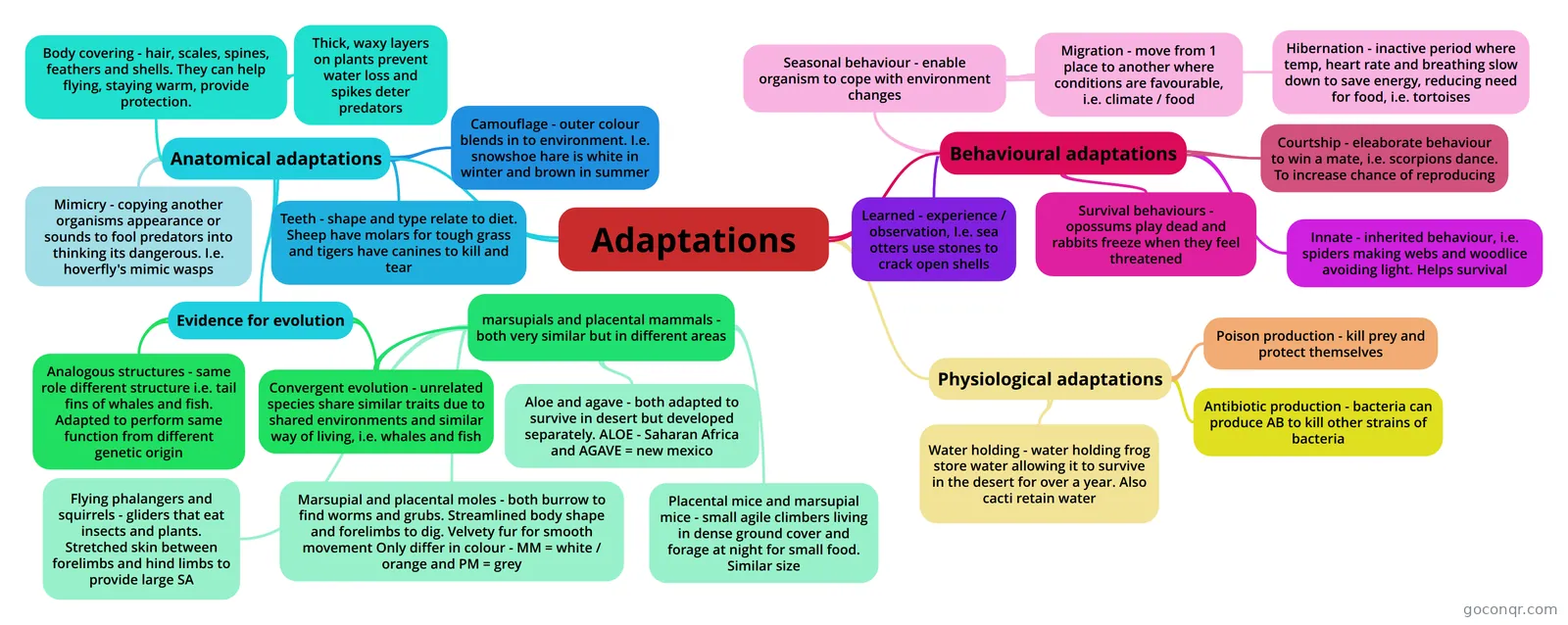
Mind map: Adaptations
Conteúdo do mapa
Adaptations
Anatomical adaptations
- Body covering - hair, scales, spines, feathers and shells. They can help flying, staying warm, provide protection.
- Thick, waxy layers on plants prevent water loss and spikes deter predators
- Camouflage - outer colour blends in to environment. I.e. snowshoe hare is white in winter and brown in summer
- Teeth - shape and type relate to diet. Sheep have molars for tough grass and tigers have canines to kill and tear
- Mimicry - copying another organisms appearance or sounds to fool predators into thinking its dangerous. I.e. hoverfly's mimic wasps
- Evidence for evolution
- Analogous structures - same role different structure i.e. tail fins of whales and fish. Adapted to perform same function from different genetic origin
- Convergent evolution - unrelated species share similar traits due to shared environments and similar way of living, i.e. whales and fish
- marsupials and placental mammals - both very similar but in different areas
- Placental mice and marsupial mice - small agile climbers living in dense ground cover and forage at night for small food. Similar size
- Flying phalangers and squirrels - gliders that eat insects and plants. Stretched skin between forelimbs and hind limbs to provide large SA
- Marsupial and placental moles - both burrow to find worms and grubs. Streamlined body shape and forelimbs to dig. Velvety fur for smooth movement Only differ in colour - MM = white / orange and PM = grey
- Aloe and agave - both adapted to survive in desert but developed separately. ALOE - Saharan Africa and AGAVE = new mexico
- marsupials and placental mammals - both very similar but in different areas
- Body covering - hair, scales, spines, feathers and shells. They can help flying, staying warm, provide protection.
Behavioural adaptations
- Survival behaviours - opossums play dead and rabbits freeze when they feel threatened
- Courtship - eleaborate behaviour to win a mate, i.e. scorpions dance. To increase chance of reproducing
- Seasonal behaviour - enable organism to cope with environment changes
- Migration - move from 1 place to another where conditions are favourable, i.e. climate / food
- Hibernation - inactive period where temp, heart rate and breathing slow down to save energy, reducing need for food, i.e. tortoises
- Innate - inherited behaviour, i.e. spiders making webs and woodlice avoiding light. Helps survival
- Learned - experience / observation, I.e. sea otters use stones to crack open shells
Physiological adaptations
- Poison production - kill prey and protect themselves
- Antibiotic production - bacteria can produce AB to kill other strains of bacteria
- Water holding - water holding frog store water allowing it to survive in the desert for over a year. Also cacti retain water
Informações
- Descrição
- AS - Level Biology (Mrs Murray) Mapa Mental sobre Adaptations, criado por Jess Hughes em 02-05-2016.
- Criado por
- Jess Hughes
- Visualizações
- 1
- Avaliação