
Mapa mental
Transitions
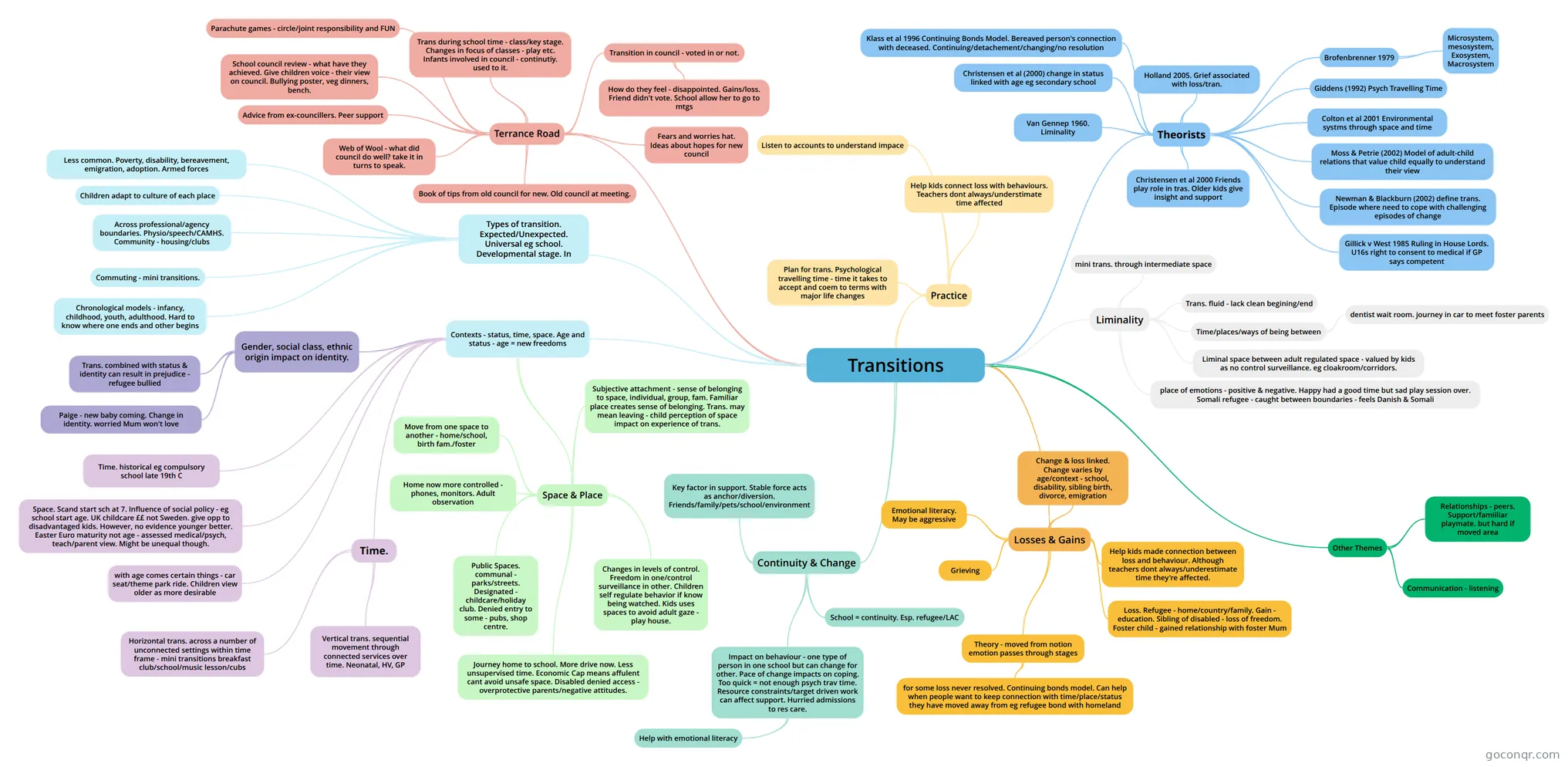
Mind map: transitions in childhood
Conteúdo do mapa
Transitions
Theorists
- Brofenbrenner 1979
- Microsystem, mesosystem, Exosystem, Macrosystem
- Colton et al 2001 Environmental systms through space and time
- Moss & Petrie (2002) Model of adult-child relations that value child equally to understand their view
- Newman & Blackburn (2002) define trans. Episode where need to cope with challenging episodes of change
- Gillick v West 1985 Ruling in House Lords. U16s right to consent to medical if GP says competent
- Christensen et al (2000) change in status linked with age eg secondary school
- Giddens (1992) Psych Travelling Time
- Christensen et al 2000 Friends play role in tras. Older kids give insight and support
- Holland 2005. Grief associated with loss/tran.
- Van Gennep 1960. Liminality
- Klass et al 1996 Continuing Bonds Model. Bereaved person's connection with deceased. Continuing/detachement/changing/no resolution
- Brofenbrenner 1979
Other Themes
- Relationships - peers. Support/famiiliar playmate. but hard if moved area
- Communication - listening
·
- Types of transition. Expected/Unexpected. Universal eg school. Developmental stage. In
- Chronological models - infancy, childhood, youth, adulthood. Hard to know where one ends and other begins
- Commuting - mini transitions.
- Children adapt to culture of each place
- Less common. Poverty, disability, bereavement, emigration, adoption. Armed forces
- Across professional/agency boundaries. Physio/speech/CAMHS. Community - housing/clubs
- Types of transition. Expected/Unexpected. Universal eg school. Developmental stage. In
Practice
- Plan for trans. Psychological travelling time - time it takes to accept and coem to terms with major life changes
- Help kids connect loss with behaviours. Teachers dont always/understimate time affected
- Listen to accounts to understand impace
Contexts - status, time, space. Age and status - age = new freedoms
- Time. historical eg compulsory school late 19th C
- Space. Scand start sch at 7. Influence of social policy - eg school start age. UK childcare ££ not Sweden. give opp to disadvantaged kids. However, no evidence younger better. Easter Euro maturity not age - assessed medical/psych, teach/parent view. Might be unequal though.
- with age comes certain things - car seat/theme park ride. Children view older as more desirable
- Gender, social class, ethnic origin impact on identity.
- Trans. combined with status & identity can result in prejudice - refugee bullied
- Paige - new baby coming. Change in identity. worried Mum won't love
- Space & Place
- Move from one space to another - home/school, birth fam./foster
- Subjective attachment - sense of belonging to space, individual, group, fam. Familiar place creates sense of belonging. Trans. may mean leaving - child perception of space impact on experience of trans.
- Changes in levels of control. Freedom in one/control surveillance in other. Children self regulate behavior if know being watched. Kids uses spaces to avoid adult gaze - play house.
- Home now more controlled - phones, monitors. Adult observation
- Public Spaces. communal - parks/streets. Designated - childcare/holiday club. Denied entry to some - pubs, shop centre.
- Journey home to school. More drive now. Less unsupervised time. Economic Cap means affulent cant avoid unsafe space. Disabled denied access - overprotective parents/negative attitudes.
- Time.
- Horizontal trans. across a number of unconnected settings within time frame - mini transitions breakfast club/school/music lesson/cubs
- Vertical trans. sequential movement through connected services over time. Neonatal, HV, GP
Continuity & Change
- Key factor in support. Stable force acts as anchor/diversion. Friends/family/pets/school/environment
- School = continuity. Esp. refugee/LAC
- Impact on behaviour - one type of person in one school but can change for other. Pace of change impacts on coping. Too quick = not enough psych trav time. Resource constraints/target driven work can affect support. Hurried admissions to res care.
- Help with emotional literacy
Losses & Gains
- Change & loss linked. Change varies by age/context - school, disability, sibling birth, divorce, emigration
- Emotional literacy. May be aggressive
- Help kids made connection between loss and behaviour. Although teachers dont always/underestimate time they're affected.
- Grieving
- Loss. Refugee - home/country/family. Gain - education. Sibling of disabled - loss of freedom. Foster child - gained relationship with foster Mum
- Theory - moved from notion emotion passes through stages
- for some loss never resolved. Continuing bonds model. Can help when people want to keep connection with time/place/status they have moved away from eg refugee bond with homeland
Liminality
- mini trans. through intermediate space
- Trans. fluid - lack clean begining/end
- Time/places/ways of being between
- dentist wait room. journey in car to meet foster parents
- Liminal space between adult regulated space - valued by kids as no control surveillance. eg cloakroom/corridors.
- place of emotions - positive & negative. Happy had a good time but sad play session over. Somali refugee - caught between boundaries - feels Danish & Somali
Terrance Road
- Advice from ex-councillers. Peer support
- School council review - what have they achieved. Give children voice - their view on council. Bullying poster, veg dinners, bench.
- Trans during school time - class/key stage. Changes in focus of classes - play etc. Infants involved in council - continutiy. used to it.
- Transition in council - voted in or not.
- How do they feel - disappointed. Gains/loss. Friend didn't vote. School allow her to go to mtgs
- Web of Wool - what did council do well? take it in turns to speak.
- Fears and worries hat. Ideas about hopes for new council
- Book of tips from old council for new. Old council at meeting.
- Parachute games - circle/joint responsibility and FUN
Informações
- Descrição
- Page 1. Key concepts, case study, theorists
- Criado por
- claire_cornelius
- Visualizações
- 12
- Avaliação