
Mapa mental
Plant Responses to Environment
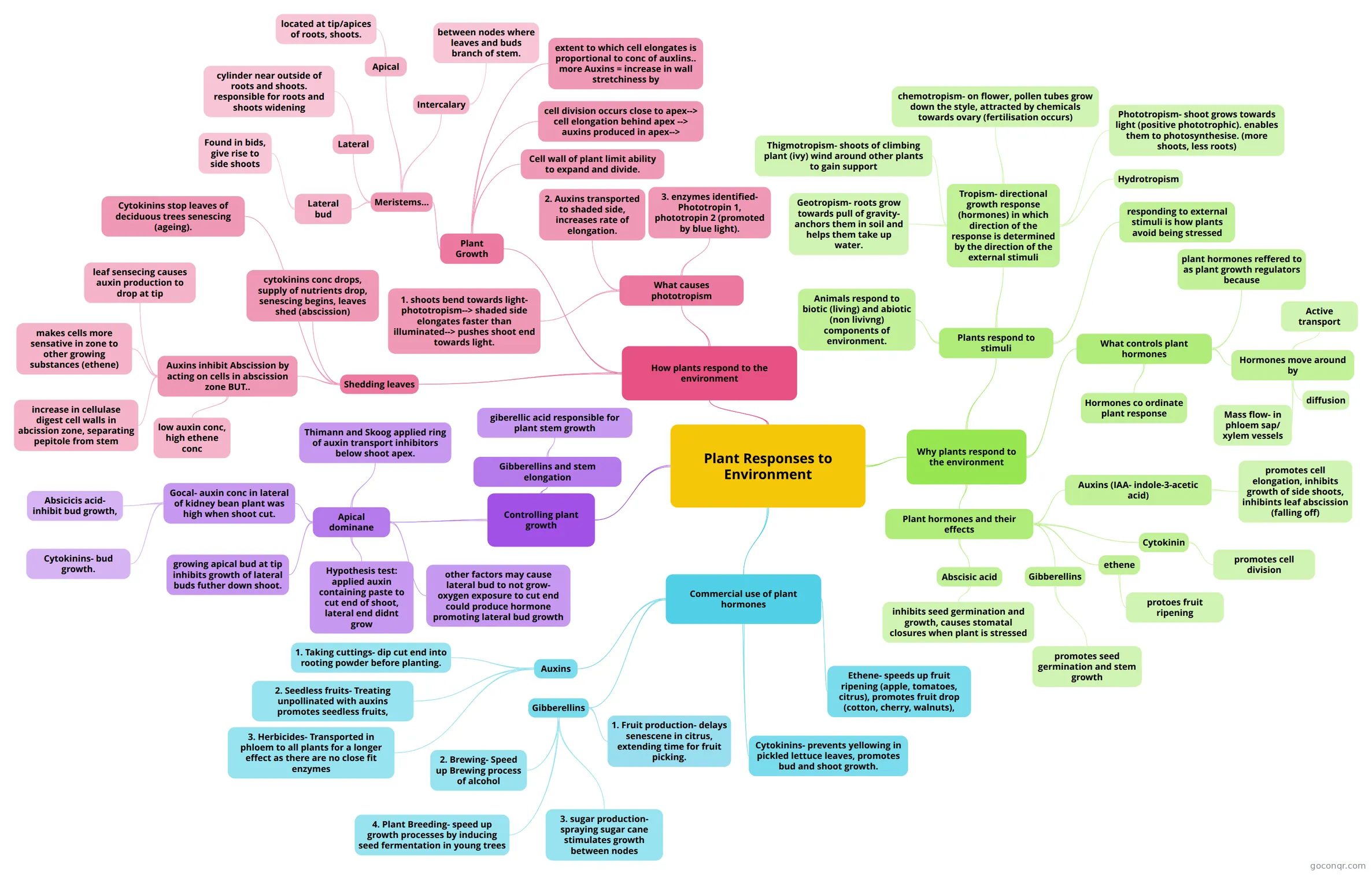
Mind map: Plant Responses to Environment
Conteúdo do mapa
Plant Responses to Environment
Why plants respond to the environment
- Plants respond to stimuli
- responding to external stimuli is how plants avoid being stressed
- or being eaten and to help them survive long enough to reproduce
- Tropism- directional growth response (hormones) in which direction of the response is determined by the direction of the external stimuli
- Phototropism- shoot grows towards light (positive phototrophic). enables them to photosynthesise. (more shoots, less roots)
- Geotropism- roots grow towards pull of gravity- anchors them in soil and helps them take up water.
- needed for support (Turgid), photosynthesise and cool plant, water has minerals (nitrates) needed for amino synthesis
- chemotropism- on flower, pollen tubes grow down the style, attracted by chemicals towards ovary (fertilisation occurs)
- Thigmotropism- shoots of climbing plant (ivy) wind around other plants to gain support
- Hydrotropism
- Animals respond to biotic (living) and abiotic (non livivng) components of environment.
- responding to external stimuli is how plants avoid being stressed
- What controls plant hormones
- Hormones co ordinate plant response
- plant hormones reffered to as plant growth regulators because
- unlike animals, hormones not produced in endocrine gland but by cells in various tissues in plant
- Hormones move around by
- Active transport
- diffusion
- Mass flow- in phloem sap/ xylem vessels
- Plant hormones and their effects
- Auxins (IAA- indole-3-acetic acid)
- promotes cell elongation, inhibits growth of side shoots, inhibints leaf abscission (falling off)
- Cytokinin
- promotes cell division
- Gibberellins
- promotes seed germination and stem growth
- Abscisic acid
- inhibits seed germination and growth, causes stomatal closures when plant is stressed
- ethene
- protoes fruit ripening
- Auxins (IAA- indole-3-acetic acid)
- Plants respond to stimuli
How plants respond to the environment
- Plant Growth
- Cell wall of plant limit ability to expand and divide.
- therefore, growth occurs in particular places of plants where there are immature cells that are capable of diving. these are MERISTEMS
- Meristems...
- Apical
- located at tip/apices of roots, shoots.
- responsible for roots and shoots getting longer
- located at tip/apices of roots, shoots.
- Lateral bud
- Found in bids, give rise to side shoots
- Lateral
- cylinder near outside of roots and shoots. responsible for roots and shoots widening
- Intercalary
- between nodes where leaves and buds branch of stem.
- growth between nodes responsible for shoot getting longer
- between nodes where leaves and buds branch of stem.
- Apical
- cell division occurs close to apex--> cell elongation behind apex --> auxins produced in apex-->
- auxins travel (diffusion, AT) --> cells in zone of elongation --> elongate/shoots grow
- extent to which cell elongates is proportional to conc of auxlins.. more Auxins = increase in wall stretchiness by
- promoting AT of H+ by ATPase on plasma membrane--> cell wall--> lowers pH therefore, optimum condition for wall loosening enzymes to work Expanisins- break cellulose bonds, increase H+ conc, disrupt hydrogen bonds with wall therefore, less rigid and expands to take in water.
- Cell wall of plant limit ability to expand and divide.
- What causes phototropism
- 1. shoots bend towards light- phototropism--> shaded side elongates faster than illuminated--> pushes shoot end towards light.
- 2. Auxins transported to shaded side, increases rate of elongation.
- 3. enzymes identified- Phototropin 1, phototropin 2 (promoted by blue light).
- there is alot of activity of P1 on light side, thought that change in gradient causes redistribution of auxins
- Shedding leaves
- Cytokinins stop leaves of deciduous trees senescing (ageing).
- Leaf acts as sink for phloem transport, therefore, leaf garunteed good supply of nutrients.
- cytokinins conc drops, supply of nutrients drop, senescing begins, leaves shed (abscission)
- Auxins inhibit Abscission by acting on cells in abscission zone BUT..
- leaf sensecing causes auxin production to drop at tip
- makes cells more sensative in zone to other growing substances (ethene)
- low auxin conc, high ethene conc
- increase in cellulase digest cell walls in abcission zone, separating pepitole from stem
- Cytokinins stop leaves of deciduous trees senescing (ageing).
- Plant Growth
Controlling plant growth
- Apical dominane
- growing apical bud at tip inhibits growth of lateral buds futher down shoot.
- When tip removed, auxin conc in shoot low and bud grows.
- Hypothesis test: applied auxin containing paste to cut end of shoot, lateral end didnt grow
- other factors may cause lateral bud to not grow- oxygen exposure to cut end could produce hormone promoting lateral bud growth
- Thimann and Skoog applied ring of auxin transport inhibitors below shoot apex.
- lateral bud grew. thereofre, norm auxin conc in lateral inhibits growth and decreased conc promotes growth. BUT both variables may be affected by a third.
- Gocal- auxin conc in lateral of kidney bean plant was high when shoot cut.
- 2 hormones invovled:
- Absicicis acid- inhibit bud growth,
- increase auxin conc, keep acid levels high, when tip removed, hormone decrease, bud grows
- Cytokinins- bud growth.
- direct application = override apical dominane effect. High auxin conc = shoot apex a sink for cytokinins in root. Meant that most cytokinin goes to shoot apex. When removed, cytokinin spread evenly around plant promoting growth
- growing apical bud at tip inhibits growth of lateral buds futher down shoot.
- Gibberellins and stem elongation
- giberellic acid responsible for plant stem growth
- Apical dominane
Commercial use of plant hormones
- Auxins
- 1. Taking cuttings- dip cut end into rooting powder before planting.
- Encourages root growth as it contains auxins, fungicides and talcum powder
- 2. Seedless fruits- Treating unpollinated with auxins promotes seedless fruits,
- promotes ovule growth, triggers automatic auxin production
- 3. Herbicides- Transported in phloem to all plants for a longer effect as there are no close fit enzymes
- 1. Taking cuttings- dip cut end into rooting powder before planting.
- Gibberellins
- 1. Fruit production- delays senescene in citrus, extending time for fruit picking.
- improves apple shape, elongates grape stalks
- 2. Brewing- Speed up Brewing process of alcohol
- 3. sugar production- spraying sugar cane stimulates growth between nodes
- and males stems longer therefore more sugar yield (4.5 tonnes by hectar)
- 4. Plant Breeding- speed up growth processes by inducing seed fermentation in young trees
- 1. Fruit production- delays senescene in citrus, extending time for fruit picking.
- Cytokinins- prevents yellowing in pickled lettuce leaves, promotes bud and shoot growth.
- short shoots with many branches produced
- Ethene- speeds up fruit ripening (apple, tomatoes, citrus), promotes fruit drop (cotton, cherry, walnuts),
- promotes female sex expression (cucumbers), decrease chances of self pollination and increase yield. lateral growth
- Auxins
Informações
- Descrição
- Plant Responses to Environment
- Criado por
- Lester Stoffels
- Visualizações
- 19
- Tags
- Histórico
-
- Criado por Sarah Pirbhai · 18 mai 2013
- Copiado por Lester Stoffels · 1 ago 2016
- Avaliação