
Mapa mental
Immunoglobulins
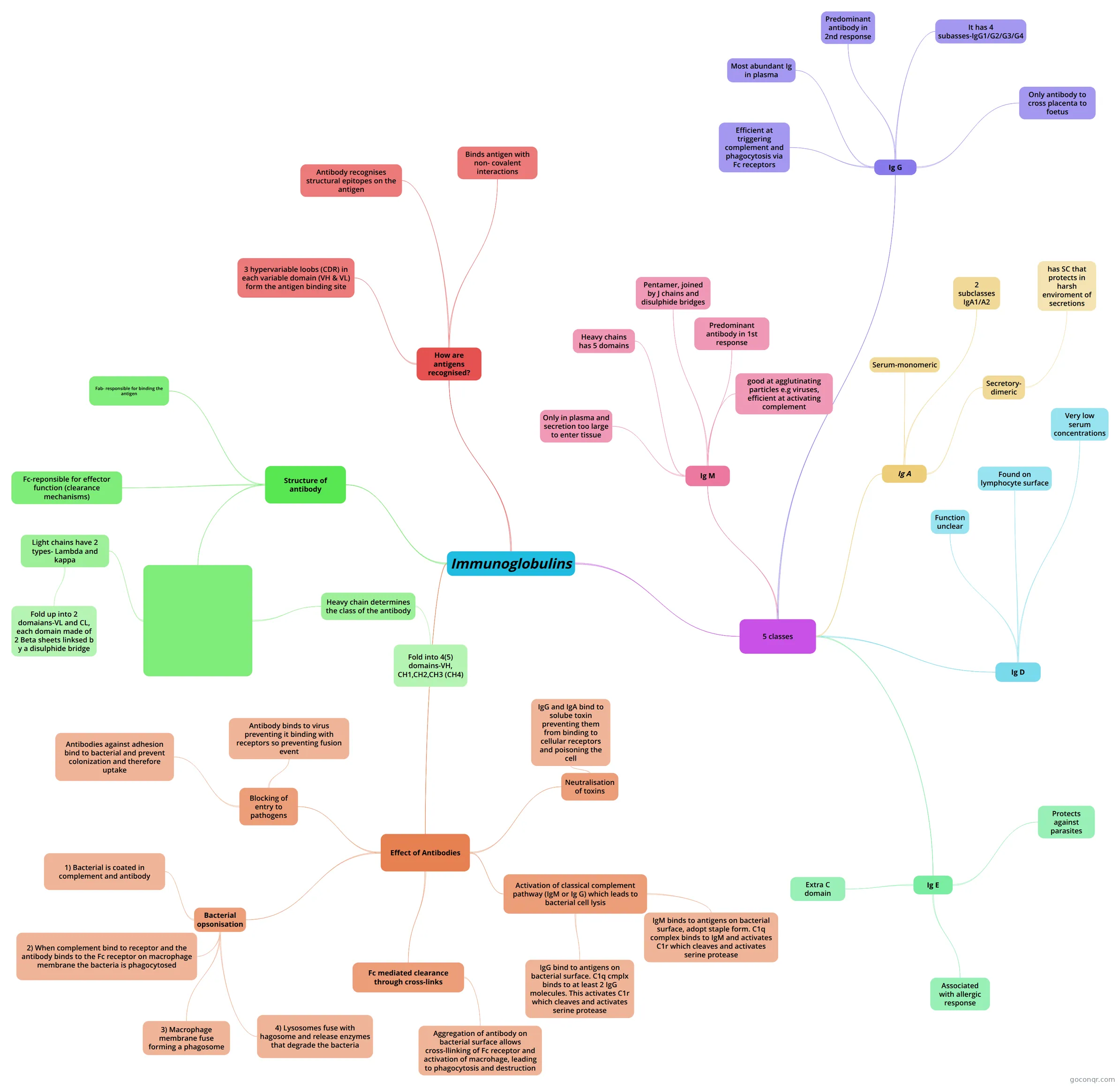
Mind map: Immunoglobulins
Conteúdo do mapa
Immunoglobulins
5 classes
- Ig A
- Secretory- dimeric
- has SC that protects in harsh enviroment of secretions
- 2 subclasses IgA1/A2
- Serum-monomeric
- Secretory- dimeric
- Ig D
- Very low serum concentrations
- Found on lymphocyte surface
- Function unclear
- Ig G
- Most abundant Ig in plasma
- It has 4 subasses-IgG1/G2/G3/G4
- Efficient at triggering complement and phagocytosis via Fc receptors
- Only antibody to cross placenta to foetus
- Predominant antibody in 2nd response
- Ig M
- Only in plasma and secretion too large to enter tissue
- Pentamer, joined by J chains and disulphide bridges
- Heavy chains has 5 domains
- good at agglutinating particles e.g viruses, efficient at activating complement
- Predominant antibody in 1st response
- Ig E
- Extra C domain
- Associated with allergic response
- Protects against parasites
- Ig A
Structure of antibody
- Light chains have 2 types- Lambda and kappa
- Fold up into 2 domaians-VL and CL, each domain made of 2 Beta sheets linksed b y a disulphide bridge
- Heavy chain determines the class of the antibody
- Fold into 4(5) domains-VH, CH1,CH2,CH3 (CH4)
- Light chains have 2 types- Lambda and kappa
- Fab- responsible for binding the antigen
- Fc-reponsible for effector function (clearance mechanisms)
How are antigens recognised?
- 3 hypervariable loobs (CDR) in each variable domain (VH & VL) form the antigen binding site
- Antibody recognises structural epitopes on the antigen
- Binds antigen with non- covalent interactions
Effect of Antibodies
- Blocking of entry to pathogens
- Antibody binds to virus preventing it binding with receptors so preventing fusion event
- Antibodies against adhesion bind to bacterial and prevent colonization and therefore uptake
- Neutralisation of toxins
- IgG and IgA bind to solube toxin preventing them from binding to cellular receptors and poisoning the cell
- Activation of classical complement pathway (IgM or Ig G) which leads to bacterial cell lysis
- IgM binds to antigens on bacterial surface, adopt staple form. C1q complex binds to IgM and activates C1r which cleaves and activates serine protease
- IgG bind to antigens on bacterial surface. C1q cmplx binds to at least 2 IgG molecules. This activates C1r which cleaves and activates serine protease
- Bacterial opsonisation
- 1) Bacterial is coated in complement and antibody
- 2) When complement bind to receptor and the antibody binds to the Fc receptor on macrophage membrane the bacteria is phagocytosed
- 3) Macrophage membrane fuse forming a phagosome
- 4) Lysosomes fuse with hagosome and release enzymes that degrade the bacteria
- Fc mediated clearance through cross-links
- Aggregation of antibody on bacterial surface allows cross-llinking of Fc receptor and activation of macrohage, leading to phagocytosis and destruction
- Blocking of entry to pathogens
Informações
- Descrição
- (Immunology) Mapa Mental sobre Immunoglobulins, criado por w.tetteh em 01-05-2013.
- Criado por
- w.tetteh
- Visualizações
- 200
- Tags
- Avaliação