
Mapa mental
Enzymes
Conteúdo do mapa
Enzymes
Biological Catalysts made of protein
- They are globular proteins with a specific tertiary shape
- The protein shape folds in a spherical shape or globular shape
- They have hydrophilic R groups outside the molecule
- Each Enzyme has a particular sequence of amino acids and the elements in the R groups determine the bonds they make with each other
- They have hydrophilic R groups outside the molecule
- The protein shape folds in a spherical shape or globular shape
- They are globular proteins with a specific tertiary shape
Enzymes are used in metabolism as it is a series of enzyme controlled reaction
- Metabolism refers to all reactions in the body
- These include:
- Anabolic reactions- building up molecules
- Catabolic reactions - breaking down molecules
- Anabolic reactions- building up molecules
- These include:
- Metabolism refers to all reactions in the body
Active sites
- An enzyme acts on the substrate
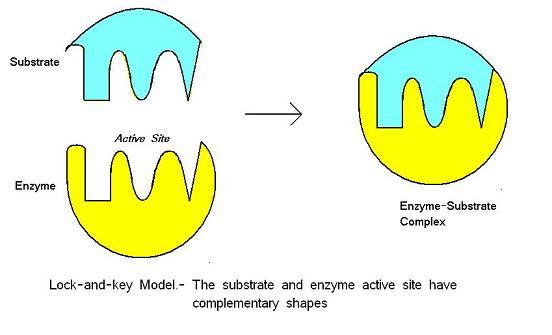
- It makes a temporary bond at the active site forming a enzyme-substrate complex
- The lock-and-key model
- The unique shape of the active site means that it will only catalyse one type of reaction
- The unique shape of the active site means that it will only catalyse one type of reaction
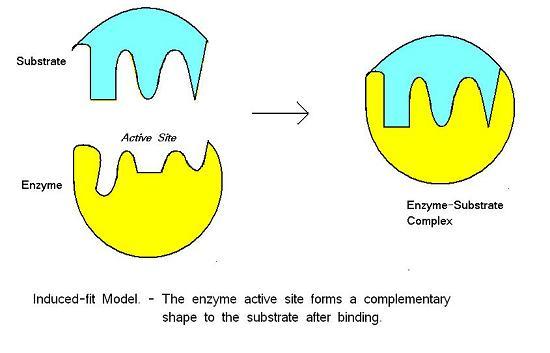
- Lysozyme and the influenced fit model
- Observations that an enzyme's shape was altered by binding its substrate suggested that it was flexible and not rigid
- The induced fit model was proposed suggesting that the enzymes shape slightly alters to accommodate the substrate
Activation Energy
- Molecules must have enough kinetic energy to react
- The minimum energy required for molecules to react, breaking existing bonds in the reactants is the activation energy.
- If you increase kinetic enegrgy it makes chemicals react as it makes collisions more likley
- Heat speeds up reaction in non living things
- But in most living organisms temperatures above 40 degrees will denature the enzymes
- Instead enzymes work by lowering the amount of activation energy
- When a substrate enters the active site of an enzyme. The molecule alters its shape allowing reaction to occur at lower temperatures than in the absence of enzymes.
- Instead enzymes work by lowering the amount of activation energy
- But in most living organisms temperatures above 40 degrees will denature the enzymes
- Heat speeds up reaction in non living things
- If you increase kinetic enegrgy it makes chemicals react as it makes collisions more likley
- The minimum energy required for molecules to react, breaking existing bonds in the reactants is the activation energy.
- Molecules must have enough kinetic energy to react
Enzyme Controlled reactions
- The progress of an enzyme-catalysed reaction for a certain concentration of a substrate can be followed by measuring either the formation of product or disappearance of substrate.
Factors effecting enzymes
- Temperature-Increased temperature increases genetic energy. This increases the amount of successful collisions between enzyme and substrate.
- The rate of reaction doubles every 10 degree temperature rise up to a particular temperature. In most molecules this is 40 degrees
- Above 40 degrees the reaction rate slows down because despite more kinetic energy hydrogen bonds start to break down due to the increased vibration. This changes its tertiary structure and alters the shape of the active site and substrate.
- PH level- Most have an optimum PH level. Small PH changes around the optimum PH cause a small reversible change in the enzyme. Extremes in PH can cause the enzyme to denature.
- The changes on the amino acid side chain of the enzymes active site are effected by hydrogen or hydroxyl ions.
- At low PHs excess H+ ions are attracted to negative charges and nutralise them
- At high PH excess OH- ions neutralise the positive charges .
- This distrupts the ionic and hydrogen bonds maintaining the shape of the active site.
- This denatures the enzymes as it changes the shape. No enzymes- substrate complexes form and the enzymes activity is lost.
- This distrupts the ionic and hydrogen bonds maintaining the shape of the active site.
- At high PH excess OH- ions neutralise the positive charges .
- Substrate concentration- The rate of an enzyme-catalysed reaction varies with changes in substrate concentration . If the enzyme concentration is constant the rate of the reaction increases as substrate concentration does.
- At low substrate concentration the enzymes only have a few substrates to collide with so the active sites are not working to full capacity. With more substrate there are more active sites filled.
- The concentration of the substrate is controlling the rate of reaction and is a limiting factor. When all of active sites are occupied the rate of reaction is at its maximum.
- When all the active sites are full the enzyme is saturated. Even if more substrate is added the reaction can't go any faster.
- Other factors such as temperature control the rate of reaction
- When all the active sites are full the enzyme is saturated. Even if more substrate is added the reaction can't go any faster.
- Enzyme Concentration
- Once a product leaves the active site the enzyme active site can be reused. This means that only a small enzyme concentration is needed to catalyse a large number of reactions.
- The number of substrate molecules that an enzyme can turn in to products in a given time is the turn over number.
- One of the fastest enzymes known is catalyse. The higher the enzyme concentration the more active sites meaning the faster the reaction.
- Temperature-Increased temperature increases genetic energy. This increases the amount of successful collisions between enzyme and substrate.
Enzyme Inhibition
Imagens e arquivos do mapa
Informações
- Descrição
- AS level Biology Mapa Mental sobre Enzymes, criado por Matthew Bagshaw em 07-11-2016.
- Criado por
- Matthew Bagshaw
- Visualizações
- 0
- Avaliação