
Mapa mental
PRIMATES
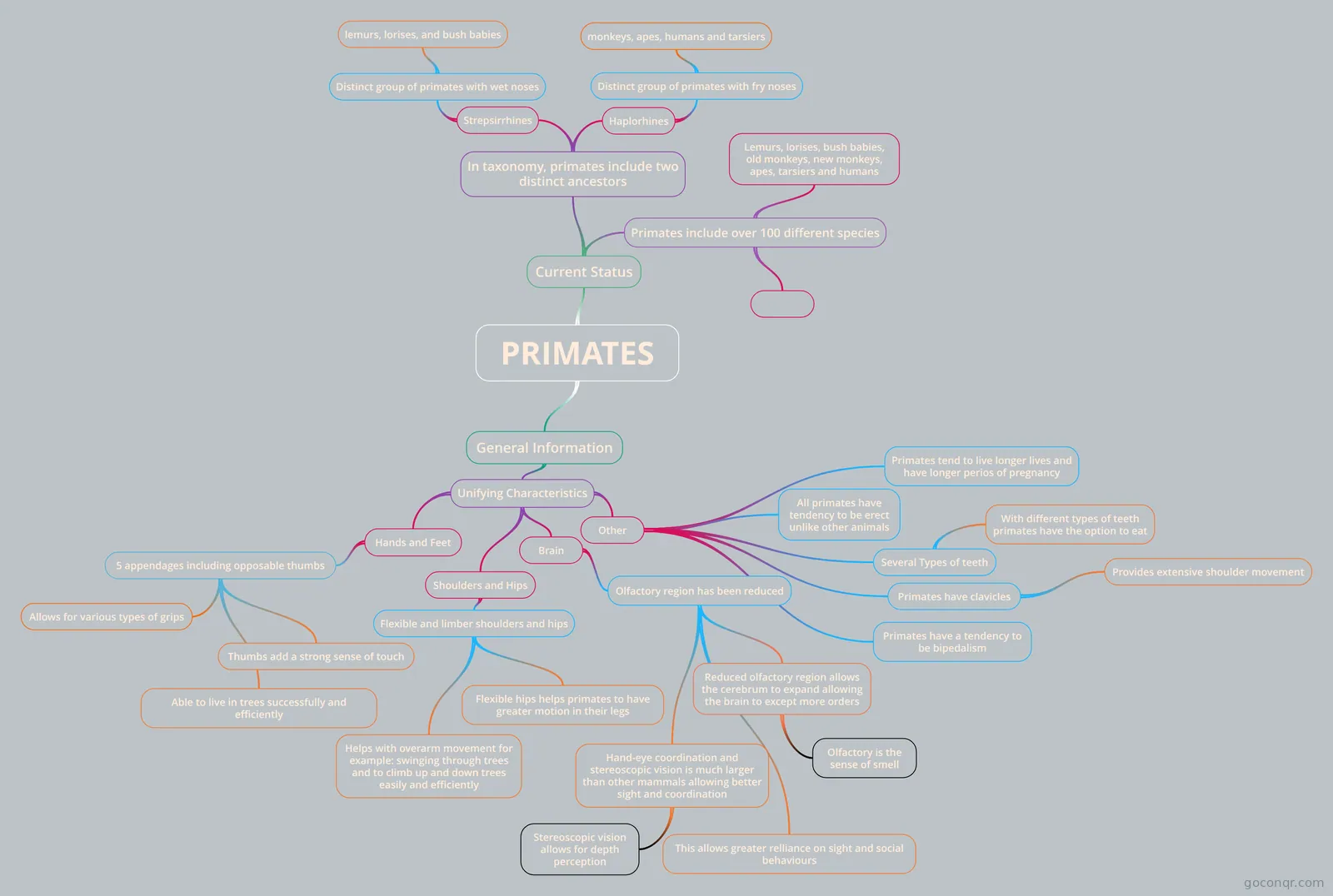
Mind map: Primates
Conteúdo do mapa
PRIMATES
General Information
- Unifying Characteristics
- Hands and Feet
- 5 appendages including opposable thumbs
- Allows for various types of grips
- Thumbs add a strong sense of touch
- Able to live in trees successfully and efficiently
- 5 appendages including opposable thumbs
- Shoulders and Hips
- Flexible and limber shoulders and hips
- Helps with overarm movement for example: swinging through trees and to climb up and down trees easily and efficiently
- Flexible hips helps primates to have greater motion in their legs
- Flexible and limber shoulders and hips
- Brain
- Olfactory region has been reduced
- Reduced olfactory region allows the cerebrum to expand allowing the brain to except more orders
- Olfactory is the sense of smell
- This allows greater relliance on sight and social behaviours
- Hand-eye coordination and stereoscopic vision is much larger than other mammals allowing better sight and coordination
- Stereoscopic vision allows for depth perception
- Reduced olfactory region allows the cerebrum to expand allowing the brain to except more orders
- Olfactory region has been reduced
- Other
- Primates have clavicles
- Provides extensive shoulder movement
- All primates have tendency to be erect unlike other animals
- Primates have a tendency to be bipedalism
- Several Types of teeth
- With different types of teeth primates have the option to eat
- Primates tend to live longer lives and have longer perios of pregnancy
- Primates have clavicles
- Hands and Feet
- Unifying Characteristics
Current Status
- In taxonomy, primates include two distinct ancestors
- Strepsirrhines
- Distinct group of primates with wet noses
- lemurs, lorises, and bush babies
- Distinct group of primates with wet noses
- Haplorhines
- Distinct group of primates with fry noses
- monkeys, apes, humans and tarsiers
- Distinct group of primates with fry noses
- Strepsirrhines
- Primates include over 100 different species
- Lemurs, lorises, bush babies, old monkeys, new monkeys, apes, tarsiers and humans
- In taxonomy, primates include two distinct ancestors
Informações
- Descrição
- Grade 11 Biology Mapa Mental sobre PRIMATES, criado por Jaden N em 19-11-2016.
- Criado por
- Jaden N
- Visualizações
- 1
- Avaliação