
Mapa mental
Nerves and Hormones
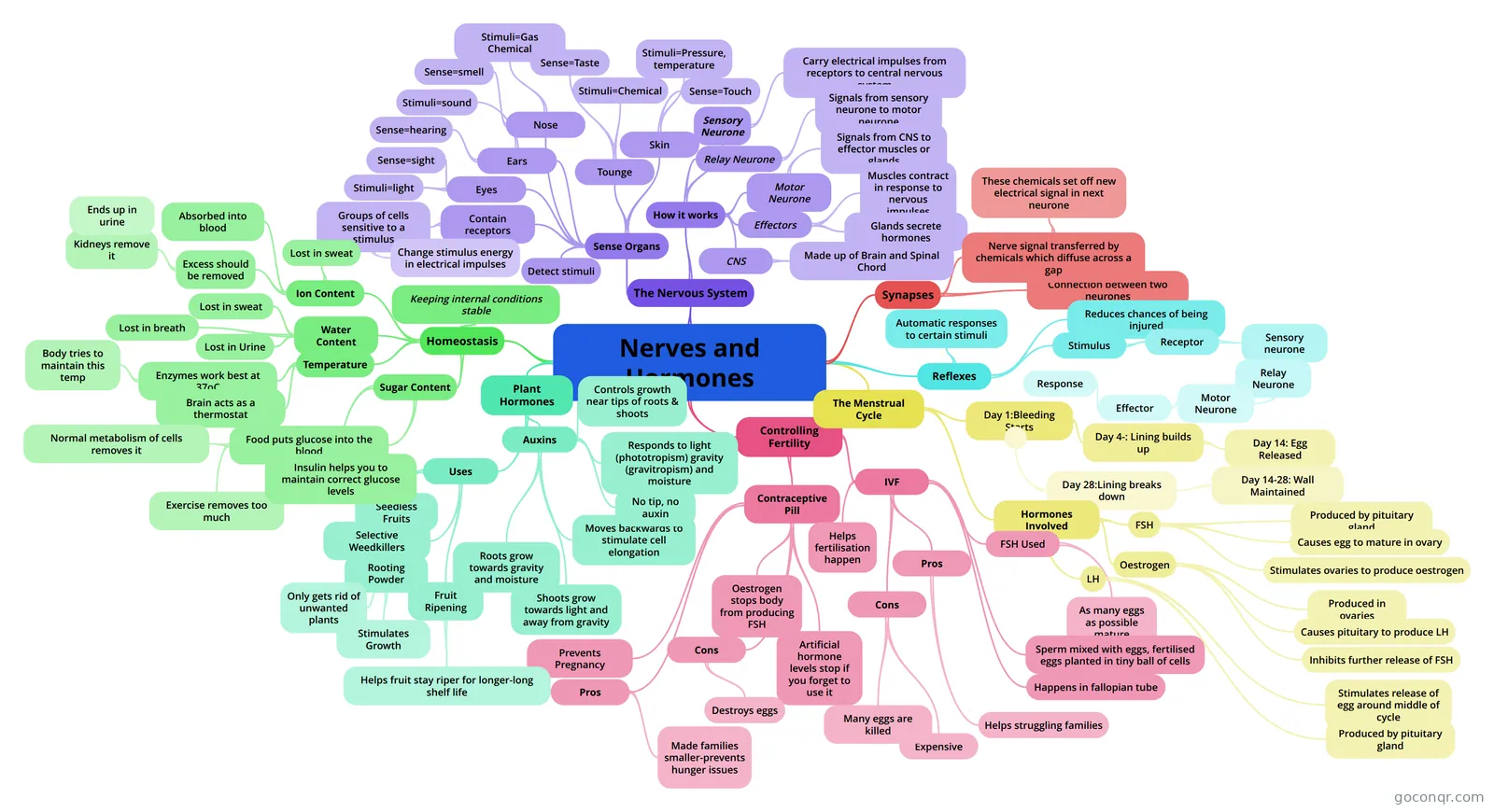
Mind map: Nerves and hormones
Conteúdo do mapa
Nerves and Hormones
The Nervous System
- Sense Organs
- Detect stimuli
- Contain receptors
- Groups of cells sensitive to a stimulus
- Change stimulus energy in electrical impulses
- Groups of cells sensitive to a stimulus
- Eyes
- Stimuli=light
- Sense=sight
- Ears
- Sense=hearing
- Stimuli=sound
- Nose
- Sense=smell
- Stimuli=Gas Chemical
- Tounge
- Sense=Taste
- Stimuli=Chemical
- Skin
- Sense=Touch
- Stimuli=Pressure, temperature
- How it works
- Sensory Neurone
- Carry electrical impulses from receptors to central nervous system
- Relay Neurone
- Signals from sensory neurone to motor neurone
- Motor Neurone
- Signals from CNS to effector muscles or glands
- Effectors
- Muscles contract in response to nervous impulses
- Glands secrete hormones
- CNS
- Made up of Brain and Spinal Chord
- Sensory Neurone
- Sense Organs
Synapses
- Connection between two neurones
- Nerve signal transferred by chemicals which diffuse across a gap
- These chemicals set off new electrical signal in next neurone
Controlling Fertility
- Contraceptive Pill
- Prevents Pregnancy
- Oestrogen stops body from producing FSH
- Artificial hormone levels stop if you forget to use it
- Pros
- Made families smaller-prevents hunger issues
- Cons
- Destroys eggs
- IVF
- FSH Used
- As many eggs as possible mature
- Sperm mixed with eggs, fertilised eggs planted in tiny ball of cells
- Happens in fallopian tube
- Pros
- Helps struggling families
- Cons
- Expensive
- Many eggs are killed
- Helps fertilisation happen
- FSH Used
- Contraceptive Pill
Plant Hormones
- Auxins
- Controls growth near tips of roots & shoots
- Responds to light (phototropism) gravity (gravitropism) and moisture
- Moves backwards to stimulate cell elongation
- No tip, no auxin
- Shoots grow towards light and away from gravity
- Roots grow towards gravity and moisture
- Uses
- Selective Weedkillers
- Only gets rid of unwanted plants
- Fruit Ripening
- Helps fruit stay riper for longer-long shelf life
- Rooting Powder
- Stimulates Growth
- Seedless Fruits
- Selective Weedkillers
- Auxins
Homeostasis
- Keeping internal conditions stable
- Ion Content
- Lost in sweat
- Absorbed into blood
- Excess should be removed
- Kidneys remove it
- Ends up in urine
- Kidneys remove it
- Water Content
- Lost in sweat
- Lost in breath
- Lost in Urine
- Sugar Content
- Food puts glucose into the blood
- Normal metabolism of cells removes it
- Exercise removes too much
- Insulin helps you to maintain correct glucose levels
- Food puts glucose into the blood
- Temperature
- Enzymes work best at 37oC
- Body tries to maintain this temp
- Brain acts as a thermostat
- Enzymes work best at 37oC
Reflexes
- Automatic responses to certain stimuli
- Reduces chances of being injured
- Stimulus
- Receptor
- Sensory neurone
- Relay Neurone
- Motor Neurone
- Effector
- Response
- Effector
- Motor Neurone
- Relay Neurone
- Sensory neurone
- Receptor
The Menstrual Cycle
- Day 1:Bleeding Starts
- Day 4-: Lining builds up
- Day 14: Egg Released
- Day 14-28: Wall Maintained
- Day 28:Lining breaks down
- Day 28:Lining breaks down
- Day 14-28: Wall Maintained
- Day 14: Egg Released
- Day 4-: Lining builds up
- Hormones Involved
- FSH
- Produced by pituitary gland
- Causes egg to mature in ovary
- Stimulates ovaries to produce oestrogen
- Oestrogen
- Produced in ovaries
- Causes pituitary to produce LH
- Inhibits further release of FSH
- LH
- Produced by pituitary gland
- Stimulates release of egg around middle of cycle
- FSH
- Day 1:Bleeding Starts