Mapa mental
Pack 17 - Energy, Ecosystems and Nutrient cycles
Conteúdo do mapa
Pack 17 - Energy, Ecosystems and Nutrient cycles
Food chains and energy transfer:
- Most plants convert energy from sunlight into chemical energy in organic comounds
- Nitrates and phosphates are required to make these organic compounds
- Food chains:
- Producers:
- Photosynthetic organisms manufacture organic substances
- Consumers:
- Consume other organisms to obtain their energy
- Primary consumers eat producers
- Secondary consumers eat primary consumers
- Saprobionts
- Extracellular digestion
- Break down things to absorbable parts
- Assimilated
- Break down things to absorbable parts
- Extracellular digestion
- Producers:
- Trophic levels
- Energy flows from primary producers to consumers. Each group is said to be at a certain trophic level
- e.g. grass-->rabbit-->fox
- There are usually only 4 or 5 trophic levels due to the inefficiency of energy transfer
- Food webs:
- In any habitat, many food chains are inter-linked to form food webs
- Some organisms will be in more than one trophic level
- The greater the number of interactions, the more stable the food web is
- Most plants convert energy from sunlight into chemical energy in organic comounds
Biomass
- Total mass of living material in a specific material in a specific area at a given time
- All organisms contain a variable volume of water
- Dry mass is measured by drying the sample in an oven at 100 degrees until a constant mass is reached.
- Issues:
- Organisms must be dead
- Only small samples can be taken
- Sample may not be representative
- Only small samples can be taken
- Organisms must be dead
- Issues:
- Measured in dry mass per given area in a given time
- Calorimetry can be used to estimate the chemical energy store in dry mass
- 1. Sample of dry material weighed
- 2. Burnt in pure oxygen in a sealed chamber
- 3. Bomb is surrounded by water bath
- 4. Heat of combustion causes temp. of the water to rise
- 3. Bomb is surrounded by water bath
- 2. Burnt in pure oxygen in a sealed chamber
- 1. Sample of dry material weighed
- Total mass of living material in a specific material in a specific area at a given time
Energy transfer and Productivity
- 90% of energy from the sun is lost, even more is lost of the energy hitting a leaf:
- Some energy used for evaporation
- Some energy is reflected by cuticle
- Not all light hits the cuticle
- Not all wavelengths used in photosynthesis
- Low CO2 Conc. may limit photosynthesis
- Gross primary production (GPP) and net primary production (NPP)
- GPP = The chemical energy store in a plant biomass, in a given area volume at a given time
- NPP = Chemical energy store in plant biomass after respiratory losses to the environment
- NPP = GPP - R
- Less than 10% NPP in plants available to consumers
- Not all plant eaten
- Some used in respiration for ATP production
- Some lost in egestion and excretion
- Plant material is difficult to digest
- Less than 20% available from secondary to tertiary
- Not all consumed
- Some parts are lost in faeces
- Lost in excretion
- Net production of consumers
- N = I - (F+R)
- I = Chemical energy
- F = chemical energy lost to environment
- R = Respiratory loss
- N = I - (F+R)
- 90% of energy from the sun is lost, even more is lost of the energy hitting a leaf:
Productivity and farming practices
- Increasing the efficiency of energy transfer leads to higher yields
- Intensive farming techniques:
- Restrict movement - less energy used in muscle contraction
- Environment kept warm - reduce heat loss from the body
- Optimum amount of food for max growth
- Predators excluded so no loss to other organisms
Chemical and biological control of agricultural pests
- Pesticides
- Effective ones should:
- Be specific to only one organism
- Biodegrade
- Not accumulate
- Development of genetic resistance
- Mutation confers resistance
- Pests without mutant allele are killed by pesticide
- Organisms with allele for resistance survive
- Breed to pass on allele
- Organisms with allele for resistance survive
- Pests without mutant allele are killed by pesticide
- Mutation confers resistance
- Effective ones should:
- Biological Control
- Eradicating pests may mean that other pests can multiply
- Very specific, once introduced the organisms reproduce themselves
- Pests can't become resistant
- Integrated control systems
- Aim to keep pests are acceptable levels
- Choose varieties of animals/plants that are resistance to pest
- Providing habitats close to crops for natural predators
- Monitor crops for signs of pests
- Remove pests mechanically
- Use biological agents
- Use pesticides
- Use biological agents
- Remove pests mechanically
- Monitor crops for signs of pests
- Providing habitats close to crops for natural predators
- Pesticides
Nutrient cycles
- Saprobiotic organisms:
- Activate a gene that makes digestive enzymes
- Enzymes are secreted and hydrolyse surrounding material into soluble compounds
- Compounds are absorbed by cells and assimilated
- Enzymes are secreted and hydrolyse surrounding material into soluble compounds
- Activate a gene that makes digestive enzymes
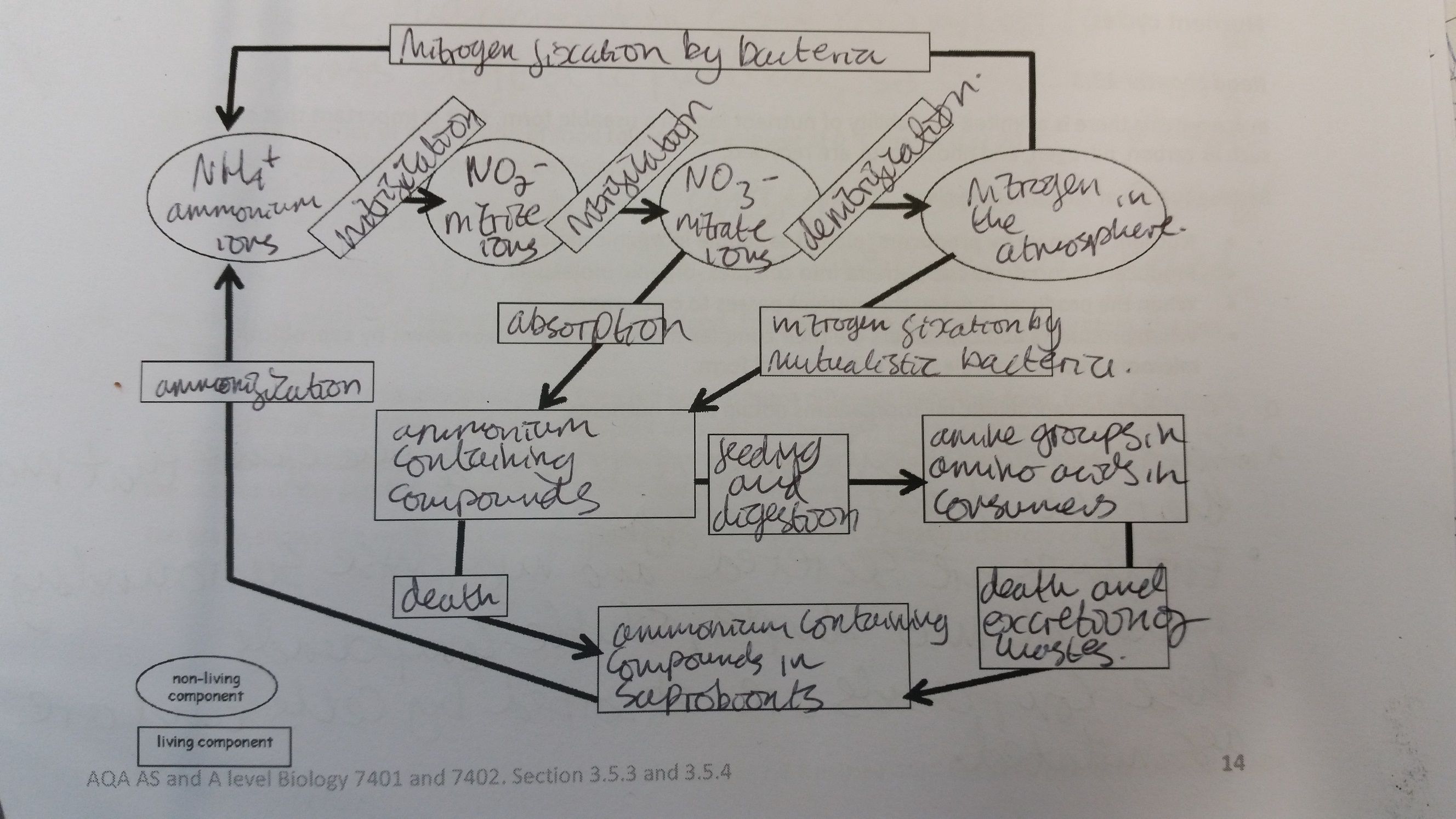
- Nitrogen cycle
- Ammonification
- Production of ammonia from organic nitrogen containing compounds
- Carried out by saprobiotic organisms
- Nitrification
- Oxidation of ammonium ions to nitrate ions
- Then oxidation of nitrite ions to nitrate ions
- Oxidation of ammonium ions to nitrate ions
- Nitrogen Fixation
- Reduce gaseous nitrogen to ammonia
- Denitrification
- Denitrifying bacteria convert soil nitrates into gaseous nitrogen in anaerobic conditions
- Ammonification
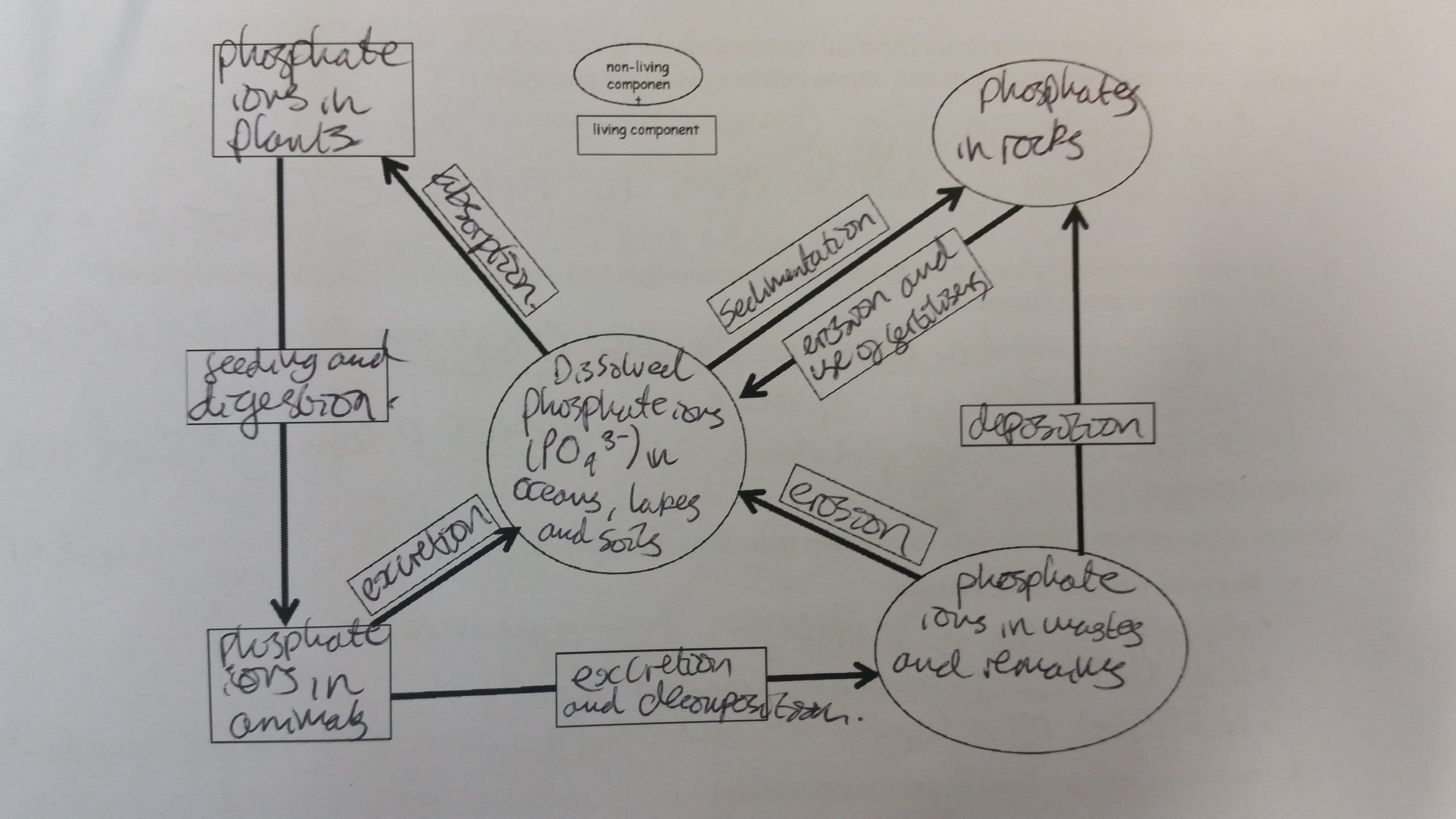
- Phosphorus cycle
- Role of Mycorrhizae
- This is the association between certain types of fungi and most plants
- Fungi act as extension of plants to increase surface area
- Plants provide organic compounds
- Mycorrhizae provide water and minerals and resist drought
- Fertilisers
- Natural fertilisers
- Dead and decaying remains of animals and plants
- Animal waste
- More expensive
- Artificial fertilisers
- Mined from rocks and deposits
- Convert into different forms and blended to give balance of minerals
- Agricultural ecosystems
- Intensive food production means minerals are taken away
- Nitrogen is needed for growth (amino acids)
- Environmental issues:
- Leeching occurs:
- This is the process by which nutrients are removed from the soil
- Rainwater dissolves soluble nutrients, this is carried into watercourses
- This can lead to eutrophication
- 1) Nitrate ion concentration increases due to leaching
- 2) Algae bloom - upper layers become densely populated
- 3) Algae absorb light - light cannot penetrate lower levels
- 4) Light becomes the limiting factor for plants below - they die
- 5) Lack of dead plants no longer the limiting factor for saprobionts, so they grow
- 6) Saprobionts require oxygen for respiration, increased oxygen demand
- 7) Oxygen concentration in water reduces, nitrates released from decaying organisms
- 8) Oxygen now limiting factor for fish - they die
- 9) Less competition for anaerobic respiration, so anaerobic organisms increase
- 10) Anaerobic organisms continue to decompose material and release nitrate and toxic waste
- 9) Less competition for anaerobic respiration, so anaerobic organisms increase
- 8) Oxygen now limiting factor for fish - they die
- 7) Oxygen concentration in water reduces, nitrates released from decaying organisms
- 6) Saprobionts require oxygen for respiration, increased oxygen demand
- 5) Lack of dead plants no longer the limiting factor for saprobionts, so they grow
- 4) Light becomes the limiting factor for plants below - they die
- 3) Algae absorb light - light cannot penetrate lower levels
- 2) Algae bloom - upper layers become densely populated
- 1) Nitrate ion concentration increases due to leaching
- This is the process by which nutrients are removed from the soil
- Leeching occurs:
- Natural fertilisers
- Saprobiotic organisms: