
Notas
Derive and Apply - Practice Questions and answers for AS Physics A OCR - Mechanics G481
Conteúdo das notas (1)
Página 1
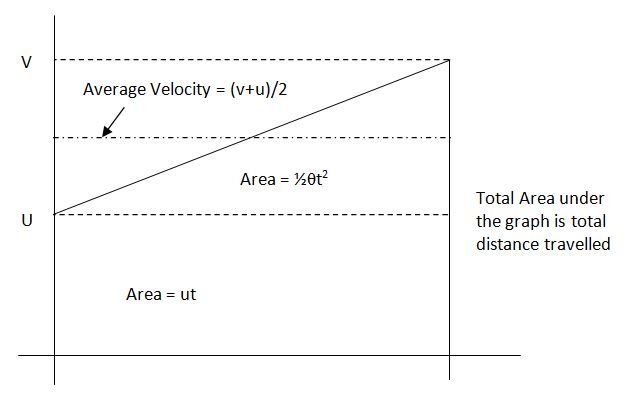
Derive the equations of motion for constant acceleration in a straight line from a
velocity against time graph
Equation 1
Rearrange the acceleration equation = a=(v-u)/t ----> v=u+at
Equation 2
Area of triangle on graph --------> ½ (v-u) t
Equation 3
Area of triangle on graph = ½ (v-u) t The acceleration equation = a=(v-u)/t
Rearrange the equation = (v-u)=at
Substitute (v-u) in Area of triangle on graph for (at) = ½ (v-u) t ------> ½ a t^2
Area of rectangle = ut
Add area of triangle and area of rectangle together ---------> u t + ½ a t^2
Equation 4
Average velocity = (v+u)/2
Displacement = average velocity x Time -----------> s=½ (v-u) t
Equation 5
Equation 4 = s=½ (v-u) t v=u+at
Rearrange for t = t=(v-u)/a
Substitute t in equation 4 = s=(v-u)/2 x (v-u)/a
Rearrange the equation = 2as=(v-u)x(v-u)
= 2as=v^2-u^2
Rearrange this equation -----------> v^2=u^2+2as
Apply the definition of work done to derive the equation for
the change in gravitational potential energy
Work done = force x distance
Force = mass x acceleration
Weight = mass x gravitational field
strength
G.P.E.
= m x g x h
Apply
the equations of constant acceleration to describe and explain the motion of an object due to a
uniform velocity in one direction and a constant acceleration in a
perpendicular direction
You can talk about ‘large’
deceleration/acceleration but not ‘quick’.
Apply the principle of moments to solve
problems,
including the human forearm
Clockwise moment = anticlockwise moment.
New Page
Informações
- Descrição
- Derive and Apply - Practice Questions and answers for AS Physics A OCR - Mechanics G481
- Criado por
- nikeishabk
- Visualizações
- 561
- Tags
- Avaliação