
Notas
GEO 3200 1
Conteúdo das notas (1)
Página 1
Formation of the Earth and the Moon
Solar Nebula Hypothesis
1. Cold cloud of gas and dust rotates and compresses into a disk-like shape
90% mass concentrated in the center
Turbulence in cloud causes matter to collect in certain locations
2. Clumps of matter begin to form in the disk
Accretion of matter (gas and dust) around clumps by gravitational attraction
Clumps develop into proto-planets
Solar wind drives lighter elements outward
Debris from impact was thrown into orbit around Earth and collected to form the Moon
Moon formed from impact, mantle of impacting body included, proportions of Fe and Mg differ from Earth's mantle ~4.4 Ga
Cold Accretion Model (secondary differentiation)
Earth formed by acccretion of dust and larger particles of metals and silicates
Originally a homogeneous mix throughout
Differentiation: result of heating and partial pressure; possible sources are radioactive decay, gravitational compression, bombardment
Differentiation after Accretion
Iron and nickel sink to form core
Less dense material (Si and O combined with remaining iron and other metals) forms mantle and lighter crust (dominated by silicon and oxygen)
Presence of volatile gases on Earth indicates that complete melting did not occur
Earth was repeatedly partly melted by great impacts, such as the Moon-forming impact
Hot Accretion (primary differentiation)
Internal zonation of planets is a result of hot heterogeneous accretion
Hot solar nebula
Initial crystallization of iron-rich materials forms planet's core
With continued cooling, lower density silicate materials crystallized
Archean Crust
One differentiation occurred, Earth's crust was dominated by Fe and Mg silicate minerals
Earth experienced heating and partial melting, it may have been covered by an extensive magma ocean
Magma cooled to form Komatiites -- ultramafic rocks composed of olivine and pyroxene
Oceanic Crust
4.5 Ga
Formed at mid-ocean ridges
Composed of Komatiite and basalt
Widespread
Formed by partial melting of ultramafic rocks in upper mantle
Continental Crust
4.4 Ga
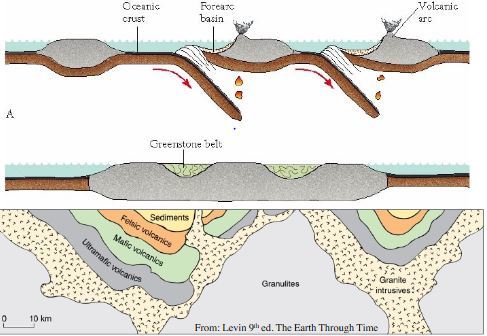
Formed at subduction zones
Composed of Tonalite, granodiorite, granites
Local
Formed by partial melting of wet, sediment covered mafic rocks in subduction zones
BIFs -- What are they and why are they important?
Anoxic Atmosphere
Earth's early atmosphere was strongly reducing and anoxic (lacked free oxygen)
Evidence is in sedimentary rocks: lack oxidized iron in oldest sed rocks, dark due to presence of carbon, lack carbonate rocks, abundant chert
The chemical building blocks of life could not have formed in the presence of O2!!
Appear During the Precambiran
Includes cherts--red oxidized iron, gray unoxidized iron
Lighter colored stuff is precipitated quartz
Precipitates on shallow sea floor
Iron sourced from:
weathering of iron-bearing rocks on continents
Submarine volcanoes and hydrothermal vents
Stopped forming 1.9 billion years ago
We infer oxygen began to appear in the early atmosphere due to these BIFs being evidence for it
Forming an O2 Rich Atmosphere
Result of photochemical dissociation
UV radiation in upper atmosphere breaks water into H and O
Photosynthesis: bacteria and plants produce oxygen
Volcanic Outgassing
Release of water vapor and other gases from the Earth through volcanism
Most of the water on the surface of the Earth and in the atmosphere was outgassed during the first billion years of Earth history
Formation of the Hydrosphere
Once at the Earth's surface, gases and other volatile elements underwent a variety of changes
water vapor condensed and fell as rain
rain water accumulated in low places to form seas. the seas were originally freshwater
Carbon dioxide and other gases dissolved in the rain and the water was much more acidic than today
this caused rapid chemical weathering (adds Na, Ca, K, and other ions to seawater)
change to more alkaline water may have occured rapidly, this neutrilized the acidic seas
Ions accumulated in the seas, increasing salinity
Seas are less acidic (CaCo3 forms shells of marine organisms and limestones
Two main depositional environments
Submarine volcanic zones
Rift basins
both provide the necessary sources of iron and silica!
The Oxygen Revolution
The earth atmosphere had NO free oxygen, NO ozone layer
Early oceans were rich in dissolved iron and silica, rare today
Silica today is extracted from seawater at the same rate it is dissolved since it is used by organisms for making skeletons
Iron can ONLY be dissolved in oxygen poor water, where only bacteria can survive
BIFs from this time can be traced for hundreds of miles, laid down uniformly and continuously
Can only form by an oxidation reaction
Two models demonstrate how BIFs could form in the early ocean, but neither alone can account for the sheer volume of BIFs worldwide
The formation of BIFs and the composition of our present day atmosphere both require the appearance of free oxygen in the atmosphere
Cyanobacteria (producers of stromatolites) were also present at this time, photosynthesizing away and generating free oxygen
With the presence of free oxygen in the oceans, bacteria had a new niche that could be filled: that of iron-oxidizing bacteria
With the lack of any ozone layer, UV radiation was very high, and with free oxygen in the ocean, inorganic precipitation could also occur
With free oxygen in the ocean and atmosphere, a new ecological niche could be filled RESPIRATION
Oxygen in the atmosphere = UV producing ozone layer to block the UV
Two Models for forming BIFs
1. Inorganic precipitation: UV radiation forms and iron compound in surface water
2. Organic precipitation: bacterial photosynthesis breaks up dissolved iron carbonate to generate energy
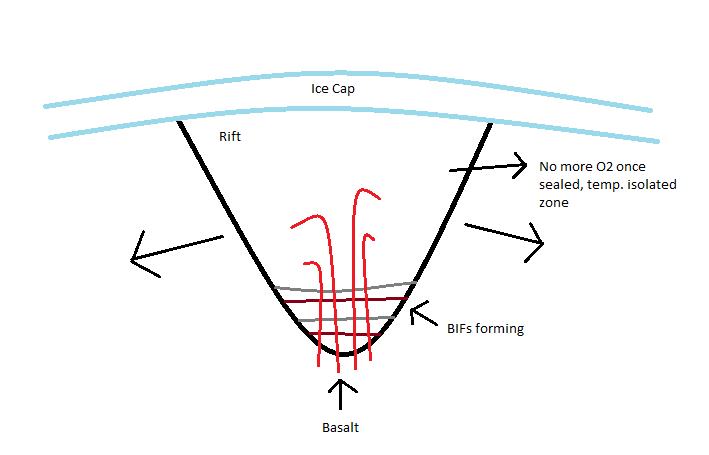
BIFs in Rifts
During the Neoproterozoicm part of the Amazon craton tried to rift apart
This forming a 120 triple junction failed rift
At the time of rifting, the area was isolated and covered in ice
Only hydrothermal activity in the glaciated rift deposited minerals, mainly silica, iron and Mg, forming a BIF
Proterozoic Glaciations
During the Neoproterozoic, the Earth experienced at least TWO episodes of global glaciation
One glacial episode was in the Cryogenian period
Other was in the Edicaran period
Resulted in extensive continental glaciations
Seds deposited in basins and shelf areas along the eastern edge of the N.America craton
Most of these rocks deformed during Paleozoic orogenies
Snowball Earth
The entire Earth was ice-covered for long periods of time
Each glacial period lasted for millions of years and ended violently under extreme greenhouse conditions
The Glacial Part
Snow fall+sea ice=increased albedo=more snow fall
Once ice reached critical latitude (~30 degrees) 1/2 Earth's surface covered, the feedback is tremendous and ices the whole Earth
The Warming Part
Heat escaping from Earth's interior prevents oceans from freezing to the bottom
Surface erosion is also prevented
CO2 supply to atmosphere and oceans continues due to volcanism and plate tectonics
But it cannot be absorbed do to the ice cover!
Over millions of years, CO2 levels become so high they offset the ice-albedo feedback
Once melting begings, new water vapor in the air dramatically increases global warming effect (water vapor is the strongest greenhouse gas)
Glaciation reverses and very rapidly enters an extreme greenhouse phase
Evidence for Glaciations
Glacial striations
Tillites (lithified, unsorted conglomerates and boulder beds)
Glacial dropstones
Varved clays
So why did glaciations happen in the first place?
Plate tectonics may have had a role
Continents were located around the equator so there was no tropical ocean
Heat lost by reflection from the rocks on the surface on the continents may have caused global cooling (land plants had not appeared yet)
As continental glaciers and icecaps formed, reflectivity of snow and ice furthered the temperature decrease
Glaciations are associated with:
Decrease in CO2 and increase in O2
CO2 causes the greenhouse effect and global warming
Decrease in CO2 may have caused cooling
Decrease in CO2 was probably caused by increase in the number of photosynthetic organisms
Limestones
Association of limestones with glacial deposits suggests that times of photosynthesis and CO2 removal alternated with times of glaciations
Proterozoic Life
Dominated by prokaryotes
Archae in deep sea hydrothermal vents
Planktonic prokaryotes floated in seas and lakes
Anaerobic prokaryotes in oxy-deficient environments
Cyanobacteria (stromatolites) -- photosynthetic
Eukaryotes started to appear, have distinct masses presumed to be the remains of cell nuclei or organelles
Trace fossils appear about 560 Ma (burrows)
Imprints of soft bodied organisms
Ediacarian (Neoproterozoic) fauna, lived before predators, until this time most organisms were microscopic
Snowball Earth -- what's the hypothesis about and what evidence is used to support it?
Early Paleozoic
Ordovician
Tactonic Orogeny -- Queenston Clastic Wedge; was between Laurentia (N. America, east coast) and Baltica (Europe and western Russia); carbonate platform wedged into subduction zone, exotic terrane
The Five Mass Extinctions
1. End Ordovician: 60%
2. Late Devonian
3. End Permian: 80-95% marine species
4. End Triassic: 50% marine invertebrates, 80% land quadrupeds
5. End Cretaceous
The orogenies of North America - timing and extent
Cambrian
Tommotian stage (early Cambrian)
several skeletal elements
Not part of any living phylum today
Cambrian explosion (middle and late Cambrian) of marine life, few species and genera, many body plans
Bottom-dwellers abundant
Trilobites
Arthropods
Early fish
Softbodied creatures - cnidarians, predatory worms
Huge carnivores - anomalocarids
Enchinoderms, inarticulate brachiopods, mollusks
Stromatolites less abundant
Reefs: Archeocyathids, suspension feeders, probably sponges
Paleozoic Life
Ordovician
Radiation in graptolites and nautiloids
Life in sediments, burrower diversification
Jawless fishes
Grazing snails
Articulate brachiopods
Chrinoids expanded
Reefs: Coral-strome reefs, rugose corals, tabulate corals, stromatoporoids
Plants may have invaded land, not much evidence, restricted to moist habitats
Late Paleozoic
Devonian
Acadian Orogeny -- Catskill Clastic Wedge; famous unconformity Old Red Sandstone (Hutton); second phase of Appalachian mountain building
Mississippian
Antler Orogeny --
Mississippian-Pennsylvanian-Permian
Alleghenian Orogeny -- Formed the Appalachian Mountains; northwestern Africa collided with southeastern N. America
Mesozoic
Triassic
Sonoma Orogeny -- Put exotic terrain on western U.S. (volcanic arc)
Cretaceous
Nevadan Orogeny --
Sevier Orogeny -- Middle Jurassic to earliest Cenozoic
Cenozoic
Laramide Orogeny --
Alpine Orogeny --
Himalayan Orogeny --
Silurian
Wingless insects
Early land plants
Evolutionary radiation of brachipods, bivalve mollusks, graptolites
Trilobites did not recover from extinctions
Swimming animals - ammonoids, euripterids
Jawless fishes to jawed fishes
Devonian
First insects
First amphibians
First forests
First sharks
Ferns
Mosses
Formation of Earth and Moon
BIFs
Snowball Earth
Orogenies of North America
Diversity of Life
Informações
- Descrição
- Geology (Historical Geology) Notas sobre GEO 3200 1, criado por supergoober em 23-04-2014.
- Criado por
- supergoober · abr 2014
- Atualizado
- 20 jun 2016
- Visualizações
- 629
- Tags
- Avaliação