
Notas
Intro to lingu
Conteúdo das notas (6)
Página 1
Syntax
Syntax is the component of grammar that deals with how words are combined into phrases and sentences.
Lexical Categories(“parts of speech”)
Distribution criteria The criteria we use for determining part of speech then aren’t based on the meanings of the word, but on its distribution: morphological and syntactic.
Nouns Some nouns, (called count/countable nouns) which denote entities which can be counted have a plural form (e.g. chair – cf. one chair, two chairs); some nouns denote an uncountable mass and for this reason are called mass/uncountable/noncount nouns, and so cannot be pluralised (e.g. furniture – hence the ungrammaticality of ∗one furniture, ∗two furnitures).
Pronouns Personal pronoun: John has a red car. He likes it. Possessive pronoun: John likes his car. Reflexive pronoun: John likes himself.
Determiner: Distribution criteria: Determiners appear at the very beginning of English noun phrases. Determiners of English (D)
a) Articles: the, a, an
b) Deictic articles: this, that, these, those
C) Quantifiers: every, some, many, most, few, all, each, any, less, fewer, no
d) (Cardinal) numerals: one, two, three, four, etc.
e) Possessive pronouns: my, your, his, her, its, our, their
f) Some wh-question words: which, whos
4. Auxiliaries what we might’ve called “helper verbs” in school: Has/Had, Is/Was, Are/Were, Does/Did, Can/Could, May/Might, Will/Would, Shall/Should, Must, Ough
**Sentences are composed of discrete units that are combined using rules. This system of rules explains how speakers can store infinite knowledge in a finite space – their brains. The part of grammar that represents a speaker’s knowledge of sentences and their structures is called syntax (and the rules of syntax, going back to the second proposition, combine words into phrases and phrases into sentences). • Sentences consist not of words strung together like beads on a string, but of organized constituents.
Syntactic Properties
Word Order: The rules of syntax specify the correct word order for a language. something we mentioned in passing earlier – the rules of syntax specify the correct word order for a language (or orders, depending on context and the circumstances). The rules of the syntax also specify the grammatical relations of a sentence, such as subject and direct object. (Ła) Common patterns of word order include SVO (subject-verb-object; among others, it is predominant in English and Modern Hebrew),
Argument structure (arguments / complements; adjuncts) : for a sentence to be considered grammatical, a verb (also nouns, adjectives, prepositions, etc.1 ) requires all its required arguments to be present in the sentence.
Agreement: distinct expressions in a sentence may be required to have the same value for some grammatical feature (e.g. tense, gender, number, person) , in which case we say that they agree with respect to that feature. Such features are called agreement features, and this phenomenon is called agreement.
Syntactic constituents
we conduct three tests to determine if a sentence is a constituent or not:
Substitution: we substitute the sentence with a pronoun
Answers to questions:
lefting: It was X that Y, where X
Syntactic Category
A syntactic category consists of a set of expressions that have very similar syntactic properties; that is, they have approximately the same word order and co-occurrence requirements. A family of expressions that can substitute for one another without loss of grammaticality is called a syntactic category.
Lexical categories A syntactic category is a class of expressions which share a common set of grammatical properties.
cat, boy, list liberty: noun (N)]
jump, know, save: verb (V)
smooth, interesting, old: adjective (Adj)
quickly, effectively, well: adverb (Adv)
on, under, above: preposition (P)\
Functional Categories
determiner (Det), which includes the articles a and the, as well as demonstratives such as this, that, these, and those, and “counting words” such as each and every.
auxiliary (Aux), which includes the verbs have, had, be, was, and were, and the modals may, might, can, could, must, shall, should, will, and would.
**We distinguish between content words (lexical items; e.g. cat, sandwich, lingjuistics, etc.) and function words (words that serve some grammatical function, such as determiners, modals, etc.).
Labels
N = noun
V = verb
A = adjective
ADV = adverb
P = preposition
D/DET = determiner
Q = quantifier
I= Inflection / T=tense
c\COMP = complementiser
Recursive rules:
the number of sentences in a language is infinite and that languages have various means of creating longer and longer sentences, such as adding an adjective or a prepositional phrase. For example, we’ve seen in Introduction to Syntax that an NP may contain another NP
Syntactic ambiguity:
arises when it is possible to analyze a sentence as having more than one structure, each with its own meaning. For example, with binoculars might be attached either to Sherlock or to the man:
The rules of syntax account for:
Distinguishing grammatical from ungrammatical sentences;
Disentangling structural ambiguity (see above);
Cases where two differently structured sentences have the same meaning (e.g. The father silently wept vs The father wept silently);
Systematic relationships of form and meaning between two sentences, like declarative sentences and their corresponding interrogative forms, e.g. The boy can sleep vs Can the boy sleep?
Phrase Structure Rules
S→ NP VP
NP → Det N
VP → V NP
VP → V
\VP → V PP
PP → P NP
VP → V CP
CP → C S
Universal Grammar The basic design of language is universal.
Universal Grammar specifies that syntactic rules are structure dependent and that movement rules may not move phrases out of certain structures such as coordinate structures. = constraint These constraints exist in all languages—spoken and signed—and need not be learned. UG also contains parameters of variation, such as the order of heads and complements, and the variations on movement rules. A child acquiring a language must fix the parameters of UG for that language.
Questions about Syntax:
1. what is Lefting exactly ?
2. Syntactic properties: Argument and Agreement
3. S-structure and d-structure
4. is "his" a pronoun or determener. determeners are at the very start of sentence?
Página 2
Morphology
Morphology is a subfield of linguistics that studies the internal structure of words.
Word Because each word is a sound-meaning unit, each word stored in our mental lexicon must be listed with its unique phonological representation, which determines its pronunciation, and with a meaning. For literate speakers, the spelling, or orthography, of most of the words we know is included. Because the sound-meaning relation is arbitrary, it is possible to have words with the same sound and different meanings (bear and bare) and words with the same meaning and different sounds (sofa and couch).
Lexical categories:
Open class (content words): nouns, verbs, adjectives, adverbs.
Closed class (function words): pronouns, determiners, prepositions, conjunctions.
Morpheme:
the minimal linguistic unit—is thus an arbitrary union of a sound and a meaning (or grammatical function) that cannot be further analyzed (the smallest linguistic unit that carries a meaning.) WE dstinguish between two types of morphemes: –
Bound morphemes: always have to be attached to the stem/root of a word in order to be used. e.g. un-, pluralizer -s, -ly, etc.;
Free morphemes: can be used by themselves, e.g. dog, desire, gentle, etc.
Discreetness
The decomposition of words into morphemes illustrates one of the fundamental properties of human language—discreteness. In all languages, sound units combine to form morphemes, morphemes combine to form words, and words combine to form larger units—phrases and sentences.
Affixes
Affixes are bound morphemes.
Prefixes occur before other morphemes: un- (undo), pre- (premeditate, prejudge), bi- (bipolar, bisexual).
Suffixes follow other morphemes: -ing (sleeping, eating, running, climbing), -er (singer, performer, reader), -ist (typist, pianist, novelist, linguist), and –ly (manly, sickly, friendly).
Infixes are inserted into other morphemes: kanga-bloody-roos, forty-bloody-seven
Circumfixes are affixes which has two parts, one placed at the start of a word, and the other at the end. Examples from Chickasaw, a Muskogean language spoken in Oklahoma chokma “he is good” ik + chokm + o “he isn’t good” lakna “it is yellow” ik + lakn + o “it isn’t yellow”
Root
Morphologically complex words consist of a morpheme root and one or more affixes. Root may or may not stand alone as a word. Example: paint in painter, read in reread, ceive in conceive, and ling in linguist.
Root and Stem
When a root morpheme is combined with an affix, it forms a stem. Other affixes can be added to a stem to form a more complex stem. With the addition of each new affix, a new stem and a new word are formed. Linguists sometimes use the
Derivational Morphology
Bound morphemes like -ify and -cation are called derivational morphemes. When they are added to a base, a new word with a new meaning is derived. The form that results from the addition of a derivational morpheme is called a derived word.
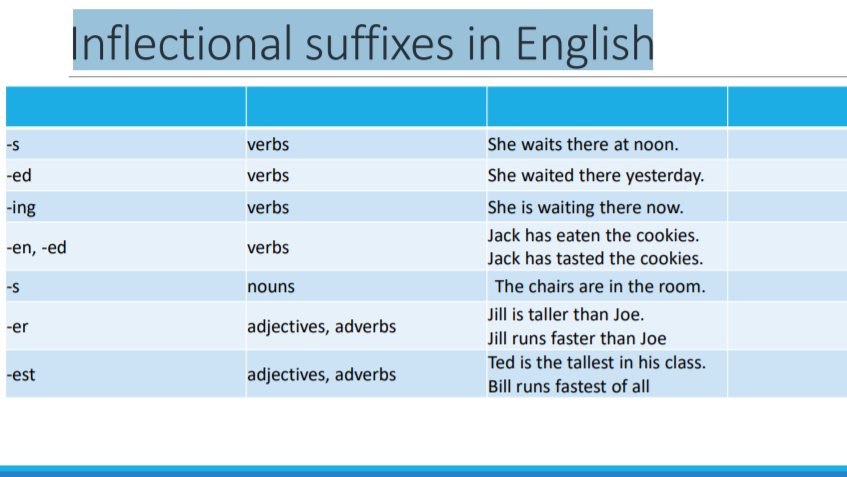
Inflectional suffixes
(see picture below)
Inflectional vs. Derivational morphology
(see picture below)
*n many languages, words can be inflected for some or all of the following: tense, mood, person, number, grammatical gender, aspect, comparison, case, evidentiality, etc.
Restrictions on derivational affixes
The repeated morph constraint (multiple application constraint - Lieber) prevents the same affix to be applied twice in succession. In this form, this constraint is too strong, because there are cases contradicting this restriction: re-re-write in English. Some examples:
Phonological constraints: The noun-producing suffixal –al (arrival, rebuttal) is added only to V which are stressed on the final syllable. Morphological constraints: The base may have to belong to a particular morphologically defined class before affixation can occur.
Syntactic Constraint: Most affixes can be added only to certain word classes (N, V, A).
Semantics Constraint: un- restricted to bases with positive meaning – therefore *unill, *unpessimistic (but unhappy, unoptimistic).
Allomorphs4
when a unit of meaning varies in sound without changing the meaning (often depending on its environment). In other words, allomorphs are variants of the same morpheme. For example:
. the pluralizer –s suffix, pronounced differently in dresses [/iz/], bites [/s/], dogs [/z/];
. the in– prefix, realized as [im] before a labial consonant (e.g. impossible), [ir] before /r/ (e.g. irregular), il– before /l/ (e.g. illegible) and [in] in all other cases (e.g. inflammable, incorrect);
Homomorphs
Homomorphs are morphemes with the same form but different meanings.(e.g. the comparative –er [pretti–er, smart–er] vs. the nominalizer –er [talk–er, dance–(e)r])
Morphological processes
Affixation
Alternations
Compounding
Reduplication
Suppletion
Clipping
Coinages
Initialisms / Acronyms
blends
Backformation
Morphological types of languages
From a morphological standpoint, languages may be classified according to the richness of verb and noun morphology.
1) Analytic Languages (isolating languages)
2) Synthetic languages
Agglutinating languages
Fusional languages
Polysynthetic languages
Analytic Languages (=isolating languages)
Analytic languages are so called because they are made up of sequences of free morphemes— each word consists of a single morpheme, used by itself with meaning and function intact. Purely analytic languages, also called isolating languages, do not use affixes to compose words.
Synthetic languages
In synthetic languages, bound morphemes are attached to other morphemes, so a word may be made up of several meaningful elements.
agglutinating- In agglutinating languages, like Hungarian, the morphemes are joined together relatively “loosely.” That is, it is usually easy to determine where the boundaries between morphemes are.
fusional- In fusional languages, one morpheme may express more than one grammatical feature.
Polysynthetic- Polysynthetic languages heavily rely on morphology. These languages may use one word to express that which English expresses through a sentence. In some synthetic languages, highly complex words may be formed by combining several stems and affixes; this is usually a matter of making nouns (subjects, objects, etc.) into parts of the verb forms.
*English - originally fusional, but now both analytic properties (future morpheme will, perfective morpheme have, etc. are separate words) and synthetic properties (plural (-s), are bound morphemes)
Concatenative morphology involves linear affixation; i.e., adding affixes to the beginning or the end of a root or stem.
nonconcatenative morphology (discontinuous , non-linear): Circumfixes and interweaving Morphemes are morphemes that occur in two parts, one on each side of a stem. There are different types of nonconcatenative morphology: Reduplication, alternations (ablaut), Suppletion, Root-and-pattern morphology
Questions- Morphology
Página 3
Phonetics
• Phonetics: the study of the minimal units that make up a language, called phonemes. It is divided into three sub-fields:
Acoustic phonetics: focuses on the physical properties of sounds;
Articulatory phonetics: the study of how the vocal tract produces the sounds of language.deals with how speech sounds are produced;
Auditory phonetics: concerned with how listeners perceive sounds. how we hear sounds
We will mostly deal with articulatory phonetics in this course.
Speech Sounds To describe speech sounds, it is necessary to know what an individual sound is, and how each sound differs from all others. This is not as easy as it may seem, for when we speak, the sounds seem to run together and it isn’t at all obvious where one sound ends and the next begins. However, when we know the language we hear the individual sounds in our “mind’s ear” and are able to make sense of them, unlike the sign painter in the cartoon. bus vs. the sound of coughing
Phoneme A phone is any distinct speech sound. A phoneme is a speech sound in a given language.
Speech production
Regressive sounds: the air stream is created by pushing air out through the mouth or nose. (most sounds in human languages are egressive).
Ingressive sounds: the airstream flows inwards through the mouth or nose. (English: Huh! –surprise, “sss” " (an inward hiss) to express empathy when another is hurt.)
Identity of speech sounds
No two speakers ever say the same word identically. (The speech signal produced when one speaker says cat is not the same as that of another speaker’s cat.) Even two utterances of cat by the same speaker will differ to some degree. Our knowledge of a language determines when we judge physically different sounds to be the same. Our linguistic knowledge makes it possible to ignore nonlinguistic differences in speech. Furthermore, we are capable of making sounds that we know are not speech sounds in our language.
Speech Sounds
Consonants are distinguished from vowels in that consonants are produced with a constriction somewhere in the vocal tract that impedes airflow
Vowels have at most only a slight narrowing and allow air to flow freely through the oral cavity.
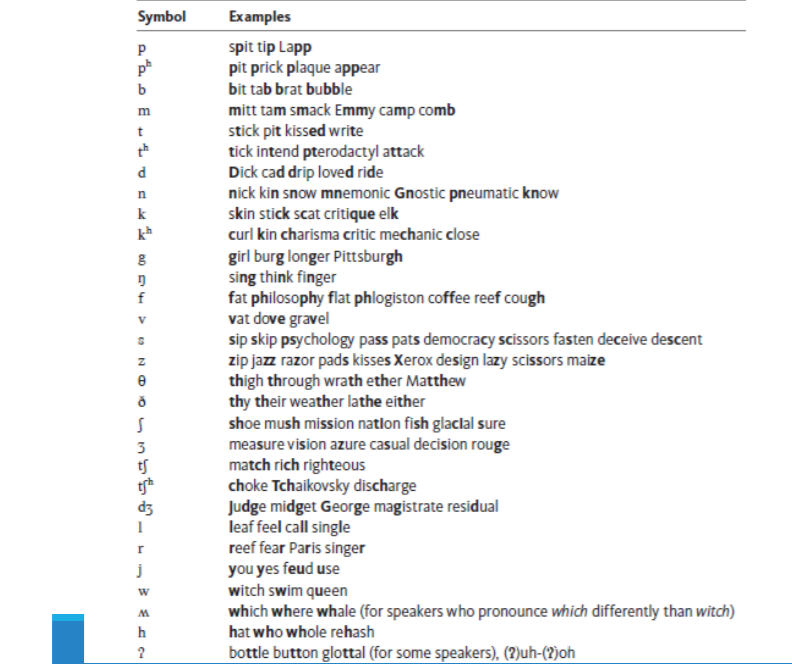
Consonant
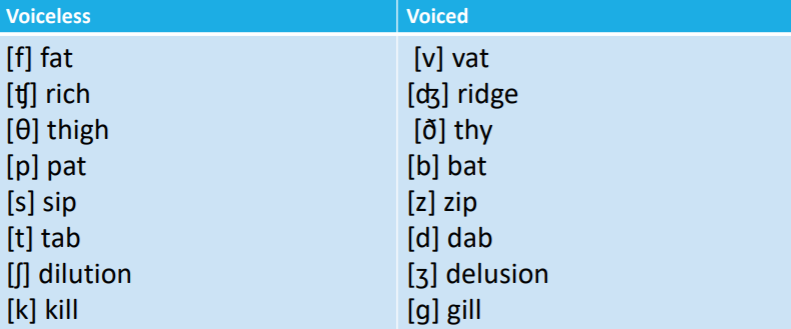
• Voicing (whether the vocal cords are vibrating or not)
• Place of articulation (where the airstream is most obstructed)
• Manner of articulation (the particular way the airstream is obstructed)
Voicing: Sounds made with the vocal folds vibrating are called voiced sounds, and sounds made without such vibration are called voiceless sounds. Sounds are voiceless when the vocal cords are apart so that air flows freely through the glottis into the oral cavity.
Place of articulation:
Bilabials articulate by bringing both lips together.
Labiodentals We are articulated these sounds by touching the bottom lip to the upper teeth.
Interdentals are pronounced them by inserting the tip of the tongue between the teeth.
Alveolars are pronounced with the tongue raised in various ways to the alveolar ridge.
Palatals the constriction occurs by raising the front part of the tongue to the palate.
Velars are produced by raising the back of the tongue to the soft palate or velum.
Uvulars are produced by raising the back of the tongue to the uvula, the fleshy protuberance that hangs down in the back of our throats
Glottals are formed from the flow of air through the open glottis, and past the tongue and lips as they prepare to pronounce a vowel sound, which always follows [uh-oh)
Manner of Articulation
Stops are made by obstructing the airstream completely in the oral cavity.
Fricatives are made by forming a nearly complete obstruction of the vocal tract. The opening through which the air escapes is very small, and as a result a turbulent noise is produced.
Affricates are complex sounds, made by briefly stopping the airstream completely and then releasing the articulators slightly so that frication noise is produced.
Flaps (sometimes called taps) are similar to stops in that it involves the complete obstruction of the oral cavity. The closure, however, is much faster than that of a stop: the articulators strike each other very quickly.
Nasals are produced by relaxing the velum and lowering it, thus opening the nasal passage to the vocal tract.
Approximants, like all consonants, involve constriction of the vocal tract, but the constrictions are not narrow enough to block the vocal tract or cause turbulence:
Liquids are formed with slightly more constriction than glides, and their quality changes ◦
Glides are made with only a slight closure of the articulators (so they are fairly close to vowel sounds), and they require some movement (or “gliding”) of the articulators during production.
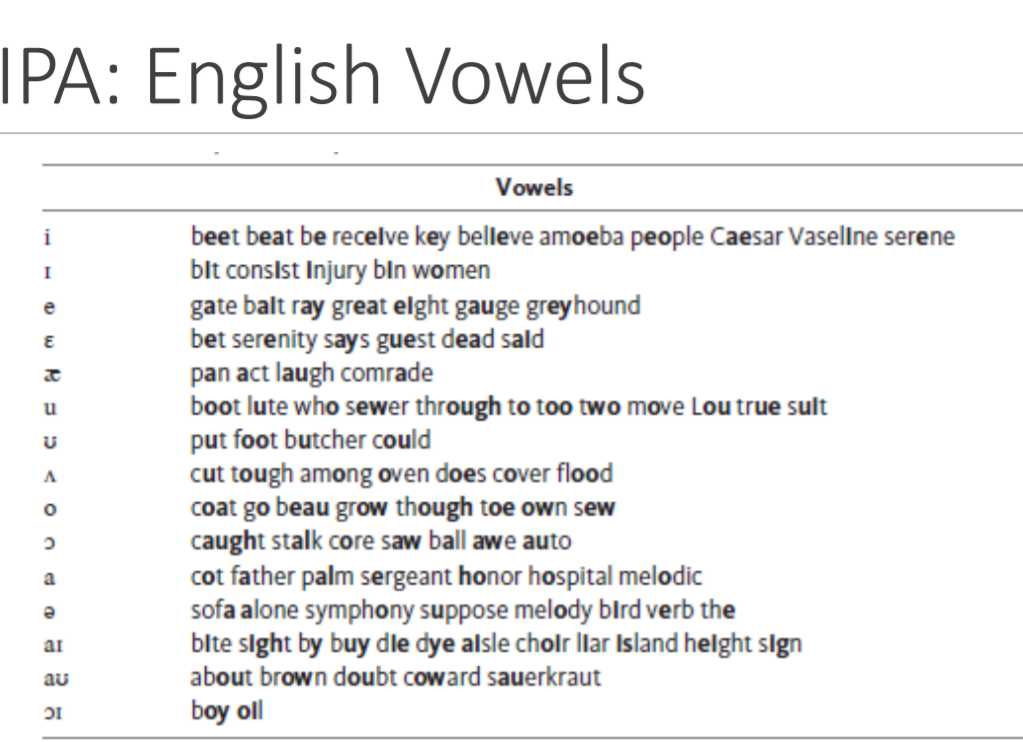
Vowels
Vowels in turn are often divided into two categories: monophthongs and diphthongs.
Monophthongs = simple vowels, composed of a single configuration of the vocal tract,
Diphthongs = complex vowels, composed of a sequence of two different configurations.
There are four main ways in which speakers can change the shape of the vocal tract and thus change vowel quality:
raising or lowering the body of the tongue
avancing or retracting the body of the tongue
rounding or not rounding the lips
making these movements with tense or lax gestures
segments and suprasegmentals.
Onset,...
Suprasegmental FEatures
Página 4
Phonology
The study of how speech sounds form patterns is phonology. The word phonology refers both to the linguistic knowledge that speakers have about the sound patterns of their language and to the description of that knowledge that linguists try to produce.
Phonology vs. phonetics
– Phonetics is concerned with the study of speech sounds and their production, classification, and transcription
– Phonology is concerned with the distribution and patterns of speech sounds in a particular language, or in languages in general
Phone: A phonetic realization of a phoneme. Phoneme: The smallest unit of speech distinguishing one word (or word element) from another.
Phonology tells you what combinations of sounds could be an actual word, and what combination of sounds could not be an actual word.
How do we identify phonemes?
•Phonemes are the linguistically contrastive or significant sounds of a language
•Such a contrast is usually demonstrated by the existence of minimal pairs
•Minimal pair = a pair of words which are distinguished by a difference in only one sound
Rules of phonology
Assimilation- Rules of assimilation cause a sound (or gesture) to become more like a neighboring sound (or gesture) with respect to some phonetic property
Insertion- Insertion. Phonological rules of insertion cause a segment not present at the phonemic level to be added to the phonetic form of a word.
Metathesis- Metathesis is a transposition of sounds
Deletion- Deletion rules eliminate a sound that was present at the phonemic level. Such rules apply more frequently to unstressed syllables and in casual speech.
Aspiration- is a process in which a consonant becomes aspirated. there is a phonological rule of English that says that a voiceless stop such as /t/ is aspirated when it occurs at the beginning of a word (e.g., in top), but when it occurs after a voiceless alveolar fricative (i.e., after /S/), it is unaspirated (e.g., in stop).
Phonology: Deep and Surface
Underlying Representations: phonological knowledge rules: allophonic processes (assimilation/ vowel harmony/insertion(=epenthesis) / deletion / metathesis /aspiration)
Surface Representations: phonetic implementation
Página 5
Semantics
Semantics is a subfield of linguistics that studies linguistic meaning and how expressions convey meanings. Semanticists study not only word meanings, but also how word meanings combine to produce the meanings of larger phrasal expressions.
Lexical semantics: Lexical semantics deals with the meanings of words and other lexical expressions, including the meaning relationships among them.
Compositional semantics- Compositional semantics is concerned with phrasal meanings and how phrasal meanings are assembled.
Two Aspects of Linguistic Meanings:
Reference- The particular entities in the world to which some expression refers are called its referents.
Sense- You can think of the sense of an expression as some kind of mental representation of its meaning, or perhaps some kind of concept.
Meaning Relationships There are many ways for two words to be related.
phonologically related (e.g., night/knight, which share the same pronunciation),
morphologically related (e.g., lift/lifted, which both share the same root),
syntactically related (e.g., write/paint, which are both transitive verbs);
semantically (the word pot is intuitively more closely related semantically to the word pan than it is to the word floor.).
Homonymy
Two or more words are homonyms if they either sound the same (homophones), have the same spelling (homographs), or both, but do not have related meanings.
Polysemy
A word is polysemous if it can be used to express different meanings. The difference between the meanings can be obvious or subtle
Semantic relationship
hyponymy - are “lower names.” (The prefix hypo– means “under” or “below.”) A hyponym is a specific instance of its hypernym.
hypernyms- are what you can think of as “higher names.” (The prefix hyper– means “over” or “high” while the suffix -nym means “name.”) A hypernym is more general than its hyponyms.
synonymy A meaning relationship between words where their reference is exactly the same or nearly the same meaning:
Antonymy- Words that are opposite in meaning are antonyms. There are several kinds of antonymy.
There are complementary pairs: ◦ alive/dead present/absent awake/asleep ◦ They are complementary in that alive = not dead and dead = not alive, and so on.
There are gradable pairs of antonyms: ◦ big/small hot/cold fast/slow happy/sad
Reverse (Reverses are pairs of words that suggest some kind of movement, where one word in the pair suggests movement that “undoes” the movement suggested by the other.) ◦ To put together / to take
Converses (Converses have to do with two opposing points of view or a change in perspective: for one member of the pair to have reference, the other must as well) ◦ Borrow / lend; send / receive
Página 6
Pragmatics
Pragmatics is concerned with our understanding of language in context.
Linguistic context has to do with what preceded a particular utterance in a discourse.
Situational context gives information about the situation in which it is uttered. Situational context allows us to refer to things in the world around us even if they have not been mentioned before in the discourse.
Social context includes information about the relationships between the people who are speaking and what their roles are.
**In syntax, we discuss grammatical vs. ungrammatical. In pragmatics, we refer to utterances as being felicitous or infelicitous.
Anaphora Pronouns
are lexical items that can get their meaning from other NPs in the sentence or in the larger discourse. Anaphora = A feature of grammatical structure referring back in the text / discourse. Any NP that an anaphora (a pronoun) depends on for its meaning is called its antecedent. Pronouns are sensitive to syntax, discourse, and situational context for their interpretation.
Pronouns and Syntax
There are different types of pronouns. Reflexive pronouns are pronouns such as himself and themselves. In English, reflexive pronouns always depend on an NP antecedent for their meaning and the antecedent must be in the same clause, as illustrated in the following examples:
1. Jane bit herself.
2. *Jane said that the boy bit herself.
3. *Herself left.
Gricean Maxims
Grice divided his maxims into four categories, each of which focuses on a different aspect of the way that utterances are used in cooperative discourse. These categories are quality, relevance, quantity, and manner. Each category contains between one and four maxims. Note that while these are written as “rules” for the speaker to follow, they are broader than that: the speaker follows these in being cooperative, but it is just as important for discourse that the hearer assumes that the speaker is following them.
The maxims of quality
The maxims of quality address our expectations of honesty in conversation. There are two maxims of quality.
Do not say what you believe to be false.
Do not say that for which you lack adequate evidence.
The maxims of quality
The maxims of quality address our expectations of honesty in conversation. There are two maxims of quality.
Do not say what you believe to be false.
Do not say that for which you lack adequate evidence.
The maxims of quantity
The maxims of quantity concern how much information it is appropriate for a speaker to give in a discourse. Of course, there are some situations in which more information is needed and others in which less is needed. Notice how the two maxims of quantity are phrased in order to make allowances for these differences.
Make your contribution as informative as is required.
Do not make your contribution more informative than is required
The maxims of manner
The maxims of manner, on the other hand, have nothing to do with the information itself; rather, these maxims have to do with expectations about how one goes about giving and interpreting that information in being a cooperative conversational partner.
Avoid obscurity of expression. (That is, don’t use words or phrases that are hard to understand.)
Avoid ambiguity.
Be brief.
Be orderly.
Entailment
One kind of reasoning commonly used to draw conclusions is based on the concept of entailment. Any two sentences X and Y, sentence X entails sentence Y if whenever X is true, Y must be true as well. The X sentence entails the Y sentence. X: Ian eats a large breakfast every day. Y: Ian eats a large breakfast on Mondays.
Presupposition
Presuppositions are situations that must be true for utterances to be appropriate, so that Take some more tea has the presupposition “already had some tea.”
Informações
- Descrição
- English Notas sobre Intro to lingu , criado por ena ena em 20-01-2019.
- Criado por
- ena ena · jan 2019
- Atualizado
- 22 jan 2019
- Visualizações
- 0
- Avaliação