
11. Memory and Vaccination
Slides do conjunto (26)
-
- The importance of memory immune responses
- The principle features of memory T cells (e.g. effector versus central)
- The principle features of memory B cells (e.g. the need for T helper cells, affinity maturation)
- The definition of vaccines and immunisation (vaccination)
- The definition and role of passive and active immunisation
- Important considerations in developing a vaccine
- Types of vaccination strategies (with named pathogens/diseases): Live (attenuated), killed, conjugate, subunit
- Approaches undertaken to enhance immunogenicity of vaccines: Adjuvants, Carrier systems e.g. viral vectors and dendritic cells
-
- Primary
- Initial response to infection
- Eradication of pathogen first time
- Contraction of T and B cells following clearance of pathogen
- Appearance of memory cells
- Secondary
- Response to reinfection of same pathogen
- Memory cells: faster, more powerful, more specific than primary response, lasts for longer periods
- Memory B cell more specific for antigen that BCR recognises due to SHM that occured during primary response
-
- Long-lived, small resting cells
- Do not need presence of pathogen to maintain themselves
- Numbers are consistent throughout lives- balance between proliferation and death, stem cell-like, constantly proliferating to replenish
- Overexpress survival genes eg Bcl-2
- Require IL-7 for survival, memory CD8 T cell also requires IL-15
- Higher levels of integrins LFA-1 and CD2 on surface than naive T cells- high level of adhesion molecules, can migrate quicker
- Cytokine or cytolytic response is faster and more powerful than initial response- less damage to body
-
- Memory CD4 and CD8 T cells are divided into subtypes on basis of chemokine receptor CCR7
- Effector memory T cells: Specialised for rapidly entering inflamed tissue
- CCR7 negative- so that remain in tissue and dont go off into LN (not responsive to CCL21 and CCL19)
- Rapidly matures into effector cell
- Secretes large quantities of cytokines early after stimulation at site of infection
- Express receptors for pro-inflammatory chemokines and integrins
- Found at site where pathogen originally entered
- Central memory T cells: Specialised for migrating through lymphoid tissue
- CCR7 positive- circulate through LN in search for pathogen entering at different place
- Take longer to be reactivated than effector memory T cells
- Do not secrete large amounts of cytokines
- Upon restimulation differentiate into effector memory cells
-
- Secondary Ab response is dominated by class-switched B cells
- Initial exposure to antigen- make vast IgM= weak affinity for antigen
- Secondary exposure- class switched to IgG= higher affinity for antigen

-
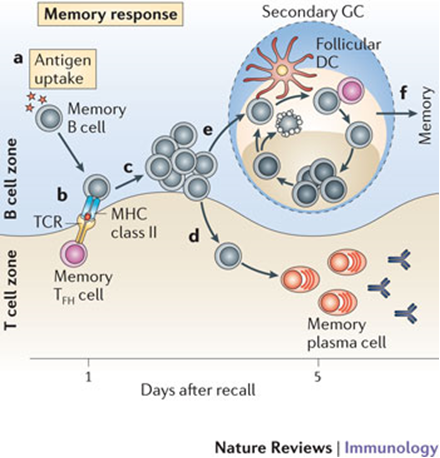
Memory B Cell Response Requires Th Cells
- BCR binds antigen + moves to LN/ spleen
- Higher levels of MHC-II:peptide complexes and co-stimulatory molecules on memory B cell - rapid binding of Th cell
- CD4 Th cell gives appropriate cytokine and costimulatory signals to induce memory cell proliferation
- Memory B cell moves to GC and undergoes SHM to increase affinity for antigen (has to undergo negative selection again to ensure not autoreactive due to mutations)
- Memory cell leaves LN/spleen and exists as long-lived plasma cell in BM, or recirculates
-
- Transmission (usually injection) of small amount of dangerous pathogen to induce a robust immune response upon secondary encounter with the same pathogen
- Used in 18th century for control against smallpox
- Risks: viral load, aggressive infection leading to death
-
- Smallpox:
- Two types: variola major (30-35% morality), variola minor (1% morality)
- 12 day incubation before symptoms
- Infects mucosa and draining LN
- First wave causes cell lysis, enters blood stream
- Second wave in spleen/LN- causes spleen rupture, attacks skin, bleed to death
- Cowpox:
- Commonly transmitted to milkmaids-> never developed small pox
- Jenner hypothesised: pus of cowpox blisters contains protective immunity to smallpox
- Scraped pus of cowpus blister and inoculated into young boy-> never developed smallpox
-
- Definition of vaccine: Biologically prepared weakened version of a disease causing micro-organism that induces a robust immune response to the aggressive form of the micro-organism upon secondary encounter
- Vaccination can manipulate the immune system:
- To protect against disease causing pathogens
- To protect against or treat cancer
- To desensitize immune system to allergens
- To desensitize autoaggressive immune cells or elicit Treg cell responses to control autoimmunity
- Principles of vaccination is herd immunity:
- 80% need to be immune- if successful even unvaccinated could be protected from infection
- Reduces transmission
- All pathogens need host- remove host= kill of pathogen reservoir
-
Vaccination- Who do we vaccinate?
- Age determines vaccination program as our immune responses are distinctly different from childhood through to elderly:
- Babies:
- Prone to infection
- Dont have full immune system (takes time to build T and B cell reservoirs)
- Skin is thin- less effective barrier
- Poor blood brain barriwer
- Protected in uterus but once outside, exposed to wide range of pathogens
- Aging (elderly):
- Thymus shrinks- makes fewer T cells, T cell repertoire shrinks
- If infected with NEW pathogen, at risk of not making TCR specific for pathogen
- B cell needs CD4 T cell help- B cell response wiped out too
- Most recirculating T and B cells are memory cells to previous pathogens
-
Features of an Effective Vaccine

- Inducing neutralising Ab's to block pathogen from entering cells- decreases infectivity and damage to tissues
- Practical considerations: cost, stability eg storage temp (if needs to be kept at cold temp not good for africa- no fridges)
- Need balance of safety and efficacy (safety>efficacy)
-
- Active: Induce protective immunity
- Someone who isn't infected and either naturally infected or give vaccine to induce immune response
- Ab's generated in response to immune cells activated by antigen
- Passive= Give protective immunity
- When someone has memory response to a pathogen
- Isolate their Ab's and transfer from one individual to another
-
- Natural:
- Naturally infected with pathogen and make immune response
- Artificial:
- Given vaccination to fool immune system into thinking infected with pathogen and make immune response
- Aims to achieve immunological memory
- Better response than serum Ab vaccine
-
- Natural:
- Via placenta
- Foetus recieves maternal IgG (binds to placenta and taken up by endocytosis)
- IgG's against toxins, viruses and bacteria
- Lasts ~3 month
- Via colostrum (breast milk)
- Have Lysozymes, interferons, leukocytes
- High conc IgA (result from stimulation of B cells in mothers intestine and migration to breast)
- Ab's to intestinal microbes high in colostrum
-
- Artificial:
- Heterologous (horse to man)
- IgG response to toxin low in humans but high in horses
- Took horse anti-tetanus serum containing Ab's to toxin and injected soldiers
- Horse serum provided brief protection but more powerful than humans- eventually caused serum sickness (seen as foreign)
- Homologous (man to man)
- Take plasma serum from people with protective immunity and inject newly infected people
- Ab's can be polyclonal (multiple isotypes, multiple antigenic targets, recognise lots of epitopes) or monoclonal (single isotype, single antigenic targte, one epitope
- Monoclonal- isolate B cells and clone them so they secrete large amounts of same Ab that can be used in a vaccine
-
Louis Pasteur: Attenuated Vaccine

- Student left chicken cholera on bench-> aged cholera
- Gave aged cholera to healthy chicken then infected with fresh cholera-> lived
- Infected normal healthy chicken with fresh cholera-> died
- Artificially induced damage (mutations) to natural pathogen, weakens virulence and induces immunity
- To make an effective vaccine: Isolate pathogen, inactivate pathogen and inject
-
- Features:
- One dose to achieve substantial immune response
- Similar to natural infection
- Good for cell-mediated response
- Antigen processed and presented to CD4 and CD8 T cells
- Also leads to Ab production
-
- How to attenuate pathogen:
- Attenuated= altered pathogen does not cause disease but grows in host transiently
- Grow in abnormal conditions (eg BCG)
- Culture in inappropriate host cell to induce mutations (eg Sabin polio virus)
- Eg. Isolate pathogen from patient, pathogen has been grown in human cultured cells, infect monkey cells, virus acquires mutations to survive in monkey cell, put back in human and can no longer grow in human cells but triggers immune response
- Problems:
- Can mutate back to WT pathogen in vaccinated host
- Not able to give to immunocompromised people- wont make good immune response and if stays in body too long may mutate back to virulent form
-
- Genetically engineered attenuated virus
- Isolate pathogenic virus and Identify parts of virus genes that are receptor binding, virulence genes and core proteins
- In vitro mutate virulence genes or remove completely
- Generate mutants incapable of reversion to WT
- Toxoids separate virulence from cell binding properties
-
- Features:
- Several boosters needed to achieve substantial immune response- build immunity over time
- Good for Ab production (not good for T cell response)
- Inactivation of virus must preserve structure of immunogenic epitope:
- Heat- generally destroys structure
- Chemical- formaldehyde or alkylating compound (eg Salik polio vaccine), chemically crosslinking molecules together
-
Reductionist Approach to Vaccination
- Genetically synthesise key components of pathogen to induce a protective immune response
- Advantages:
- Elicits immune response only to desired antigen
- Less side effects
- Industrial production
- Disadvantages:
- Requires details of knowledge of pathogen (life cycle, major virulent determinants, route of infection)
- Most pathogen subunits too small to induce immune response alone, require adjuvants or insert into viral vectors
-
Reductionist Approach to Vaccination
- Conjugate Vaccines:
- Molecules outside of pathogens are good targets for immune response- can prevent entering into cell
- Polysaccharides (T cell independent) are poor at eliciting correct type of B cell response (T-cell dependent) and often induce IgM Ab- weak affinity
- Solution: Take bacterial polysaccharide epitope and chemically link to epitope of another pathogen that is T cell dependent (eg antigen tetanus toxoid protein)
- BCR recognises polysaccharide- conjugate gets internalised, processed, both epitopes presented
- Toxoid protein induces the T helper cells to secrete cytokines
- Cytokines act on the polysaccharide specific B cells to class switch to appropriate class good for dealing with bacterial pathogen
-
Reductionist Approach to Vaccination
- Adjuvants:
- Important component of killed/dead vaccines
- Materials used to boost adaptive immune response (some can act as complex that absorbs and stabilised vaccine for long period of time so it acts like multiple booster vaccines)
- Act on innate immune response
- Main types of action:
- Act as depot enhancing the time for APCs to find them
- Stimulate innate immune cells (via TLRs) to make cells think theyve seen pathogen- increase in cytokines eg virulent bacterial epitopes
- Transport antigen (vaccine) to LN to be presented to T and B cells
-
Reductionist Approach to Vaccination
- Viral Vectors:
- Carry pathogenic molecules into immune system (eg membrane proteins of influenza) and clone into virus vector
- Viral vector itself relatively harmless, self-limiting virus that replicates a little and dies off
- Upon injection into body, puts high levels of viral membrane proteins on its surface- primes immune system to be responsive to virus
-
Reductionist Approach to Vaccination
- DC based Vaccines
- Tumours have slightly different RNA to normal human cells
- Take tumour RNA and introduce into DCs, activate DCs to process and present tumour peptides
- Give DC to patient, it will present tumour antigen to T cell and primes immune system (memory) so it will seek out tumour and destroy it
-
Selections of Vaccines for Each Subtype

Informações
- Descrição
- L20 Immunology
- Criado por
- Chloe Cavarretta · mai 2019
- Atualizado
- 9 mai 2019
- Visualizações
- 9
- Avaliação