
Notas
Rocks - GCSE Chemistry
Conteúdo das notas (1)
Página 1
ROCKS
The rock cycle and how it works
The rock cycle
is the name given to the process where rocks are formed,
changed, broken and melted as shown in the picture on the left.
It is the movement of
tectonic plates that makes the rock cycle happen. Hot magma can
cool to form igneous rocks. Fast cooling on the
surface makes basalt and slow cooling inside the crust makes
granite. When tectonic plates collide the enormous forces
can produce metamorphic rocks and rocks inside the
Earth's crust can become pushed up onto the
surface by a process called uplift.
Surface rocks are
exposed to weathering and erosion which makes sediments.
Burial of sediments produces sedimentary rock
inside the Earth's crust. Any rock in the crust can be pushed to the
surface by uplift or dragged down towards the mantle
where it can melt and form new magma.
Igneous Rocks
Sedimentary Rocks
Metamorphic Rocks
Igneous Rocks are rocks formed from the
cooling of hot magma. Igneous rocks first
formed when the Earth cooled from its molten state about
4 billion years ago. Igneous rock is still being made today
by the process of tectonic activity.
How can they be identified?
Igneous rocks contain
randomly arranged interlocking crystals. The crystal size depends
on the rate of cooling. When hot magma is
cooled quickly it makes basalt and when it is cooled
slowly it makes granite. Igneous rocks do not
contain fossils because the rock forms at a high temperature
which would destroy any living organisms.

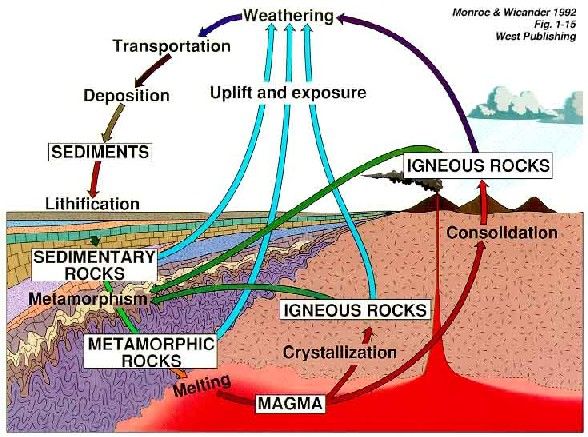
Rocks formed from
sediments are called sedimentary rocks.
Sediments are small
pieces of material that do not dissolve in water. They slowly fall down to the
bottom of a lake or the sea, and gather together over the years forming a large
mass of material.
Imagine stirring very
fine sand into a glass of water. Slowly the sand particles settle on the bottom
of the glass. They are called "sediments" .
Materials which do
dissolve (salts), stay in the water. This is what has made the sea salty over
many millions of years.
Sediments have come
from the weathering and erosion of surface rocks. The
original surface rocks were igneous rocks formed from the
cooling of molten magma. Surface rocks today
are igneous, sedimentary or metamorphic.
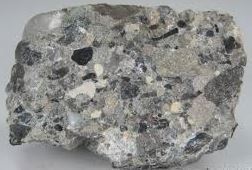
Weathering and Erosion
Weathering breaks a
rock down into small pieces. The two main processes
are exfoliation and freeze-thaw weathering. Freeze-thaw weathering
occurs when water gets into cracks in rock and then freezes
(below 0 °C) in cold weather. Water expands when it
freezes and turns to ice, and the expansion can
cause the rock to split and fragment.
In warmer weather
(above 0 °C) the ice melts (called thawing), and new cracks are
exposed allowing the process to repeat itself.
Erosion is a slow
process of wearing away weathered rock by the action of the
wind, rivers and waves. All rocks would have
been worn down flat to sea level long ago if hills and mountains
were not constantly being formed by the movement
of plate tectonics. See the rock cycle.
Transport and compaction
Small pieces of
weathered rock (called sediments) are transported by rivers.
This means that the rock pieces are moved along as the
river flows towards the sea.
During transportation,
the sediments are sorted according to size. The largest pieces
tend to be deposited first. Sand is next to settle out of the
water. The smallest particles are mud or clay, and these are moved
furthest by the river and deposited last.
Compaction - With the passing of
time, the deposits of sediment get thicker and thicker.
The sediment underneath becomes increasingly crushed
by the weight of the new sediment which is being deposited on
it from above. This is called compaction. It is this process of
compaction which eventually makes
layers of sedimentary rock.
The process may take
millions of years. The largest rock
pieces will produce conglomerate. Sand will produce
sandstone. Mud or clay will produce mudstone or shale
https://www.youtube.com/watch?v=Yf4YtDlA1oQ (Incorporar)
The formation of sedimentary rocks
Compaction eventually
forces the water out of the sediment. Salts in the water
crystallise under pressure and cement the
sediment particles together (like glue).
This is how
sedimentary rock is made.
How can Sedimentary
Rocks be Identified?
Sedimentary rock is
often formed in layers, because the original
sediment is laid down in layers. This gives the rock a
typical layered structure, which can be seen in
mudstone, and more clearly in shale.
Examples of
Sedimentary Rocks are conglomerate, sandstone, mudstone, shale
Sedimentary Rock Formation & Fossils
What is a Metamorphic
Rock?
A metamorphic rock is
a rock which has had its form changed by the action of high
temperatures and pressures (without melting).
The crystal structure
of the rock is changed in the process. Metamorphism can be
low or high grade.
Rocks can become
subject to high temperatures because they come into
contact with an igneous intrusion.
This is called contact
metamorphism or rocks become subject
to high temperatures and pressures because of tectonic
activity in the Earth's crust. This is called regional metamorphism
and it occurs where plates collide.
Examples of
metamorphic rock are Marble Slate, Schist and Gneiss.
Test your knowledge
Quizzes
Flashcards
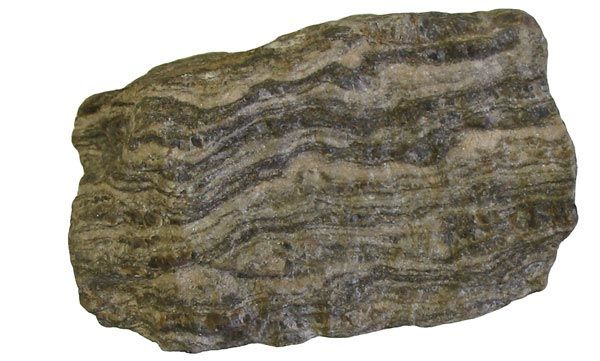
Products and Uses of Rocks
All raw materials come
from the Earth's crust, the oceans and the atmosphere.
Metals and oil have
already been discussed. Some rocks are used in
construction for building.
These include Granite, Limestone, Marble, Slate. Granite and limestone
are used in road construction.
Limestone has a number
of other important uses.
Limestone is used to
make Lime -
Quicklime - Slaked Lime - Cement -
Concrete - Glass
Powdered limestone can
be used in power station chimneys to remove acidic gases or powdered limestone can
be added to soils or lakes to reduce acidity.
Lakes and soils can become acidic because of acid rain.
Powdered limestone is cheaper than slaked
lime but acts more slowly.
Informações
- Descrição
- Notas sobre Rocks - GCSE Chemistry, criado por miminoma em 14-01-2015.
- Criado por
- miminoma · jan 2015
- Atualizado
- 7 fev 2018
- Visualizações
- 88
- Tags
- Avaliação