
Notas
surge control
Conteúdo das notas (1)
Página 1
Surge Control
surge control: to protect the pipeline system by reducing the magnitude of surges to the allowable strength limits of pipe, valves, and pumping
Two methods for managing surge:
direct control of the surge
extra protection of the pipeline or equipment
The Largest surges are generated during the following operations:
start-up and shut down operations
valve operation and now control
injection and delivery condition changes
Levels of control strategies:
training the pipeine system operation and maintenance staff in operating and maintaining their pipeline system as per ASME standards
installing basic control devices such as valves
reinforcing pipelines and implementing a special surge relief device in areas that are expected to suffer from surges
List of undesirable operational problems:
Valve failure
Power failure
Accidents
Equipment failure
Human error
An automated surge control system needs to be implemented to operate the system safely and economically
Design considerations for controlling surges and reducing potential risks:
installing thicker pipes at locations where severe surges are expected
installing block and check valves along the pipeline and at each pump station
installing automated control system such as a PID controller at each pump station.
avoid high flow rate --> potential surge is proportional to the flow velocity
longer station spacing
multiple pumping units to minimize the chance for a complete station failure
installing variable speed pumps that can reduce surge by ramping pump speed.
instaling special control devices such as surge relief tanks
avoiding sharp bends and sudden changes in slope
Control Devices valve movements can create a surge, the magnitude of which depends on the type of valve and the valve movement in terms of the position and timing in addition to the liquid compressibility and the elastic properties of the pipe.
in general it is safer to close valves slowly in 2l/a
check valves: non-return, allow fluid to flow in the normal flowing direction only and therefore they stop any reverse in flow.
Pump Unit and Pump Station Operations
pump start-up/shut down: remove or add energy from or to the pipeline.
In START UP
The liquid forces open the check valve downstream of the pump and the liquid in the line begins to move
the flowing liquid develops an upsurge in the downstream section of the pipeline and the upstream side. this depends on the starting speed of the pump
density and bulk modulus of the liquid
Surge control in start up:
control valve to open slowly in fixed speed pumps after the motor starts in order to reduce transients by interlocking the pump with control valve
variable-speed pumps ramp up the pump speed so slowly that large surges can be avoided
if multiple pumps need to be brought online start them one at a time at an interval of two times the critical period
Install PID controller to balance the flow movements and pressure behaviors at the pump station it controls control valves. and is used as feedback system.
IN SHUT DOWNS:
Surges take place due to an increase in suction pressure and a decrease in discharge pressure.
surge control in shut down:
turning pumps off one at a time at intervals at least two times the critical period
fixed speed pumps, close control valve slowly at least two times the critical period before the driver is stopped
if variable speed ramp down the pump speed so that the surge pressure can be minimized
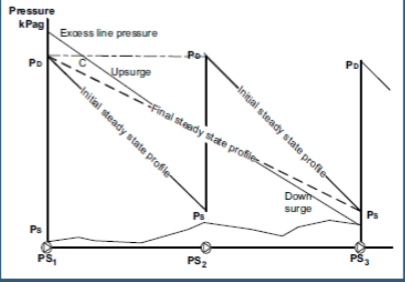
Power failure or non-scheduled events at a pumping station can cause pump tripping which happens instantaneously and cannot be avoided.
pump tripping: results in an initial rapid down-surge on the discharge side and pipe section close to the pump station.
one pump tripping might lead to other pumps tripping which can cause complete shut down
transient flow can occur upon power failure where elevation profile rises steeply downstream of the pump station
factors considered in the design phase:
thicker pipes at the locations where the severe surges are expected
avoid high flow rate
install multiple variable pumping units
install special control devices such as surge relief tanks to relieve surge pressures
avoid sudden changes in slope where vapor pockets maybe formed
Special Surge Relief Devices pressure relief valves: designed to reduce large upsurges mainly in the pipeline but not to control the down surge that may occur on pump shut-down or power failure
surge tanks:
rupture discs can be used: they are non technical pressure surge control devices consist of a bursting membrane designed to rupture at pre-set pressure.
a tank is attached to rupture disks to accept relief flow.
they must be replaced after being ruptured.
STEPS FOR SUGGESTED TO DESIGN A SURGE CONTROL SCHEME (LECTURE 4B, SLIDE 13)
EXAMPLE OF PIPELINE
Informações
- Descrição
- Normal-level (N-level) Transmission and Storage Notas sobre surge control , criado por Yasmina Moussa em 28-10-2015.
- Criado por
- Yasmina Moussa · out 2015
- Atualizado
- 7 mar 2018
- Visualizações
- 79
- Tags
- Avaliação