
Notas
Chapter 10 Lesson 1
Conteúdo das notas (2)
Página 1
Transport system in plants and humans
Diffusion
Definition of diffusion: It is the net movement of particles from a region where they are of a higher concentration of particles to a region where they are of lower concentration with particles.
The concentration gradient is the difference in concentration between 2 regions.
Relationship between the rate of diffusion and the concentration gradient:
The movement of fluid particles is random.
Particles will diffuse down their concentration gradient.
The steeper the concentration gradient, the faster the rate of diffusion.
Other factors affecting the rate of diffusion:
1. Surface area of the exchange membrane
The larger the surface area of the exchange membrane the faster particles diffuse.
2. Thickness of exchange membrane
The thinner the exchange membrane, the easier it will be for particles to go through it, hence increasing the rate of diffusion.
3. Temperature
increasing the temperature will give particles more kinetic energy, making them move faster, thus increasing the rate of diffusion. Hence, the higher the temperature, the faster the rate of diffusion.
4, Size of particles
Smaller particles can pass through the partially permeable cell membrane easier.
Types of diffusion
Diffusion of a dissolved substance
Example: A copper sulfate crystal is dropped into a jar containing water. After some time, the blue colour gradually spreads throughout the water.
Explanation: This is caused by the copper sulfate crystals diffusing evenly throughout the water.
Diffusion across a membrane
Example 1: Both the solvent and solute are able to pass through a permeable membrane.
Example 2: In amoeba, the cell surface membranes allows some substances to pass through, but not others. Oxygen, carbon dioxide and other small molecules like glucose can pass through the cell surface, but other larger
Explanation 1
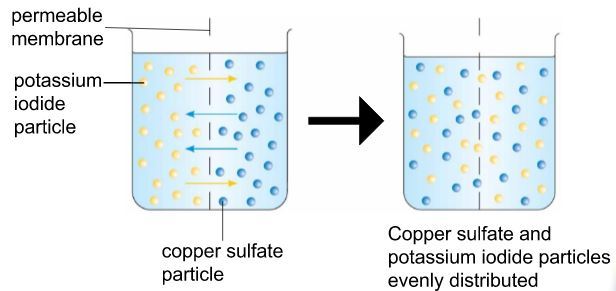
Explanation 2
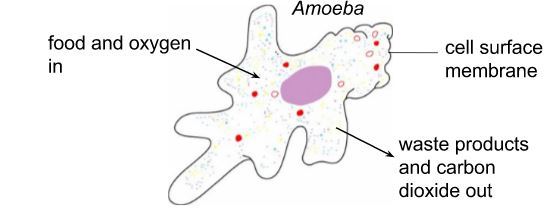
Diffusion in plants
Examples of diffusion in plants:
- During photosynthesis, carbon dioxide diffuses into the leaf from the surroundings when the concentration of carbon dioxide in the inter cellular air spaces is lower than that on the outside of the leaf during photosynthesis.
- During photosynthesis, oxygen is diffused out into the surroundings when the concentration of oxygen in the inter cellular air spaces in the leaf than that of the outside of the leaf.
- Mineral salts are transported through diffusion from one cell to another
Diffusion in humans
Examples of diffusion in humans
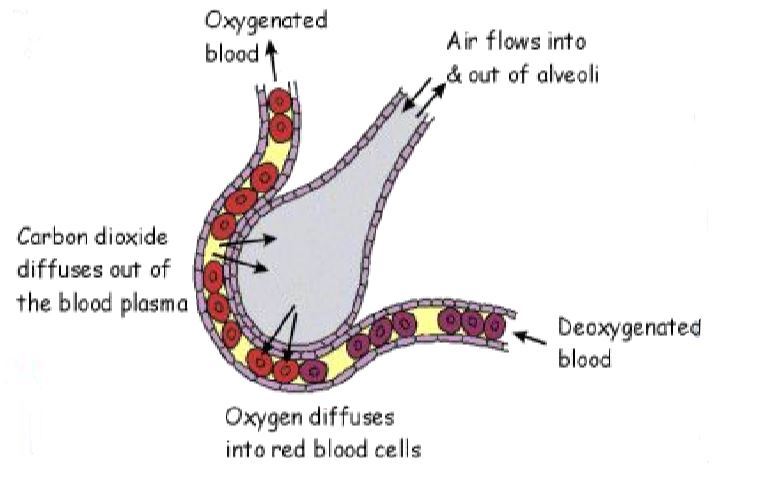
- Gaseous exchange in the lungs occurs via diffusion.
When air flows in and out of the alveolar, oxygen diffuses from the lungs into the red blood cells to be carried to the rest of the body, and carbon dioxide diffuses out of the blood plasma into the lungs to be removed from the body.
- Carbon dioxide diffuses from the blood plasma to the alveoli in the lungs.
Surface Area to Volume Ratio
Definition: The surface area to volume ratio refers to the ratio of the surface area to the volume of a cell.
The bigger the cell, the lower the surface area to volume ratio.
Cells which function in absorption have an increased surface area to volume ratio.
For example, root cells have long processes and *epithelial cells have folded membrane.
Página 2
Osmosis
Definition: Osmosis is the net movement of water molecules from a region of higher *water potential to a region of a lower water potential across a partially permeable membrane.
* Water potential is the tendency of water to move from one place to another.
Cells are living osmotic systems.
When a plant cell is placed in a solution with a high water potential
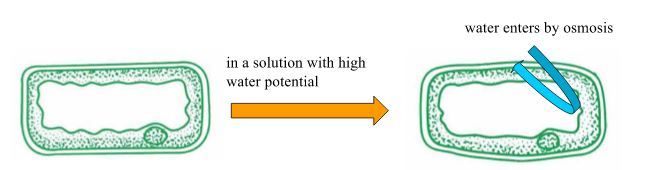
1) Water will enter the plant cell through osmosis.
2) This will result in the vacuole increasing in size.
3) Then, the plant cell will enlarge and become swollen or turgid.
4) The turgidity of the cell with water is known as turgor.
5) The pressure exerted by the water on the cell is the turgor pressure.
6) The cell wall is strong and inelastic, exerting an opposing pressure as the water enters the cell, preventing the over-expansion of the cell.
7) Hence, the cell protects the plant cell so the plant cell will not burst.
When a plant cell is placed in a solution with a low water potential
Informações
- Descrição
- Secondary 2 Biology Notas sobre Chapter 10 Lesson 1, criado por OO HENG YIM,NICOLE 3E em 17-05-2016.
- Criado por
- OO HENG YIM,NICOLE 3E · mai 2016
- Atualizado
- 21 jun 2016
- Visualizações
- 2
- Avaliação