
Notas
6. New Economic Policy (NEP)
Conteúdo das notas (1)
Página 1
National freedoms
a. Lenin allowed freedom to national and Muslim cultures.
b. In the Ukraine, although the Bolsheviks were in power, the Ukrainian language was used in government and business, and children were taught it in schools.
c. In the Muslim areas of central Asia (such as Uzbekistan and Turkmenistan) bazaars were allowed to reopen, mosques were taken from Soviet control, the Koran was restored, and native languages were encouraged.
Experts
Coal, iron, steel and railways stayed nationalised, but the Bolsheviks brought in experts, on high wages, to increase production.
Private enterprise
a. Small factories were handed back to their owners. Were allowed to sell their goods and make profits
b. New traders (called 'nepmen') were allowed to set up small private businesses.
c. At the same time - where War Communism had forced the peasants to hand over ALL their surplus grain - Lenin let them sell their surplus, and pay a tax instead. Some hard-working peasants became rich (the ‘Kulaks’).
Larger industries (coal, steel, transport) remained under state control but some larger factories were allowed to sell their products
W
War Communism failed
Bolshevik supporters were protesting (Kronstadt)
- production went down
- major discontent
- famine
Lenin knew if he didn't change the economic situation in Russia the Communists would not survive
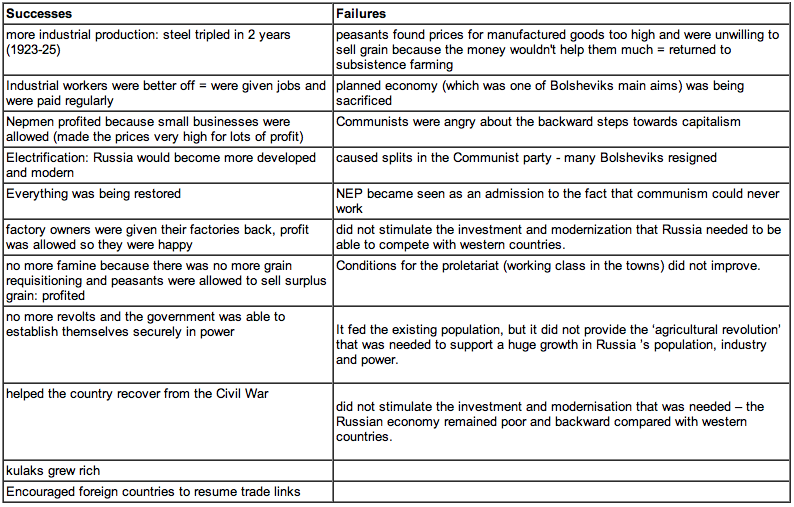
- Industrial boost because of profit motive
- Kulaks got rich as they could sell grain
- many peasants suffered as the prices the NEPmen sold goods at were too high
- factory owners were given their factories back and were allowed to sell = happy
- peasants didn't have to give grain regularly but paid tax instead
- no more famine
- industrial workers were better off
unemployment because companies were allowed to fire people (communism = no firing)
- no more revolts
- capitalist - going back on communist ideology
Bolsheviks were unhappy - NEP was capitalist and going back on communist ideology
- many Bolshevik's resigned
- others voiced their protest
Many
Many hated the NEPmen who sold cheap goods at high prices
- new social class as they were prospering
was n
was not modernizing Russia and there was always a threat of invasion
Died in January 1924 (53)
suffered several strokes since 1922 -- had been overwhelmed byt he long hours he worked after the revolution
Petrograd was renamed Leningrad
For Lenin:
- modest man who didn't have any personal ambition
- good speaker -- swayed audiences
- excellent leadership qualities
- without him - no revolution (he persuaded the Bolsheviks to take power)
- superb organizing skills
- good political judgement and good at adapting to certain circumstances -- reason they stayed in power after 1917
- used the Cheka and terror because of the civil war and chaos -- allowed more freedom after 1921
Against Lenin:
- seized power with a small group of people without the support of most of the population = dictatorship
- did not share power with other Socialists (especially SR's)
who had won the elections (CA)
-- Civil War became worse
- used ruthless methods and terror to stay in power
0 prepared to see millions of Russians suffer for his ideals
- stopped other people expressing their opinions
- made the Communist Party an organization for carrying out orders--members were not allowed to disagree with the leaders
Reasons for NEP
Effects of NEP
Opposition to the NEP
Death of Lenin
Informações
- Descrição
- * Reasons for NEP * Effects of NEP * Opposition to the new policy * Death of Lenin
- Criado por
- ShreyaDas · mar 2014
- Atualizado
- 2 set 2017
- Visualizações
- 636
- Tags
- Avaliação