
Notas
The equations and how to use them
Conteúdo das notas (15)
Página 1
Coulomb's Law:

Used to calculate the force between two charges
The units of force are the Newton
Dielectric constant of free space = 8.85 * 10^-12
It is important to remember force is a vector quantity
Página 2
Electric Fields:

This equation is used to calculate the electric field generated by a charge
Electric field strength is measured in volts per metre
The sign of E depends on the sign of Q
Electric field strength is a vector quantity

This equation is the result of combining Coulomb's law and the equation for electric field strength
Página 3
Potential Energy:

This equation is the work done moving a charge a distance
This can be used to define what voltage is:
"The work done to move a unit charge between the two points is equal to the potential difference between those two points"
Note: Voltage is a scalar quantity

This equation shows that the electric field strength of a charge is equal but opposite to voltage differentiate with respect to x (distance between the charge and the reference point).
Página 4
Gauss' Law:
"The electric flux passing through any closed surface is equal to the total charge contained within that surface."

The above equation demonstrates this law in action
When the Gaussian surface is irregular you need to break the surface into small areas and calculate the electric field normal to the surface and then integrate over the whole surface and multiply by dielectric constants

This is the dot product, which is required for irregular surfaces and simply refers to taking the component of the electric field that is normal to the surface. This produces a scalar quantity.
Página 5
Electrical Displacement and Polarisation:

This shows the origins of relative permittivity, as it causes the induced charges to set up an opposing electric field.
This leads to the "original field weakening"

This is simply a rearrangement of the above equation to have polarisation as the subject
Página 6
Capacitance:

This is derived as voltage between two conductors is proportional to the charge transferred between them. In this case capacitance is the constant of proportionality for the relationship.

This is the equation for capacitance between two parallel calculated by first finding the equations for Q and V
This method of finding capacitance can be used for a variety of different objects
Need to review how to calculate the potential difference between a variety of surfaces
Página 7
Electrostatic Energy:
The energy stored stored by the collection of charge can be derived as follows:
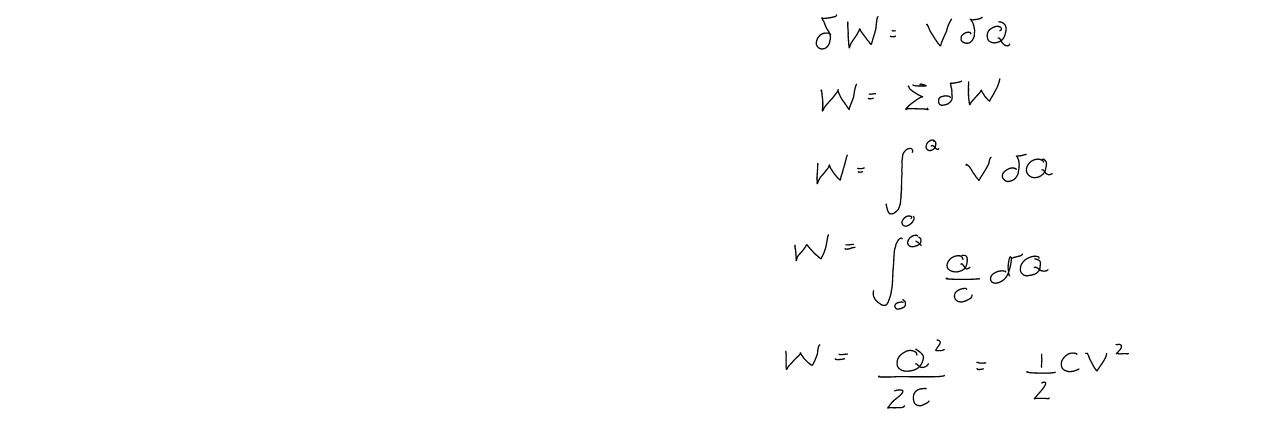
This starts by considering an isolated body with charge Q and then adding small amounts of charge δQ
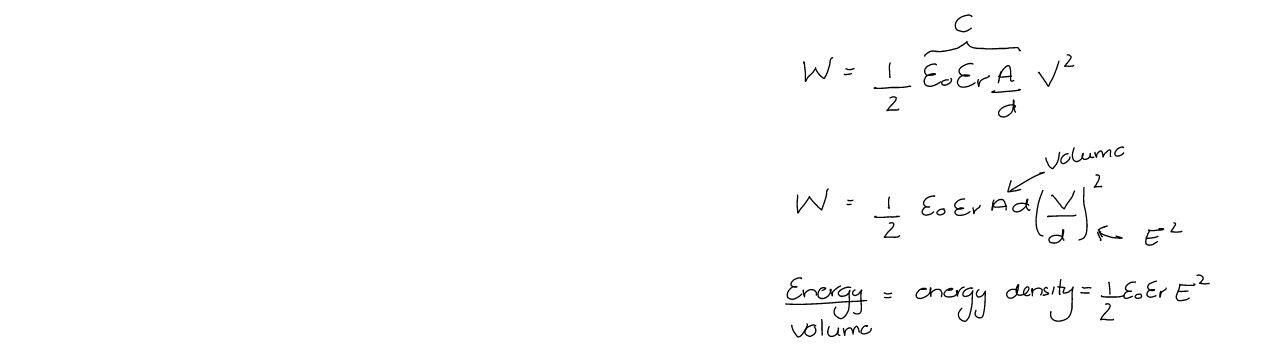
We can also calculate energy density this is done by first rewriting the equation for energy stored changing the capacitance to its equation as follows:
Página 8
Force on a current carrying conductor in a uniform magnetic field

Where:
B is magnetic flux density
I is current flowing in the conductor
L is length of the conductor
⍺ is the angle between the field normal to the force and the wire
Página 9
Current flow

Where:
q = Charge of a single electron/charge carrier
n = number of electrons/charge carriers
A = cross-sectional area of wire
v = velocity of charge carriers
Página 10
Resistivity

This equation is used then used to derive the most general form of Ohm's law:

Where J is the current density
Página 11
Magnetic Field Strength
We know that magnetic flux density is:

Where H is as follows:

The angle θ is the angle between H and the tangent to the loop around the wire.
For a circle H is tangential to the path therefore giving the following equation:

Página 12
Biot-Savart Law
This is very similar to separating up of a charge as done in electrostatics, it states that:
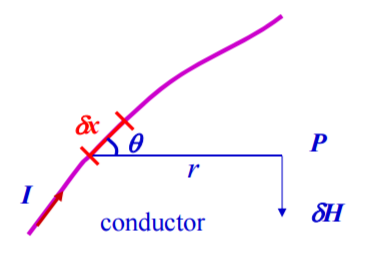
This is used for anything other than a straight wire of infinite length

Página 13
Faraday's Law
States that whenever the flux through a loop changes with time, then there's a voltage induced in the loop. This voltage is typically referred to as the electromotive force. The law can be demonstrated through the following equation:

The negative signifies that the emf opposes the change that caused it
Since Φ is total flux linkage increasing the number of turns increases the emf
This equation can be used to derive the equation for a perfect transformer as the N is taken outside of the total flux linkage equation.
Página 14
Self and Mutual Induction
In a solenoid the magnetic field strength H = n * I
If the solenoid is air filled then B = μo * n * I
Using this equation to find the emf induced in a solenoid produces the following equation:

Comparing this equation with the equation self-induced in an inductor, as shown below:

Allows the derivation of an equation for induction (L):

For mutual induction in linear circuits the mutual induction between the two is exactly the same and is calculated using the following equation:

Página 15
Energy Stored by an Inductor
As power is the product of voltage and current it is very easy to derive an equation of energy stored:

As power is rate of change of energy this means energy stored in an inductor is:

The above equation holds true even for DC as there is always energy stored in a magnetic field
Informações
- Descrição
- Engineering (16ELA005 - Electromagnetism) Notas sobre The equations and how to use them, criado por Ben Evans em 09-04-2017.
- Criado por
- Ben Evans · abr 2017
- Atualizado
- 24 abr 2017
- Visualizações
- 92
- Avaliação