
Quiz
Cells and DNA
Este quiz tem tipos de pergunta que abrem no player de sempre.
Perguntas do quiz (26)
1Single cells grow and [blank_start]divide[blank_end] to form more cells in a process called the [blank_start]cell cycle[blank_end].
A [blank_start]young[blank_end] cell undergoes cell division which promotes cell growth. The cells can then either grow into more stem cells or develop into specialized cells which in turn develop into [blank_start]mature[blank_end] cells.
[blank_start]Embryonic[blank_end] development causes many cells to [blank_start]lose[blank_end] the ability to divide as they develop into the tissues and organs that make up organisms. The cells that retain many embryonic properties are called [blank_start]adult[blank_end] stem cells.- Adivide
- Bcell cycle
- Cyoung
- Dmature
- Elose
- Fgain
- Gadult
- HEmbryonic
2Cell division produces embryonic [blank_start]stem[blank_end] [blank_start]cells[blank_end].
- Astem
- Bcells
3Check off all that apply to embryonic stem cells.
- AGive rise to a limited range of cells within a tissue.
- BCapable of developing into all the cell types of an adult organism.
- CCapable of continual cell division.
- DMake up the bulk of the embryo.
- EOccuring in the growing adult body.
- FCan develop into all the cell types.
- GHas a limited range.
4Which of these is true for the lysosome of a cell?
- AIt monitors what goes in and out of the cell
- BIt is in charge of protein synthesis
- CIt holds the organelles together
- DIt breaks down any waste in the cell
5label the prokaryotic cell
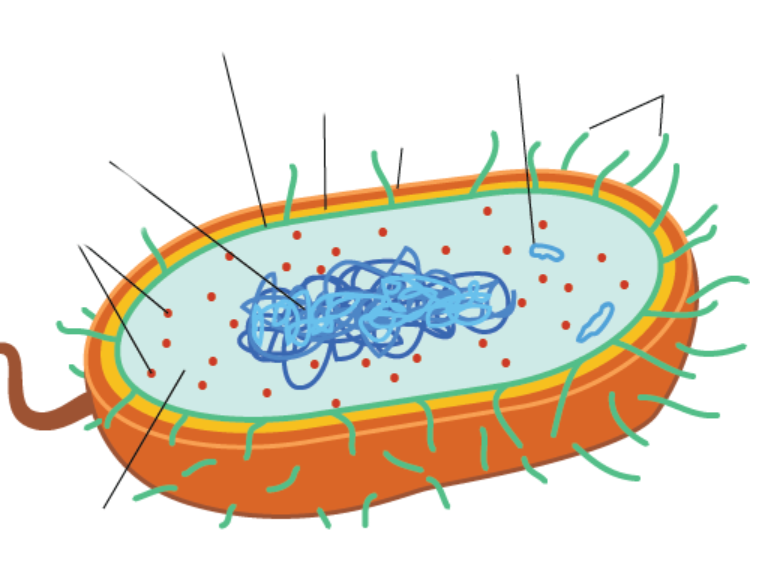
- Apili
- Bplasmid
- Ccell wall
- Dcytoplasm
- Enucleoid
- Fnucleus
- Gflagella
- Hribosomes
- Iplasma membrane
- Jchloroplasts
- Klysosomes
- Lmitochondria
- Mendoplasmic reticulum (rough)
- Nendoplasmic reticulum (smooth)
- Ocentrioles
6Label the eukaryotic cell
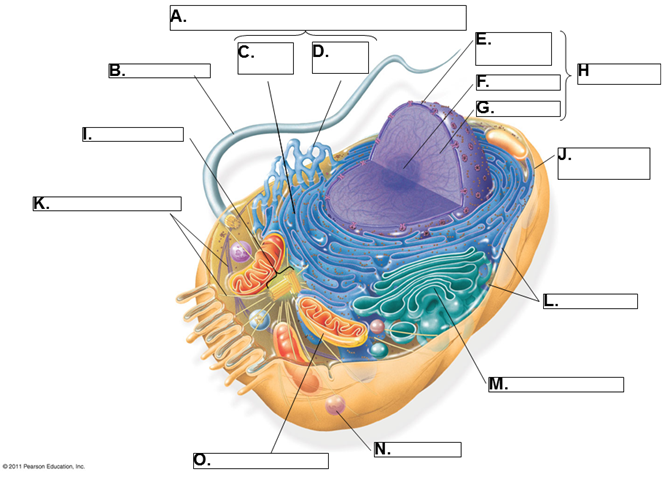
- Anucleolus
- Bnucleus
- CMitochondrion
- Dsmooth
- Erough
- Fendoplasmic reticulum
- GGolgi Apparatus
- HChromatin
- INucleoid
- JPlasmid
- KFlagella
7What is the difference between pili and flagella?
- AFlagella is for the mobility of the cell and pili is for the attachment to other cells.
- BFlagella is for the attachment to other cells and pili is for the mobility of the cell.
- CFlagella is for nuclear division and pili is for structure
- DFlagella is for structure and pili is for nuclear division
8Which of the following are organelles are present in prokaryotes but not eukaryotes?
- APlasma membrane
- BCytoplasm
- CNucleoid
- DNucleus
9Which of the following are fundamental statements of cell theory?
- ACells come only from other cells
- BCells maximize their SA;Vol ratio
- CAll living things consist of cells
- DCells are the smallest units of life
10Which part of the plasma membrane is involved in recognition of other cells?
- APhospholipid bilayer
- BIntegral proteins
- CPeripheral proteins
- DCholestrerol
11How do animals use cholesterol?
- ATo store energy
- BTo form part of the plasma membrane
- CTo insulate neurons (nerve cells)
- DTo increase blood pressure
12Which cell organelle is responsible for the production of proteins to be exported from the cell?
- ARough endoplasmic reticulum
- BFree ribosomes
- CSmooth endoplasmic reticulum
- DLysosome
13By which method do prokaryotes reproduce?
ANSWER: [blank_start]binary[blank_end] [blank_start]fission[blank_end]- Abinary
- Bfission
14Prokaryotes do not have a mitochondrion
- AVerdadeiro
- BFalso
15Complete the following statement using the correct numbers. (Use numbers not words. Ex: 15 not fiveteen)
Eukaryotes have [blank_start]80[blank_end]s ribosomes and Prokaryotes have [blank_start]70[blank_end]s ribosomes.- A80
- B70
16Which of the following is true for a ribosome?
- AIt is responsible for the breakdown of the contents of "food" vacuoles
- BIt is responsible for protein synthesis
- CIt is responsible for packaging and sending off proteins
17An animal cell is placed in a hypotonic (very weak) sugar solution and therefore the cell will decrease in mass.
- AVerdadeiro
- BFalso
18Osmosis is the movement of [blank_start]water[blank_end]
Diffusion is the movement of [blank_start]liquids and gases[blank_end]- Awater
- Bliquids and gases
19The smaller the size of a cell the less surface area to volume it has.
- AVerdadeiro
- BFalso
20Which of the following does 'surface to volume ratio' determine?
- AThe amount of absorption that occurs
- BHow long heat energy takes to get in or out
21Which of the following types of transport moves from a low concentration to a high concentration?
- ADiffusion
- BFacillated Diffusion
- COsmosis
- DActive Transport
22Decode the following DNA to mRNA
DNA --> TAC CTC CGG TGG GTG CTT GTC TGT ATC
mRNA->[blank_start]AUG[blank_end] [blank_start]GAG[blank_end] [blank_start]ACC[blank_end] [blank_start]ACC[blank_end] [blank_start]CAC[blank_end] [blank_start]GAA[blank_end] [blank_start]CAG[blank_end] [blank_start]ACA[blank_end] [blank_start]UAG[blank_end]- AAUG
- BGAG
- CACC
- DACC
- ECAC
- FGAA
- GCAG
- HACA
- IUAG
23[blank_start]A[blank_end][blank_start]U[blank_end][blank_start]G[blank_end] is the start codon
[blank_start]U[blank_end][blank_start]A[blank_end][blank_start]G[blank_end] is the end codon- AA
- BU
- CG
- DU
- EA
- FG
24Where does the first step of protein synthesis occur?
ANSWER: [blank_start]Nucleus[blank_end]- ANucleus
25The bases on tRNA are called...
- A... codons
- B... anti-codons
- C... proteins
26Drag the function to the correct primase, polymerase, and ligase:
- RNA primase; forms short lengths of [blank_start]RNA[blank_end] primer at intervals [blank_start]along the DNA strand[blank_end]
- DNA polymerase III; [blank_start]forms[blank_end] short [blank_start]DNA[blank_end] strands called Okazaki Fragments[blank_start], starting from each RNA primer[blank_end]
- DNA polymerase I; [blank_start]replaces[blank_end] the [blank_start]RNA primer[blank_end] at the start of each Okazaki Fragment with a [blank_start]DNA strand[blank_end]
- ligase; [blank_start]joins the DNA strands together[blank_end]- Aalong the DNA strand
- B, starting from each RNA primer
- Cforms
- Dreplaces
- EDNA
- Fjoins the DNA strands together
- GRNA primer
- HRNA
- IDNA primer
- JDNA strand
- KRNA strand
- Lseparates
Informações
- Descrição
- IB Science
- Autor
- Imani :D
- Idioma
- English
- Visualizações
- 65
- Etiquetas
- Avaliação
- Ainda sem avaliações Avalie este quiz