
Flashcards
OCF: Q11
Flashcards do conjunto (5)
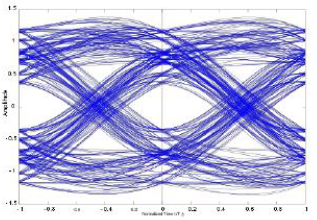
- 1Which effect can be seen in the eye diagram below?Intersymbol Interference (ISI)
- 2On the right you can see the time and frequency behavior of raised cosine functions with different roll-off factors - which line corresponds to a roll-off factor of 1? Which line corresponds to a roll-off factor of 0? Why are the raised-cosine and the square -root-raised-cosine functions so useful for communications?roll-off factor 0: Blue Line
roll-off factor 1: Turquoise Line
The RCF gives a tradeoff between the Sinc functions low BW requirement and its clock error sensitivity. The larger r, the better the timing behaviour but also the BW becomes larger
The SRCF does not fulfill the Nyquist Criteria 1 but it can have a narrow BW and still decay fast in the time domain. Via matched filter it can also fulfill Nyquist Criteria 1.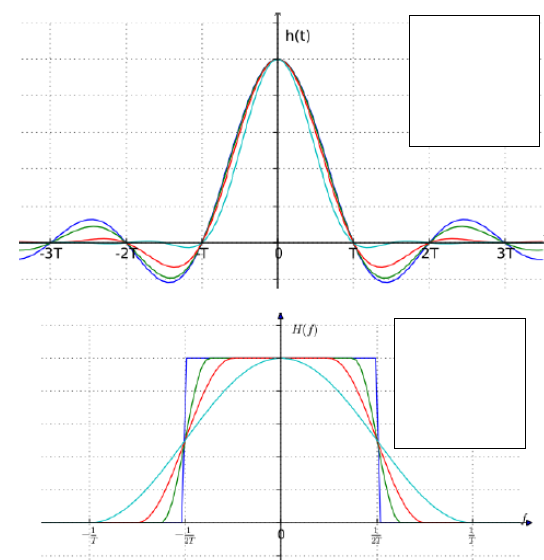
- 3Why is Nyquist criteria 1 not sufficient? Which roll-off factor would you choose based on the Nyquist criteria 2?Nyquist criteria 1 in principal guarantees that there is no ISI but it doesn't take clock/sampling errors into account.
Nyquist criteria 2 prefers the pulse shape which provides the widest eye opening -> r=1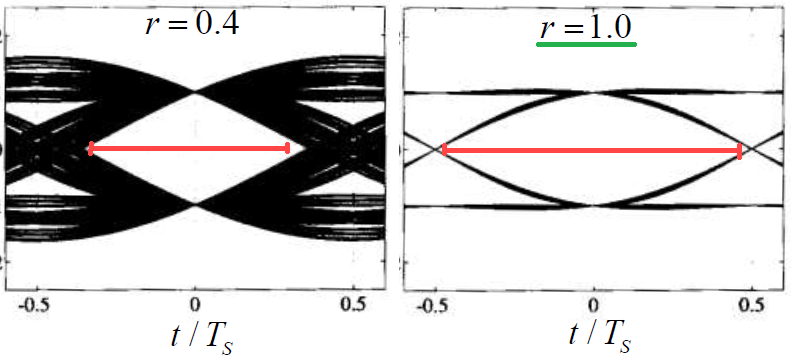
- 4Name an example for two orthogonal signals.-> two offset rect functions
-> two offset sinc functions
-> two offset exp functions
-> sine and cosine - 5Which degrees of freedom can be used for multiplexing? Name and explain the different options.Time: disjoint time-slots
Frequency: disjoint frequency slots
Polarization: orthogonal polarizations
Quadrature: Use complex symbols
Code: Code-Division Multiplexing
Space: Multiple cables, fibers, modes...
Combination of the above