
Flashcards
AS AQA Geography- Rivers
Flashcards do conjunto (39)
- 1What is a drainage basin?The area of land, bordered by a watershed, drained by a river and its tributaries.
- 2What is a watershed?The boundary of a drainage basin.
- 3What type of system is the hydrological cycle?A closed System.
- 4What is precipitation?Movement of water from the atmosphere to the earth surface in the form of rain snow or hail.
- 5How does precipitation lead to flooding?->Prolonged or heavy rainfall.
->Snow acting as a store of water then melting. - 6What is overland flow?This is a rapid form of water transfer over the surface of the ground.
- 7When is overland flow most likely to occur?->During periods of heavy rainfall.
->When the soil has become completely saturated. - 8What is infiltration?The movement of water from the ground surface into the soil.
- 9What affects the rate of infiltration?->The moisture content of the soil.
->The soils porosity. (number of air spaces) - 10What is throughflow?The downhill transfer of water through the soil layer to the river.
- 11What is percolation?The movement of water from soil into permeable rocks.
- 12What is permeable rock?A rock which can absorb water (porous) or allow water to pass through cracks and joints (pervious).
- 13What is baseflow (groundwater flow)?This is the very slow transfer of water through rocks.
- 14When can groundwater/baseflow be faster?In limestone areas where there are extensive underground channels.
- 15What is the soil moisture of: ->Clay ->Sand->Poor. Clay soils can be very wet and boggy.
->Good. Sandy soils tend to be much drier so they absorb more precipitation. - 16What is depression storage?When water is stored temporarily on the ground surface in the form of puddles.
- 17What is interception?Vegetation, particularly trees, stopping some precipitation on its way to the ground.
- 18What does vegetation do to water transfer and why?Vegetation slows it down. Some water is lost by evapotranspiration while some water is used for plant growth.
- 19What is evapotranspiration?When water loss from the ground surface to the atmosphere (evaporation) combines with water given off from plants (transpiration) to form a main output from the system.
- 20What is the water balance equation?P=O+E+/-S
P=Precipitation
O=Total run off(stream flow)
E=Evapotranspiration
S=Storage (in soil and rocks) - 21What causes a high runoff percentage?->Lack of trees
->Saturated soil
->Impermeable rock - 22What is impermeable rock?A rock which cannot absorb water.
- 23What causes a low percentage of runoff?->Lake (storage)
->Lots of trees.
->Dry soil
->Permeable rock - 24What is river discharge?The volume of water passing a given point in a given period of time, usually expressed in 'cumecs' and calculated as:
Cross sectional area x Velocity - 25Factors affecting the discharge of a river.->Distance downstream
->Climatic changes
->Land use
->Water abstraction
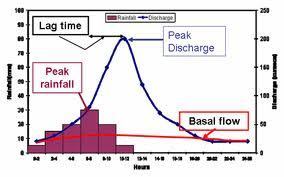
->Channel modifications - 26What is a storm hydrograph?A graph that shows the discharge of a river following a storm event.
- 27Compare the characteristics of a typical river during low-flow conditions and a typical river during high-flow conditions have?A river during low-flow has clear water and a visible river bed while a river during high-flow has murky water and no riverbed visible.
- 28The amount of energy available in a river to do 'work' depends on...->The height the water has to descend (gravity)
->The mass of water available. - 29When water starts to move downhill _______ energy is converted into ________ energy.When a water starts to move downhill potential energy is converted into kinetic energy.
- 30What is a load?The sediment carried by a river.
- 31What is solution?The invisible transport of chemicals dissolved in the water. Eg. Calcium carbonate.
- 32What is suspension?Very fine-grained mud and silt which is carried in the main body of the water. (makes the river look dark and murky)
- 33What is bedload?Larger sediments being transported along the riverbed, which is too heavy to be picked up and carried as a suspended load.
- 34What is traction?Material rolling along the river bed. Eg Boulders.
- 35What is saltation?Material moving in a series of small bounces along the riverbed. Eg. pebbles
- 36What is erosion?The picking up and removal of material.
- 37When does erosion occur?When the river has surplus energy available.
- 38What is abrasion?Where particles of rock carried by the river scrape away at the riverbed and banks. This can dislodge rock particles to add to the load of a river (sandpaper affect)
- 39What is hydraulic action?Where the power of moving water is able to dislodge loose particles of rock from the riverbed or banks.
Informações
- Descrição
- FlashCards sobre AS AQA Geography- Rivers, criado por Hannah Goodenough em 13-11-2014.
- Criado por
- Hannah Goodenough
- Visualizações
- 448
- Tags
- Avaliação