
Flashcards
Enzymes
Flashcards do conjunto (45)
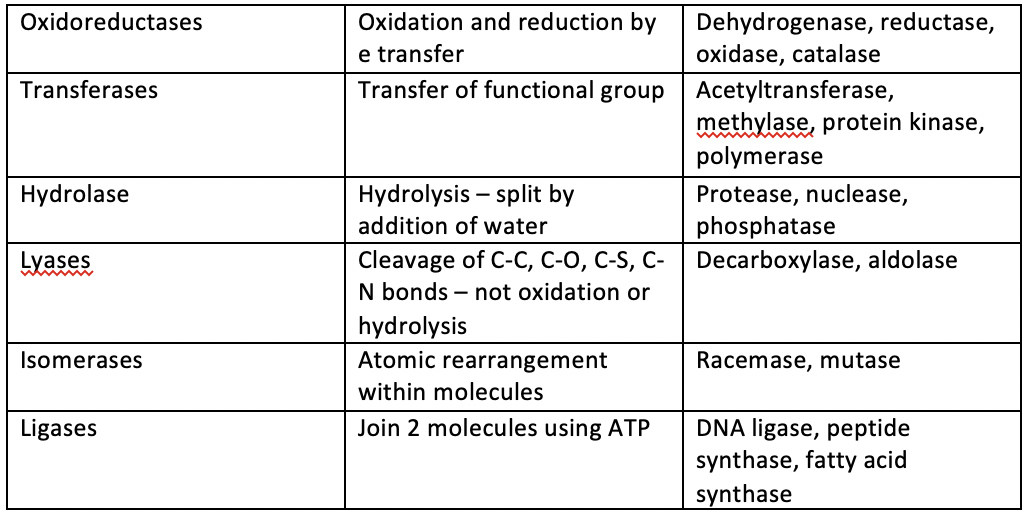
- 1Why enzyme used?Cell reactions not spontaneous or quick enough
Enzyme don't change equilibrium position
Allows rapid rate at biological conditions - 2RibozymesMade of RNA
Rest of enzymes made from proteins - 3Types of Enzyme
- 4Prosthetic groupSmall molecule integral to structure
Tightly bound
Involved in catalysis - 5CofactorsSmall molecules, essential for enzyme activity
Can be tightly bound prosthetic groups, or loosely bound cosubstrates - dissociated to be regenerated
Can be ions or organic coenzymes - 6CoenzymesBased on essential vitamins needed in diets
E.g. electron carriers as amino acid side chains have no electron carrying capacity - 7How enzymes workActive site binds to substrate
Stereospecific
Reversibel formation of ESC
Can breakdown or form product
Decrease activation - 8Transition stateTop of energy barrier
Relatively unstable
Energy change between substrate and transition state much lower in enzyme catalysis - 9CatalysisSpeed up rate at which equilibrium reached
Alternative reaction pathway
Acid base catalysis; covalent catalysis; proximity effects; substrate strain - 10Lock and keyIF true, ESC would be favourable hence product wouldn't form
- 11Induced FitSubtle arrangement increase complementarity, placing strain hence enzyme binds more tightly to transition state than substrate or product
- 12Rate depends on,,,[Enzyme]
[Substrate] - 13KmSubstrate concentration at half Vmax
Higher - slower rate
Michaelis Menten constant
Intrinsc property of enzyme on substrate
Includes how well enzyme catalysed formation of product after ESC formed - 14Michaelis menten equationVmax[s]/Km[s]
- 15KdDissociation constant (rate constant)
If K3 small compared to K2, Km~Kd - 16K3Formation of product from ESC
Also Kcat - turnover number - 17Kcat/KmMeasure of affinity
Large ratio = efficient enzyme
Rate limited by diffusion of substrate - 18Notable KcatCarbonic Ahydrase = 600,000/sec
Lysozyme = 0.5/sec - 19Linwever Burk EquationReciprocal of Michaelis-menten
gradient = Km/Vmax
Y intercept = 1/Vmax
X intercept = 1/Km - 20Units of activityKatal
1 Katal = 1 molecule of substrate/ sec - 21How do enzymes work?ESC increase local effective concentration fo reactants. Unfavourable loss of entropy when substrate binds offset by enthalpy change of binding
- 22Features of enzymesDenaturation destroys activity
Stereospecific for substrate and cofactors
Active site in hydrophobic clefts
Enzyme interact with non-covalent interactions
Proximity adn orientation of reactive groups of substrate important - stabilise transition state - 23LysozymeNatural antibiotic in sweat, egg white, tears, saliva
Cuts peptidoglycan at peptide links, causing lysis - 24Structure of peptidoglycan linksNAG and NAM
NAM linked with amino acid via peptide bond. D isomer hence not hydrolysed by protease - 25How lysozyme worksBinds to sugar moiety
Hydrophobic active site accommodates 6 residues, all fit easily except D - strained
Offset by favourable bidding of others, but forced into half chair hence more reactive
Bond between D and E cut by enzyme - 26Amino acid actionGlu-35 and Asp-52 either side of bond between D and E
Dissociate to form negatively charged carboxylate with neutral pH
Glu-35 behave as acid (abnormal high pKA)
Asp-52 deprotonated - 27Old mechanismGlu-35 donates H to glucosidic bond, leaving ring D with positive charged carbon
Stabilised by -ve charge of Asp-52 and lone pair O electrons.
Carbon reacts with water activated by -ve change on Glu-35.
Water donates OH to D and H to regenerate Glu-35
(Incorrect - instead nucleophilic attack) - 28New mechanismNucloephilic attack by Asp-52 on C1 of ring D displaces oxygen of glycosidic bond. Takes carbonyl hydrogen from glucose-35
glycosyl enzyme intermediate reacts with water to form second product adn regenerate enzyme - 29General principles of enzyme catalysisGeometric effects
Nucleophilic attack
acid catalysis
electrostatic effects
molecular recognition
water exclusion from hydrophobic cleft - 30Geometric effectsdistorted into Half chair makes more reactive and stabilised transition states
- 31Nucleophilic attackenzyme attack reactive group of substrate
- 32Acid catalysisenzyme donate H+ to first product
- 33Electrostatic effectsIn incorrect mechanism, carbonic ion stabilised by negative group on enzyme
- 34Molecular recognitionDiverse and specific recognition of several hexose residues in substrate
- 35Competitive inhibitorsSimilar shape, bind to AS preventing substrate
Vmax unchanged but Km increased (slower rate)
Overcome by higher substrate concentration
Reversible inhibition
e.g. methotrexate chemotherapy drug mimics folic acid, preventing DNA replication - 36Irreversible Inhibitioncovalent adduct.
much less needed to be potent
not recycled
targeted against amino acid side chain
e.g. sarin in acetylcholinesterase - 37Other inhibitorsChemically unreactive but use catalytic activity
Suicide inhibitor resembles substrate
Enzyme reacts to form covalent bond but cannot go further so commits suicide
e.g. penicillin with serine in active site of cell wall formation in bacteria - 38Reversible covalent modificationImportant and rapid.
Mainly eukaryotes
Initiated by extracellular signal - hormone/ growth factor
e.g. phosphorylation of serine, threonine or tyrosine- catalysed by kinases
Serine/ threonine control metabolism, tyrosine control cell growth and differentiation. tyrosine kinase involved in events leading to cancer - 39Genetic ControlLong term control mechanism in higher eukaryotes, short term in bacteria
Tryptophan represses production of all enzymes in tryptophan biosynthesis pathway - prevent cell wasting energy on unnecessary production - 40Activation of zymogensSome enzyme produced and stored in inactive form (zymogen)
Can be switched on when needed e.g. blood clotting and digestive enzymes
Can only be turned off by destruction - 41Allosteric EnzymesDO NOT obey Michaelis menten kinetic
Often associated with metabolic activity
several subunits bind to subunit
sigmoidal shaped curve - affinity depends on if any substrate bound already (if bound, easier for next to) - 42Allosteric activators/ inhibitorsActivators shift S curve left (more easily bound)
Inhibitors shift S curve right - 43Phosphofructokinase4 active sites, used in glycolysis
controlled by allosteric effectors
inhibited by ATP - feedback inhibition when cell doesn't need energy from glucose enzyme turned off
AMP activates - back on when ATP low - 44Cooperative bindingBehave like haem
T state has lower oxygen affinity.
Converted to higher R affinity by binding
When R, easier for rest to bind - 45CompartmentationKey reaction pathways catalysed by different enzymes
Allows greater control so can activate synthesis whilst inhibiting degradation - amplifies change
Eukaryotes can do forward and reverse in different compartment, preventing products being immediately used in opposite reaction
Informações
- Descrição
- Biology of Cells IA (Macromolecules in the Cell) FlashCards sobre Enzymes, criado por Alice Hathaway em 07-01-2019.
- Criado por
- Alice Hathaway
- Visualizações
- 16
- Avaliação