
Flashcards
AQA Physics unit 1
Flashcards do conjunto (57)
- 1What is Infra-red Radiation?Infra-red radiation is a type of electromagnetic radiation which involves waves rather than particles
- 2What are the 3 ways Heat energy can be transferred?Radiation
Convection
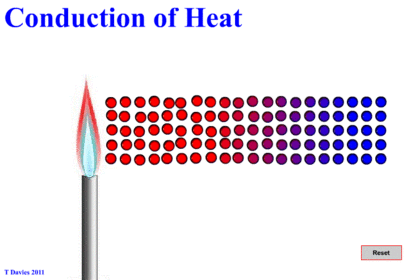
Conduction - 3Why are metals good conductors?Because of their free electrons-they move faster and collide with other free electrons transferring heat energy trough the metal.
- 4What is Conduction?Conduction of heat energy is the process where vibrating particles pass on their extra kinetic energy to neighbouring particles.
- 5What is Convection?Convection occurs when the more energetic particles move from the hotter region to the cooler region and take their heat energy with them.
- 6What are the 9 types of energy?Heat
Light
Kinetic-energy in moving objects
Gravitational potential-stored energy in raised objects
Chemical-Stored energy in foods, fuels, batteries
Sound-energy released from vibrating objects
Electrical-energy in moving charges or static electric charges
Elastic potential-stored energy in stretched or squashed objects
Nuclear-stored in the nuclei of atoms - 7What is the formula for finding the efficiency of any device?Efficiency=Useful energy out/Total power in
- 8What is the formula for finding the specific heat capacity of any device?Energy transferred(J) = mass(kg) x Specific heat capacity(J/kg'C) x Temperature change('C)
- 9What is Specific Heat capacity?The specific heat capacity tells you how much energy stuff can store. It is measured in the number of Joules of heat energy needed to raise the temperature of each kg by each 'C.
- 10Name 4 non-renewable energy resources.1)Coal
2)Oil
3)Natural gas
4)Nuclear fuels(uranium and plutonium) - 11Name 8 renewable energy resources.1)Wind
2)Wave
3)Tidal
4)Hydroelectric
5)Solar
6)Geothermal
7)Biomass
8)Nuclear - 12What is the formula for finding the amount of energy that is transferred by an appliance?Energy(J) = Power(kW) x Time(hours)
- 13What is the formula for calculating the cost of electricity?Number of Kilowatt-hours used = Power(kW) x Time(hours)
Cost = kWh x price per unit - 14In this sankey diagram, if each square=10J, what is: a)the total input energy(J) b)the wasted thermal energy(J) c)the wasted sound energy(J) d)the useful output energy(J)a)1000 J
b)50 J
c)40 J
d)10 J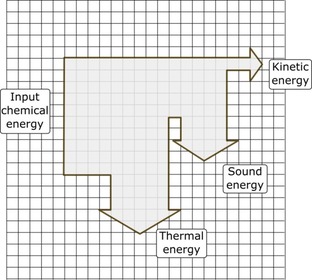
- 15Give 5 ways you could insulate your house.1)Lost insulation
2)Cavity wall insulation
3)Double glazing
4)Draught excluder
5)Curtains and Carpets - 16What is payback time and how can you work it out?Payback time is the time it takes to get your money back in savings for saving energy in your home.
Payback time(years) = Cost of insulator(pounds) / annual fuel savings(pounds per year) - 17How is electricity distributed via the National Grid?The National Grid takes electrical energy from power stations to where it is needed in homes and industry allowing for power to be generated and supplied anywhere on the Grid. The power is transmitted by having a high voltage and a low current.
- 18How do pylons and transformers help transmit power?Transformers are needed to keep the voltage at 400,000 V and the current low (doesn't lose energy through heat which costs lots and doesn't damage the cables).
The voltage is increased using a step-up transformer and the current kept very low. The voltage is reduced to it's original state at the consumers using a step-down transformer.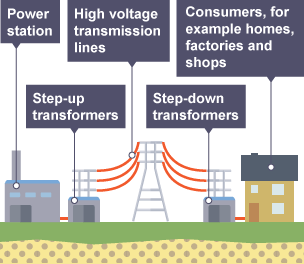
- 19What are the pros and cons of Overhead cables?-Pros: low set-up cost, easy to access, easy to set up, minimal disturbance to land.
-Cons: lots of maintenance needed, looks ugly, gets affected by the weather, not very reliable. - 20What are the pros and cons of Underground cables?-Pros: Minimal maintenance, is hidden, isn't affected by weather, reliable.
-Cons: high set-up cost, hard to access, hard to set up, has lots of disturbance to the land. - 21What are the advantages and disadvantages of fossil fuels?Advantages: Currently available, cheap to run, fairly low set up costs.
Disadvantages: Non-renewable, Quarries destroy the landscape, Burning fossil fuels emits carbon dioxide into the atmosphere.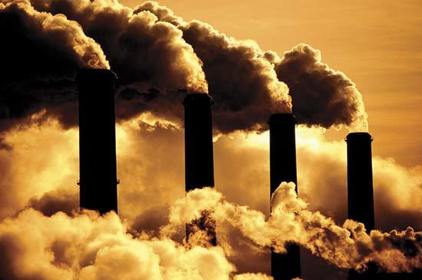
- 22What are the advantages and disadvantages of Nuclear energy?Advantages: Available for thousands of years, No pollution because nothing gets burned, very reliable.
Disadvantages: Produces radioactive waste that must be stored in lead lined with containers, can lead to potential nuclear disasters.
- 23What are the advantages and disadvantages of Biofuel energy?Advantages: renewable, doesn't require any special/expensive equipment, can be used very easily, doesn't add to the greenhouse effect.
Disadvantages: large areas of land are needed to grow enough trees.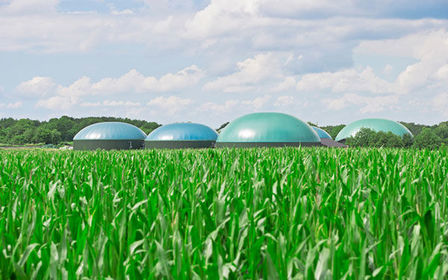
- 24What are the advanatages and disadvantages of Geothermal energy?Advantages: Renewable, no pollution, doesn't damage the environment.
Disadvantages: very few places in the world where you can do this, costs a lot of money to drill into the ground.
- 25What are the advanatages and disadvantages of Tidal energy?Advantages: renewable, no pollution, reliable, cheap to run.
Disadvantages: costs a lot to build the dam, the dam may cause local flooding.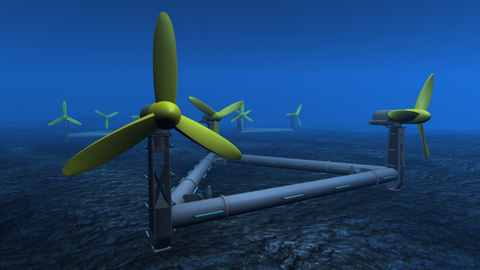
- 26What are the advanatages and disadvantages of Hydroelectric energy?Advantages: renewable, no pollution, we can store the water up high.
Disadvantages: costs a lot of money to build a dam, the dam can ruin the environment.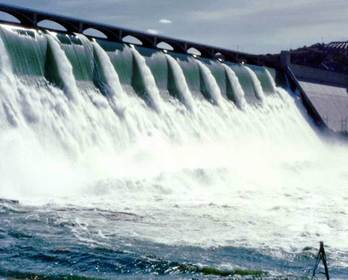
- 27What are the advanatages and disadvantages of Solar energy?Advantages: renewable, no pollution, minimal rain cost.
Disadvantages: solar cells are expensive, only works if it's sunny(unreliable), cannot connect to the national grid.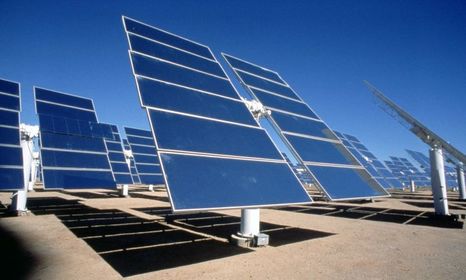
- 28What are the advanatages and disadvantages of Wave energy?Advantages: renewable, no pollution.
Disadvantages: needs lots of machines which cost a lot of money, the machines look ugly, the machines can be damaged by storms.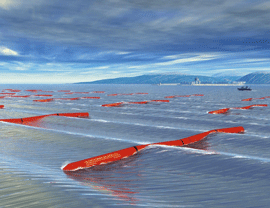
- 29What are the advanatages and disadvantages of Wind energy?Advantages: Renewable, no carbon emissions, feeds into the national grid, no permanent damage
Disadvantages: visual and noise pollution, unreliable, cannot increase supply, high initial costs.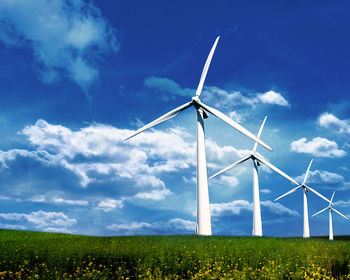
- 30How does evaporation take place and why does it have a cooling affect in liquid?The particles in a liquid have different energies. Some will have enough energy to escape from the liquid and become a gas. The remaining particles in the liquid have a lower average kinetic energy than before, so the liquid cools down as evaporation happens because it loses heat energy.
- 31How does condensation take place?The particles in a gas have different energies. Some may not have enough energy to remain as separate particles, particularly if the gas is cooled down. They come close together and bonds form between them. Energy is released when this happens.
- 32Name 4 ways that a vacuum flask is designed to prevent heat transfer.1)double walled vacuum to stop conduction and convection
2)silvered walls to stop radiation
3)supported using insulating foam
4)plastic copper filled with cork or foam that reduces conduction - 33What is the conservation of energy principle?Energy can be transferred usefully from one form to another, stored or dissipated(spread out and lost)-but it can never be created or destroyed.
Also, energy is only useful when it can be converted from one form to another. - 34Describe the arrangement and movement of the particles in solids.-strong forces of attraction hold the particles close together in a fixed regular arrangement
-the particles don't have much energy so they can only vibrate about their fixed positions - 35Describe the arrangement and movement of the particles in liquids.-they have weaker forces of attraction between the particles
-the particles are close together but can move past each other and form irregular arrangements
-they have more energy than solids
-they move in random directions at low speeds - 36Describe the arrangement and movement of the particles in gases.-there are almost no forces of attraction between the particles
-the particles have more energy than in liquids and solids
-they are free to move and travel in random directions and at high speeds - 37What do U-Values measure?How fast heat can transfer through a material (heat loss).
Heat transfers faster through materials with higher U-Values than low U-Values.
The better the insulator the lower the
U-Value. - 38What is CCS?CARBON CAPTURE and STORAGE
-used to reduce the amount of CO2 building up in the atmosphere and reduce the strength of the greenhouse effect.
-collects the CO2 from power stations before it is released into the atmosphere- pumped into empty gas fields + oil fields (like those under the North sea)
-safely stored - 39Give the disadvantages of biofuels.-In some regions, large areas of forest have been cleared to make room to grow biofuels-lots of species lose their natural habitats.
-the decay and burning of this vegetation also increases CO2 + methane emissions
-Their use is limited by the amount of available farmland - 40What are transverse waves?In transverse waves, the vibrations are perpendicular (at 90') to the direction of energy transfer. Most waves are tranverse
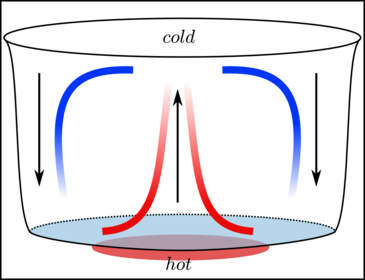
- 41Describe the convection currents in an Immersion Heater.1)Heat energy is transferred from the heater coils to the water by conduction (particle collisions)- there is almost no conduction under the heater so the water stays cold.
2)The particles near the coils get more energy and move faster meaning there is more distance between them
3)Water expands and becomes more dense
4)The reduction in density means the hotter water rises above the denser, cooler water
5)As the hot water rises, it displaces the colder water making it sink
6)The cold water is heated by the coils and a convection current is created - 42In what ways can you make conduction and convection more efficient?CONDUCTION: more efficient through a short, fat rod than through a long, thin rod
CONVECTION: more efficient in roundish, squarish containers because they allow the convection currents to work best. - 43What are longitudinal waves?In Longitudinal waves the vibrations are parallel to the direction of energy transfer of the wave. This causes compression's and rarefaction's
- 44Give 4 examples of transverse waves.1) Light and all other EM waves
2) Ripples on water
3) Waves on strings
4) A slinky spring wiggled up and down - 45Give 3 examples of Longitudinal waves.1) Sound waves and Ultrasound
2) Shock waves (e.g. seismic waves)
3) A slinky spring when you push the end - 46Why is the useful energy input of a device not usually equal to the total energy output?No device is 100% efficient and the wasted energy is usually spread out as heat.
- 47Explain how electricity is generated in a typical power station.1) The fossil fuel is burned to convert its stored CHEMICAL energy into THERMAL energy
2)The heat energy is used to heat water (or air) to produce steam.
3) The steam turns a turbine, converting HEAT energy into KINETIC energy.
4) The turbine is connected to a generator, which transfers KINETIC energy into ELECTRICAL energy. - 48What is red-shift?-Different chemical elements absorb different frequencies of light
-each element produces a specific pattern of dark lines at the frequencies as it absorbs in the visible spectrum
When we look at light from distant galaxies we can see the same patterns but at slightly lower frequencies than they should be- they're shifted towards the red end of the spectrum. This is called red-shift. - 49What is the Doppler Effect?When something that emits waves moves towards you or away from you, the wavelengths and frequencies of the waves seem different compared to when the source of the waves is stationary (occurs with both longitudinal waves and transverse waves).
-The frequency of a source moving toward you will seem higher and its wavelength will seem shorter
-The frequency of a source moving away from you will seem lower and its wavelength will seem longer. - 50What do red-shift observations tell us about the universe?Measurements of the red-shift suggest that all galaxies are moving away from us very quickly.
More distant galaxies have greater red-shifts than nearer ones - 51Describe the Big Bang Theory.According to this theory, all the matter and energy in the universe must have been compressed into a very small space.
Then it exploded from that single point and started expanding. This expansion is still going on.
It is guessed that the Big Bang happened about 14 billion years ago. - 52What is CMBR?Cosmic Microwave Background Radiation
Scientists discovered that there are microwaves coming from every direction in space: this is called CMBR.
The Big Bang theory is the only theory at the moment that can explain the presence of the CMBR. - 53Give 2 limitations of the Big Bang Theory.1) It predicts that the universe's expansion should be slowing down but it is believed that it is actually speeding up
2) It doesn't explain the cause of the explosion in the first place or what the conditions were like before it occurred - 54What is diffraction?When waves meet a gap in a barrier, they carry on through the gap. However, the waves spread out to some extent into the area beyond the gap. This is called diffraction.
The extent of the spreading depends on how the width of the gap compares to the wavelength of the waves. Significant diffraction only happens when the wavelength is of the same order of magnitude as the gap. - 55What is refraction?Sound waves and light waves change speed when they pass across the boundary between two substances with different densities, such as air and glass, causing them to change direction.
- 56Give the advantages of clockwork radios over battery radios.-They are useful when there is no mains electricity supply
-powering a clockwork radio is free- battery radios are expensive
-Clockwork radios are better for the environment- a lot of energy and harmful chemicals go into making batteries
-Batteries are tricky to dispose of
-You have to replace the batteries when the old ones run out - 57What is the purpose of pumped storage?In pumped storage, 'spare' night-time electricity is used to pump water up to a higher reservoir.
This can then be released quickly during periods of peak demand (gives extra supply when it is needed)
Informações
- Descrição
- GCSE GCSE FlashCards sobre AQA Physics unit 1, criado por Isabel Knight em 27-03-2015.
- Criado por
- Isabel Knight · mar 2015
- Atualizado
- 6 abr 2018
- Visualizações
- 174
- Avaliação