
Flashcards
Pulmonology - TB Pharmacology
Flashcards do conjunto (44)
- 1Anti - TB Agents First Line* INH or isoniazid
* Rifampin
-Rifabutin
Rifapentine
* Pyrazinamide
* Ethambutol - 2Anti _TB Agents Second Line* Quinolones (Moxifloxacin, levofloxacin, ciprofloxacin (less active))
* Aminoglycosides (amikacin, capreomycin, streptomycin)
* Cycloserine
* Ethionamide
* P-aminoalicylic acid (PAS)
* Linezolid
Bedaquiline - 3Isoniazid (INH)* isoniazid or isonicotinic hydrazide
* Prodrug: requires activation by a catalase-peroxidase, KatG
* Bacteriocidal against rapidly growing tuberculosis bacilli - 4INH Mechanism of Action* Blocks the synthesis of cell wall my color acids, the major component of MTB's envelope
* 2 enzymes affected by INH
-Fatty acid enoyl-acyl carrier protein reductase (InhA)
-Complex of a carrier protein (AcmpM) and B-ketoacyl-ACP synthase - 5INH Half Life Dose Metabolism BioavailabilityHalf Life: .7-4 hours
Dose: 300mg PO daily. Rarely given IM/IV
Metabolism: Hepatic
Bioavailability: Excellent (90%) - 6INH Toxicity* Hepatitis: 15% of INH recipients will have minor elevations in AST, True hepatitis .1-.15%
* Hepatotoxicity can occur at anytime, most likely 4-8 weeks after start of therapy
* Risk of Hepatotoxicity is correlated with age. Uncommon in patients <20. At 50-64 risk is 2%.
* Other risk factors: Alcoholic liver disease, pregnancy/post partum state, combination with acetaminophen.
* Peripheral neuropathy. Uncommon .2&. Increased risk with DM, HIV, renal failure and alcoholism, pregnant and breast feeding women. Prevention by admin of 25mg vitamin B6 daily. - 7Rifampin Mechanism of Action* Bacteriocidal against rapidly dividing bacilli
* Also active against slowly replicating Intracellular populations of bacilli
*Works my inhibiting DNA-dependent RNA polymerase; human RNA polymerase is insensitive. - 8Rifampin Half life Dose Metabolism BioavailabilityHalf Life: 1.5 - 5 hours
Dose: 600mg PO daily, can be given IV
Metabolism: Hepatic. Auto induces its metabolism via the cyp3A4 isoenzyme. Excreted into the bile and undergoes enterohepatic circulation.
Bioavailability: Excellent (95%) - 9Rifampin ToxicityHepatic. Transient asymptomatic Hyperbilirubinemia .6%. Hepatitis is rare when drug is given alone, but 2.7% when given in combination with INH.
Rash
Orange-red discoloration of body fluids (tears, saliva, etc.)
Flu-like symptoms with thrombocytopenia. (Associated with high dose, intermittent therapy)
Significant drug-drug interactions (Due to induction of cyp34A) - 10Pyrazinamide (PZA) Mechanism of ActionGreates activity against populations of dormant or semi-dormant organisms within macrophages or acidic casseus foci.
Mechanism of action is unknown; believed to target enzyme involved in fatty acid biosynthesis. - 11PZA Half Life Dose Excretion BioavailabilityHalf Life: 12 hours
Dose: Weight dependent, oral
Excretion: Hepatic and renal
Bioavailability: Excellent (100%) - 12PZA ToxicityHepatotoxicity 1%
Nausea and anorexia common
Nongouty polyarthralgia; up t 40%
Asymptomatic hyperuricemia
Acute gouty arthritis (rare except in patients with Hx of gout)
Rash (usually transient) - 13EthambutolBacteriostatic
Used to prevent development of resistance in combination regimen. Added to initial treatment regimen if prevalence of INH resistance is >4%. CT INH resistance is 9.1% (2011) - 14Ethambutol Mechanism of ActionInhibits arabinosyl transferase enzymes which are involved in arbinogalactan nd lipoarbinomannan biosynthesis in the cell wall.
- 15Ethambutol Half Life Dose Metabolism BioavailabilityHalf Life: 2.5 - 4 hours
Dose: Weight based, oral
Metabolism: Renal (adjust when GFR <50ml/min)
Bioavailability: good (80%) - 16Ethambutol ToxicityRetrobulbar neuritis
-Blurred vision, impaired red-green color vision
-Most commonly associated with high dose ethambutol (25mg/kg)
-Can lead to blindness via optic neuritis in section of not adjusting dosage in renal insufficiency - 17Anti - TB Chemotherapy Primary GoalsKill tubercule bacilli rapidly.
Prevent the emergence of drug resistance.
Eliminate persistant bacilli from the host's tissues to prevent relapse. - 18Anti - TB Chemotherapy Rationale for combination therapy3 sub populations of TB in the host
-Rapidly growing extracellular bacilli that reside mainly in cavities (largest population)
-Due to large size, most likely to harbor sub populations with random mutations which may confer drug resistance
-1/1,000,000 for INH and streptomycin
-1/100,000,000 for rifampin
-For both INH and rifampin resistant bacilli is 1/10^6 X 1/10^8 = 1/10^14
INH and Rifampin work well to prevent emergence of drug resistance. Able to clear live bacilli from sputum in about 80% of patients.
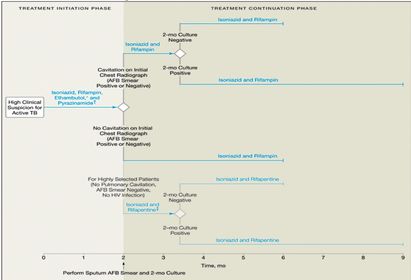
The two remaining residual populations grow more slowly a nd are protected by areas of necrosis in an acidic environment, periods of growth spurts interspersed with periods of dormancy. Role for PZA in first two months of therapy. Allowed shortening of duration of therapy from 1 yr to 6 months. - 19Duration of TB Therapy Pulmonary TB
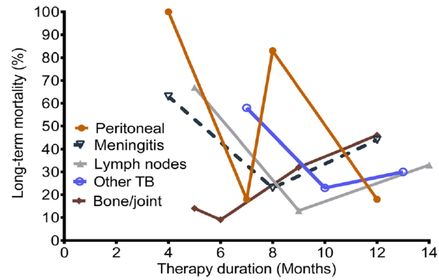
- 20Duration of TB Therapy Extra pulmonary TBThe relationship between treatment duration and mortality is a "V" shaped curve. For all disease syndromes, mortality decreased with longer treatment duration until a nadir, which was the treatment duration associated with the lowest proportion of patients with adverse long-term outcomes. Thereafter, mortality increased with longer duration of therapy.
- 21INH ResistanceOverall US INH resistance rate 8.9% (2012).
Areas where INH resistance >4% need to add 4th drug, ethambutol
CT INH resistance 13.2% (7 cases, 2012)
Due to alterations in the KatG per oxidase-catalase; INH is not activated
Less commonly, may be die to altered enzymes -- enoyl-acyl carrier protein reductase (InhA) and acyl carrier protein B-ketoacyl-ACP synthase.
Risk factors for resistance: History of prior TB, Asican/Pacific Islander, age >65, foreign born. - 22Rifampin ResistanceUncommon by itself. Usually associated with multi drug resistance with INH. 1.1% in US (2012) 1 case in CT (2012).
Due to point mutations in the polymerase gene (B-subunit rpoB)
Risk factors for INH and RIfampin resistance are prior TB history, foreign born. - 23Preventing Multidrug Rresistant - TBUse of appropriate drug regimen up front.
4 drugs in most of US
NEVER ADD ONE DRUG TO A FAILING REGIMEN
Most US MDR cases result from inconsistent or incomplete therapy as opposed to patient to patient transmission. Not true in other countries where patient to patient transmission can and does occur. - 24Cross Drug Resistance - TBResistance to INH and Rifampin
AND
Resistance to any Fluoroquinolone
AND
Resistance to any ont of the second line injectable drugs (amikacin, capreomycin, kanamycin) - 25DOT (Directly observed therapy) Optimizing adherenceDOT should be the default method for medication administration
Contact local public health department. May contract out to local VNA services.
With enhanced DOT 90.2%. Of patients completed therapy as opposed to only 61.4% completeion rate of unsupervised therapy. - 26TB Discharge Planning Connecticut State LawRequires pre-discharge collaborative planning with public health officials before a patient with active TB can be discharged from the hospital.
The local public health department must approve the discharge plan.
TB patient Hospital/Discharge Management Plan must be completed before discharge. - 27Alternative TB Agents RifabutinUseful in lieu of rifampin if patient is on ART with a PI. Can only be used with Efavirenz, Raltegravir, Dolutegravir
Half Life: 36-45 hours
Dose: Oral, must adjust with concomitant PI or NNRTI use
Metabolism: Hepatic
Bioavailability: Fair (53%) - 28Alternative TB Agents Rifabutin ToxicityUveitis: noted with concomitant clarithromycin use in MAI treatment trials of AIDS patients. Fluconazole also implicated. Inhbition of cyp3A4 by Fluconazole or clarithromycin resulting in elevated Rifabutin levels.
Rash
Orange-red discoloration of body fluids
Significant drug-drug interactions due to induction of cyp34A (less than rifampin) - 29Alternative TB Agents QuinolonesMoxifloxacin is the most active of the commercially available Quinolones against MTB and other mycobacteria.
Bacteriocidal
Effect in MTB similar to that of INH. - 30Alternative TB Agents Quinolones MoxifloxacinSimilar to Rifampin in velocity of killing.
EBA similar to that of INH.
Additional agent when NDR-TB suspected.
Useful when 2st line drugs not tolerated.
When strain resistant to INH, rifampin or ethambutol AND fluorquinalone susceptible.
CNS disease. - 31Alternative TB Agents Aminoglycosides StreptomycinEquivalent to ethambutol when used in initial phase of 6 month regimens
Resistance in areas of the world where MTB is highly prevalent, limits its utility. - 32Alternative TB Agents Aminoglycosides Streptomycin DosingDose adjusted for age and GFR
IV administration
Administer daily then reduce to 2-3x/week after 2-4 months of treatment or culture conversion
Levels are available by send out chemistry - 33Alternative TB Agents Aminoglycosides Streptomycin ToxicityOtotoxicity
Vestibulotoxicity
Neurotoxicity: Circumoral par atheists when infused; increase diffusion duration to 60 minutes.
Nephrotoxicity: Less common compared to other aminoglycosides (2%) - 34Alternative TB Agents CycloserineBacteriocidal
Inhibits cell wal biosynthesis by inhibiting racemase which converts l-ala to d-ala
Dose: oral
Metabolism: liver (35%)
Excretion: renal (50-70%). Do not use if GFR<50 unless patient on hemodialysis.
Half Life: 10-25 hours
Bioavailability: 100% - 35Alternative TB Agents Cycloserine ToxicityCNS: Headache, restless ness to psychosis or seizures.
Contraindicated in patient with known seizure disorder.
Acts as a partial agonist at the glycine recognition site of NMDA receptor.
B6 may help prevent/Treat CNS side effects.
Peak serum level should not exceed 20ug/ml - 36Alternative TB Agents EthionamideProdrugs activated by ethA
Similar to isoniazid
Inhibits my colic acid synthesis
Dose: oral
Half Life: 1.9 hours
Metabolism: Hepatic
Bioavailability: 100% - 37Alternative TB Agents Ethionamide ToxicityGI: Metalic taste, nausea, vomiting (severe), loss of appetite, abdominal pain. Symptoms reduced if taken with food. Better tolerated if titrated dose over a few days. Maybe better tolerated if split dose into w.
Hepatotoxicity: similar to INH, up to 2%
Neurotoxicity: Peripheral neuropathy, optic neuritis, depression, personality changes. Administer with B6 to reduce risk
Endocrine: hypothyroidism, hypoglycemia, gynecomastia
Caution wth concomitant admin with cyclosporine - increased risk of seizures - 38Alternative TB Agents P-Aminosalicylic acid (PAS)Bacteriostatic
Inhibits folate metabolism
Dose: Oral
Half Life: 1.1-1.6 hours
Metabolism: Hepatic (acetylation) then excreted into the urine (8-%
Bioavailability: 60-65% - 39Alternative TB Agents P-Aminosalicyclic acid (PAS) ToxicityGI: Intolurance due to N/V, diarrhea
Hepatotoxicity: .3%
Malabsorption syndrome: Steatorrhea, low serum folate levels
Hypothyroidism: Especially in combination with Ethionamide.
Coagulopothy: elevated PT - 40Other TB Medications Amikacin CapreomycinAmikacin: Helpful even in streptomycin resistant isolates
Dose: IV
Capreomycin: Used during amikacin shortage. Problems of magnesium and potassium wasting - 41Other TB Medications LinezolidProblems related to dose
Safety
Cost - 42Other TB Medications BedaquilineDiarylquinolone
Used for treatment of MDR-TB
Inhibits mycobacteria L ATP synthase
Half Life: 5.5 months
Dose: Oral
Metabolism: Hepatic, cyp3A4
Bioavailability: 36-79% (food increases bioavailability 2 fold) - 43Other TB Medications Bedaquiline RiskIncreased risk of death
QT prolongation
Transaminitis (11%) - 44CNS Penetration of Anti - TB Agents
Informações
- Descrição
- 1 PA School FlashCards sobre Pulmonology - TB Pharmacology, criado por Elle Ashe em 10-01-2016.
- Criado por
- Elle Ashe
- Visualizações
- 39
- Tags
- Avaliação