
Flashcards
Business Theme 1
Flashcards do conjunto (103)
- 1Marketingthe process of anticipating, identifying and satisfying customer needs profitabally
- 2Marketing objectivestargets or goals that an organisation hopes to achieve that are Specific, Measurable, Achievable, Realistic, Time-specific.
- 3Marketing strategiescarefully evaluated medium to long-term plans for how to achieve marketing objectives balancing available resources and marketing oppurtunities implemented through the marketing mix.
- 4Mass marketa very large market where most people tend to buy the same or similar products, and these products are aimed at the whole market.
e.g. toilet paper. - 5Question TextAnswer Text
- 6Question TextAnswer Text
- 7Question TextAnswer Text
- 8Dynamic marketsmarkets that are constantly changing, due to e.g. rising incomes, fashion changes.
- 9Stable marketmarkets in which the pace of change is slow and steady.
- 10Digital economyincludes all those areas of the economy that are affected by the development of computer hardware and software, ICT networks and online marketing.
- 11Samplingthe gathering of data from a sample of respondents, the results of which should be representative of the population as a whole.
- 12Market segmentationdividing the market into groups of consumers with similar characteristics.
- 13A generic brandthe ultimate prize of mass marketing which means thats customers associate the brand so strongly with a product that they use the brand name as if it were a product category
- 14Market orientationis when a business responds to customer needs and wants and then designs products accordingly
- 15Product orientationwhen a business responds to customer needs and wants and then designs products accordingly.
- 16Market Positioninghow individual products or brands are seen in relation to their competition in the eyes of the consumer.
- 17Market mapAn illustration of the range of positions that a product can take in a market based on two dimensions that are important to customers.
- 18Competitive advantageany feature of a business that enables it to compete effectively with rival products. An advantage may be based on price, quality, service or innovation.
- 19Product differentiationwhen customers perceive a distinct difference between your product and the alternatives provided by competitors.
- 20Question TextAnswer Text
- 21Question TextAnswer Text
- 22Question TextAnswer Text
- 23Question TextAnswer Text
- 24The basic law of demanddemand varies inversely with price.
- 25supplythe quantity of a good or service that a producer is willing and able to supply onto the market at a given price at a given time
- 26basic law of supplyas selling price increases supply increases
- 27what would a shift left of the supply curve mean on a demand and supply diagram?a decrease in supply
- 28equilibriumthe point where there is a balance between supply and demand which makes the price stable.
- 29price elasticity of demandmeasures the extent to which the quantity of a product demanded is affected by a change in price
- 30PED formula% change in quantity demanded /
% change in price - 31Interpretations of PEDMore than 1 = price elastic
Less than 1 = price inelastic
Exactly 1 = unitary price elasticity - 32price elasticchange in demand is more than the change in price
- 33price inelasticchange in demand is less than change in price
- 34income elasticity of demandthe extent to which a change in consumer incomes affects the quantity demanded of a product/service
- 35YED formula% change in quantity demanded /
% change in income - 36YED interpretationsbetween 0 and 1 = normal neccessitites e.g. fresh fruit
more than 1 = luxury e.g.restaurant meals
less than 0 = inferior e.g. primark clothes - 37Marketing Mixall of the elements of a firm's marketing strategy that are used to make their products more attractive to customers.
4 p's: product, price, promotion place. - 38Design Mixrefers to the way in which all aspect of product design are considered, including cost/ economic manufacture, aesthetic and cost, so that the product will match every customer requirement.
- 39Social trendsrefer to the way society as a whole behaves and the values that determine behaviour.
- 40A Branda product that is easily distinguished from other products so that it can be easily communicated and effectively marketed.
- 41Brandingcreating a positive and recognizable product or service in the mind of the customer.
- 423 Benefits of Effective Branding1. Added value
2. Premium prices
3. Builds customer loyalty - 43Added Valuethe difference between the selling price of a product and the costs of the material inputs.
- 445 Types of Branding1. Product brand
2. Umbrella/Family brand
3. Corporate & Own Label brand
4. Global brand
5. Service brand - 45Emotional brandingthe term given to the creation of brands that appeal to a consumer's emotional nature rather than their logical one.
- 46Promotiondesigned to inform customers and potential customers about the product/service and persuade them to buy it.
- 476 Types of Promotion1. Advertising
2. Sales offers
3. Digital
4. Sponsorship
5. Direct sales
6. Public relations - 48Pricing Strategiesa range of ways in which a business might decide on the price of a product or service.
- 49Cost-plus pricingadding a certain % to the average total cost of the product.
- 50Premium pricingthe ability to charge a higher price than competitors, without losing sales.
- 51Price skimmingcharging a very high initial price for the product.
- 52Competitive pricingcharging about the same price as, or a little less than, the prices of competing products.
- 53Penetration pricingcharging a lower price than competition to try and persuade customers of existing products to give the new product a try it, in an attempt to penetrate the market and gain market share
- 54Psychological pricingused to make the price seem more attractive than it actually is by rounding it down slightly.
e.g. £7.99 instead of £8. - 55Predatory pricinga tactic used by dominant businesses to reduce competition. Prices are set at a very low level, even below the costs of production, for as long as it takes to 'destroy' the competition.
- 56Dynamic pricingsetting flexible prices for products or services based on current market trends.
- 57Distributionmaking products available in the right place at the right time in the right quantities.
- 58Distribution channelthe route taken by the product as it moves from the producer to the customer.
- 59Multi-channel distributiona business using more than one type of distribution channel
- 60Product Life Cyclethe different stages a product passes through.
- 615 Stages of the Product Life Cycle1. Research and development
2. Introduction
3. Growth
4. Maturity
5. Decline - 62Product Portfoliothe range of products that a business produces.
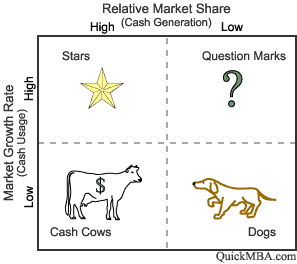
- 63Boston Matrixa method of analysing a company's products in terms of their market share and growth potential.
- 64Assetsomething of value to a business, such as cash or inventory.
- 65Liabilitysomething has a negative effect on the value of a business, such as a loan.
- 66Flexible workforcea workforce that can adapt quickly to changing circumstances.
- 67Multi-skillingthe practise of training employees so that they have the ability to do a range of tasks, or of recruiting employees who have several skills.
- 68Zero-hours contractsthe employer does not have to provide the employee with any number of particular hours, and the employee is not obliged to take the hours.
- 69Flexible hoursrequire the employee to work a certain amount of hours in a given time period but mostly there are no fixed hours they they have to on site.
- 70Outsourcingthe situation where business tasks or processes are undertaken by an external provider.
- 71Dismissala worker is told to leave the job because their behaviour is unsatisfactory or they have repeatedly failed to work to the required standard.
- 72Redundancyoccurs when a worker is told to leave the job because their skills are no longer of use to the organisation.
- 73Individual approachdirect discussions between an employer and an individual.
- 74Collective bargainingdiscussions between employers and representatives of employees.
- 75trade unionsorganisations that represent employees.
- 76Internal recruitmentrecruiting employees from within the business to fill a new job position
- 77External recruitmenta business chooses to recruit employees from outside the existing workforce to fill a vacancy.
- 78Labour turnoverthe rate at which staff leave the business.
- 79E.g. of recruitmentment hard costsadvertising, interview expenses, time spent dealing with applications
- 80E.g. of recruitment soft coststhe loss of production when staff are involved in recruitment and training.
- 81Organisational Structurethe framework, usually hierarchical, which shows how a business arranges its lines of authority and communications, and allocates responsibilities and duties
- 82Delayeringflattens an organisational hierarchy by removing levels of management.
- 83Chain of commandsets out the levels of authority for giving and taking instructions within an organisation.
- 84span of controlthe number of people directly answerable to each person in the chain of command.
- 85matrix structureindividuals belong to groups according to their speciality and they work in teams on specific projects.
- 86centralised structureinvolves keeping all decision-making at the top of the hierarchy, usually in the head office.
- 87decentralised structurebusinesses have moved the decision making process away from a central head office and spread it through the business.
- 88motivationthe will to work
- 89What was Taylor's motivation theory?the scientific management
- 90Summarise the scientific theory by taylor- employees are only motivated by money
- used technical investigations to identify best production methods
- employees need very carefully contolling - 91what was Mayo's motivation theory?human relations thoery
- 92summarise Mayo's human relations theory- more importance placed on how people interact and how they are treated
- employees are more motivated when they feel involved - 93what is Maslow's motivation theory?hierarchy of needs
- 94List the needs1. self-actualisation
2. self-esteem
3. social needs
4. safety needs
5. basic physical needs - 95What was Herzberg's motivation theoryTwo Factory theory
- 96Summarise the two factor theory1. Motivating factors - e.g. praise and promotion.
2. Hygiene factors - e.g. clean working conditions
Both are important but if one is absent there will be dissatisfaction and if they are both present employees will be motivated - 975 financial incentives1. Piecework - paid per item made
2. Commission - % of business generated
3. Bonus schemes - targets
4. Profit share - share of profits is paid
5. Performance related pay - 988 Non-Financial Incentives1. Delegation
2. Consultation - discussions about all
3. Empowerment - more trust
4. Team working
5. Flexible working - choosing hours
6. Job enrichment - different skill levels
7. Job rotation - different jobs same skill
8. Job enlargement - varied range - 99Leadershipthe art of motivating and organising a group of people to achieve a common goal.
- 100Autocratic Leaderstake top-down decisions without consultation and sometimes described as authoritarian
- 101Democratic leadersguide rather than dictate, consulting widely and encouraging everyone to participate in the decision-making process.
- 102Paternalistic leadersbehave rather as a parent might in making family decisions.
- 103Laissez Faire Leaderswill set the initial agenda and then will stand back and let employees have complete control.
Informações
- Descrição
- AS - Level Business FlashCards sobre Business Theme 1, criado por Hannah Jones em 20-12-2016.
- Criado por
- Hannah Jones
- Visualizações
- 20
- Avaliação