
11177581
Description

Quiz by Michael Jardine, updated more than 1 year ago

|
Created by Michael Jardine
almost 9 years ago
|
|
Question 1
Question
Glucose is a 6-Carbon ring that’s metabolisable as a “D-isomer”. It’s C6-H[x]-O[y]?
Answer
-
X = 12; Y = 6
-
X = 6; Y = 6
-
X = 6; Y = 12
-
X = 12; Y = 12
Question 2
Question
Glucose is a:
Answer
-
Monosaccharide
-
Polysaccharide
-
Monoglyceride
-
Polyglyceride
Question 3
Question
Glucose is consumed as starch and glycogen and broken down to glucose by [blank_start]__________[blank_end] [blank_start]__________[blank_end] [blank_start]__________[blank_end] for transport across the enterocytes.
Answer
-
Exocrine
-
Endocrine
-
Autocrine
-
Paracrine
-
Pancreatic
-
Hepatic
-
Leukocytic
-
Lymphatic
-
Glycosidases
-
Glycocytes
-
Glycosides
-
Glycogenases
Question 4
Question
How much of the postprandial glucose disposal is accounted for by skeletal muscle glucose uptake? (in humans)
Answer
-
~70-80%
-
~20-30%
-
~50-70%
-
~30-50%
-
~80-90%
-
~10-20%
Question 5
Question
Triglycerides (/“Triacylglycerols”) are complex lipids that are 3 Fatty Acids attached to a [blank_start]_______[blank_end] backbone.
Answer
-
3 Carbon Glycerol
-
3 Carbon Glycogen
-
5 Carbon Glycerol
-
5 Carbon Glycogen
Question 6
Question
Free Fatty Acids (“NEFA”: Non-Esterified Fatty Acids) are released from [blank_start]__________[blank_end] and circulate bound to [blank_start]__________[blank_end].
Answer
-
Adipocytes
-
Albumin
Question 7
Question
Triglycerides (/TriAcylGlycerols/TAGs) circulate in lipoproteins secreted from the Liver or Gut. Which type of lipoprotein is secreted from each of the two?
Liver: [blank_start]__________[blank_end]
Gut: [blank_start]__________[blank_end]
Answer
-
VLDL
-
LDL
-
HDL
-
Chylomicron
-
Chylomicron
-
VLDL
-
LDL
-
HDL
Question 8
Question
ADIPOSE-DERIVED Fatty Acids are taken up by which tissues?
Answer
-
Liver
-
Gut
-
Muscle
-
Liver and Gut
-
Liver and Muscle
-
Gut and Muscle
-
All of the above
-
None of the above
-
ALL tissues
Question 9
Question
Once dietary TriAcylGlycerols have been hydrolysed and transported across the enterocytes, they’re then esterified back into TriAcylGlycerols and packaged into:
Answer
-
Chylomicrons
-
VLDLs
-
LDLs
-
HDLs
Question 10
Question
Once adipose-derived Fatty Acids are taken up by the liver, they’re esterified into TriAcylGlycerols and packaged into:
Answer
-
Chylomicrons
-
VLDLs
-
LDLs
-
HDLs
Question 11
Question
Chylomicron-TG is metabolised at the tissue level by [blank_start]__________[blank_end], which hydrolyses CM-TG to release FA for tissue uptake.
Answer
-
LipoProtein Lipase (LPL)
-
Low-Density Lipoproteins (LDLs)
-
High-Density Lipoproteins (HDLs)
-
Very Low-Density Lipoproteins (VLDLs)
Question 12
Question
After hydrolysis of the Chylomicron-TG, the particle becomes smaller, forming CM-remnant.
This remnant particle is taken up by the [blank_start]__________[blank_end] and the TG remaining in the particle can be repackaged into a [blank_start]__________[blank_end], thereby recycling the dietary FA.
Answer
-
Liver
-
Gut
-
Muscle
-
VLDL
-
HDL
-
LDL
-
LPL
-
VLPL
-
Chylomicron
Question 13
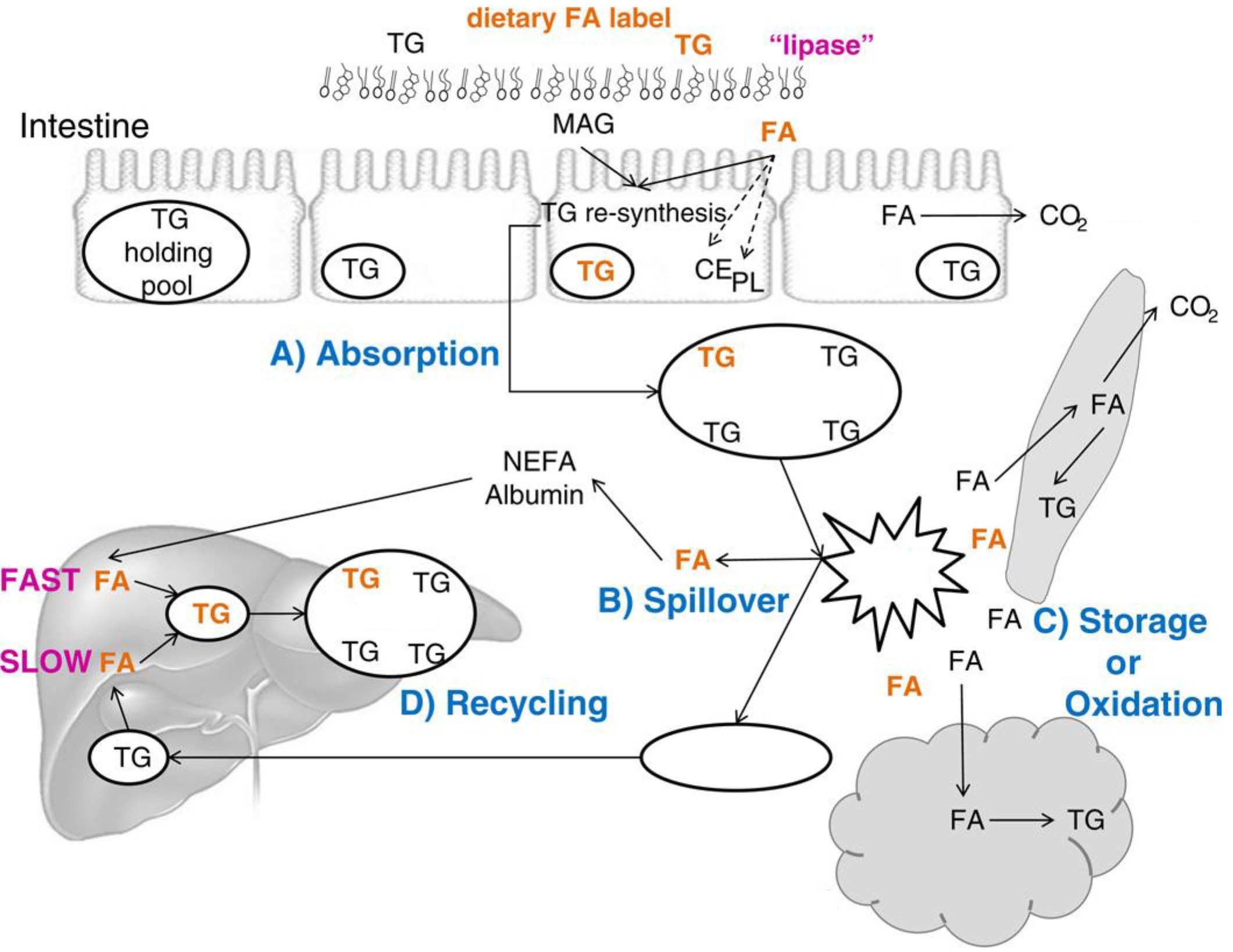
Answer
-
Chylomicron
-
LDL
-
VLDL
-
LPL
-
HDL
-
VLPL
-
LPL
-
VLPL
-
LDL
-
VLDL
-
HDL
-
Chylomicron
-
Chylomicron remnant
-
VLDL remnant
-
LDL remnant
-
HDL remnant
-
VLPL remnant
-
LPL remnant
-
VLDL
-
LDL
-
LPL
-
VLPL
-
HDL
-
Chylomicron
-
Liver
-
Adipose
-
Muscle
-
Adipose
-
Liver
-
Muscle
-
Muscle
-
Adipose
-
Liver
Question 14
Question
Which two mostly carry TAGs (/TAs/TriAcylGlycerols/TriGlycerides)?
Answer
-
Chylomicron
-
VLDL
-
LDL
-
HDL
Question 15
Question
Which two carry mostly* Cholesterol?
(not actually mostly, but more than TAGs)
Answer
-
LDL
-
HDL
-
VLDL
-
Chylomicron
Question 16
Question
Glucose uptake is limited by GLUT levels at the plasma membrane… …but can be overcome by an increase in levels of what?
Answer
-
HK2
-
HK1
-
SA1
-
SA2
Question 17
Question
The rate of fatty acid oxidation is controlled by the rate of FA entry into the mitochondria – this step is catalysed by what? (the activity of which is regulated by malonyl-CoA through ALLOSTERIC REGULATION)
Answer
-
CPT1
-
CPT2
-
HK1
-
HK2
Question 18
Question
The modification of proteins is a highly conserved process that regulates protein/enzyme activity. A diverse range of PTMs include:
[blank_start]__________[blank_end]: Addition of a phosphate (from ATP or similar triphosphates)
[blank_start]__________[blank_end]: Addition of acetate from acetyl-CoA
[blank_start]__________[blank_end]: Addition of a glucose molecule
[blank_start]__________[blank_end]: Include myristolyation (C14), palmitolyation (C16)
Answer
-
Phosphorylation
-
Acetylation
-
Glycosylation
-
Lipidation
Question 19
Question
Can Phosphorylation activate or inactivate an enzyme?
Answer
-
Activate
-
Inactivate
-
Neither
-
Either
Question 20
Question
True or false: The synthesis of new protein is another point of regulation. An example of this is Gluconeogenesis.
Answer
- True
- False
Want to create your own Quizzes for free with GoConqr? Learn more.