
Quiz
Chapter 3
This quiz has question types that open in the usual player.
Questions in this quiz (29)
1Construction uses of steel includes structural steel, cold formed steel, fastening products, reinforcing steel, fastening products, and other miscellaneous products.
- ATrue
- BFalse
2Steel is an alloy of iron and [blank_start]carbon[blank_end].
- Acarbon
3The [blank_start]higher[blank_end] the carbon content, the [blank_start]harder[blank_end] & more [blank_start]brittle[blank_end] the steel is.
- Alower
- Bhigher
- Charder
- Dsofter
- Eductile
- Fbrittle
4The four different types of heat treatment for steel includes annealing, denormalizing, hardening, and tempering.
- ATrue
- BFalse
5Match each vocabulary word to the proper definition.
(1) [blank_start]Annealing[blank_end] - heating, then slowly cooling to room temperature.
(2) [blank_start]Hardening[blank_end] - higher heat, then rapid cooling by quenching in water/brine/oil
(3) [blank_start]Normalizing[blank_end] - similar to another heat treatment but with hotter temperature and is air cooled. More corrective than strengthening or hardening.
(4) [blank_start]Tempering[blank_end] - reheating hardened steel to a lower temperature and quenching- AAnnealing
- BNormalizing
- CHardening
- DTempering
- EAnnealing
- FNormalzing
- GHardening
- HTempering
- IAnnealing
- JNormalizing
- KHardening
- LTempering
- MAnnealing
- NNormalizing
- OHardening
- PTempering
6Annealing results in the steel getting [blank_start]softer[blank_end] & more [blank_start]ductile[blank_end], [blank_start]increasing[blank_end] the toughness.
- Asofter
- Bharder
- Cbrittle
- Dductile
- Eincreasing
- Fdecreasing
7Normalizing is for [blank_start]corrective[blank_end] purposes.
- Astrengthening
- Bcorrective
- Chardening
8After hardening, the steel is [blank_start]harder[blank_end] & more [blank_start]brittle[blank_end]. Once the hardening treatment is completed, it must be followed by [blank_start]tempering[blank_end].
- Aharder
- Bsofter
- Cbrittle
- Dductile
- Eannealing
- Ftempering
- Gnormalizing
9Tempering increases [blank_start]ductility[blank_end] and [blank_start]toughness[blank_end] after [blank_start]hardening[blank_end].
- Aductility
- Bbrittleness
- Ctoughness
- Dresilience
- Ehardening
- Fannealing
- Gnormalizing
10 [blank_start]Cold[blank_end]-Formed steel products are made by rolling or pressing the steel into semi-finished or finished good at low temperatures.
- ACold
- BMild
11Cold forming results in plastic deformation causing strain-hardening that decreases yield strength, but increases the tensile (ultimate) strength and hardness.
- ATrue
- BFalse
12A steel torsion test determines the yield strength, ultimate strength, elongation, and reduction of area (Poisson's Ratio)
- ATrue
- BFalse
13A torsion test for steel determines the shear modulus (G).
- ATrue
- BFalse
14The Charpy V-notch Impact test measures the resilience or fracture energy at different temperatures.
- ATrue
- BFalse
15Protective coatings can be used to isolate the steel from moisture. [blank_start]Barrier coatings[blank_end] requires repeated application and is a standard paint that isolated the steel. [blank_start]Inhibitive primer coatings[blank_end] contain pigments that migrate to the steel surface to passivate it or transfer electrons. [blank_start]Sacrificial primers[blank_end] contain metal or zinc pigments that become anodes. These anodes give up electrons to the steel and corrode instead of the steel.
- AInhibitive Primer coatings
- BBarrier coatings
- CSacrificial Primers
- DInhibitive primer coatings
- EBarrier coatings
- FSacrificial Primers
- GInhibitive Primer coatings
- HBarrier coatings
- ISacrificial primers
16Cathodic protection (CP) is a technique used to control the corrosion of a metal surface by making it the cathode of an electrochemical cell/circuit.
- ATrue
- BFalse
17Without CP, protons can cause decomposition of the metal.
- ATrue
- BFalse
18Steel production is energy intensive.
- ATrue
- BFalse
19The ASTM E8 is a test
- Afor assessing SPF durability when subjected to loading
- Brequiring use of a universal testing machine to evaluate the efficacy of elastometric roof coverings
- Cfor assessing stress-strain relationships for metals used in civil infrastructure
- Dnone of the above
20The horizontal line between 800C and 600C:
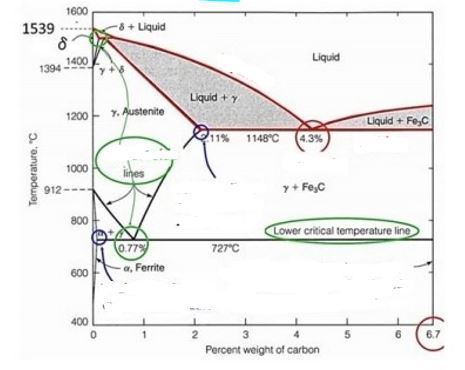
- Adistinguishes liquidus and solidus at a critical temperature
- Bdistinguishes the realm of most civil engineering steels (above the line) versus iron carbide (below the line)
- Cindicates when a liquid alloy becomes a solid mixture of alpha and gamma at a specific temperature, rather than existing over a temperature range
- Dindicates that steel with 0.77% carbon melts at 727C
21The horizontal line highlighted indicates:
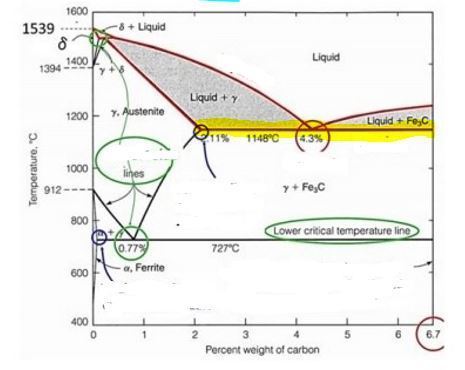
- Athe critical carbon dissociation temperature above which steels are high-strength
- Ba threshold at which upon cooling the liquid solution under eutectic temperature results into two solid solutions, both coexisting at the same time and in chemical equilibrium
- Ca critical temperature and carbon concentration at which iron is two different materials
- Dnone of the above
22The point highlighted represents the realm of steels with high toughness and less than ~0.03% carbon.
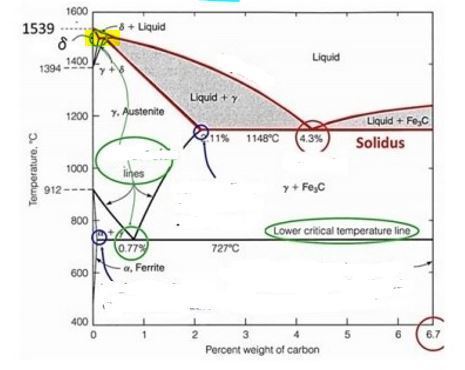
- ATrue
- BFalse
23The two points represent eutectoid reaction points, where at specific carbon solubility limits, the microstructure of solid material changes as a function of temperature.
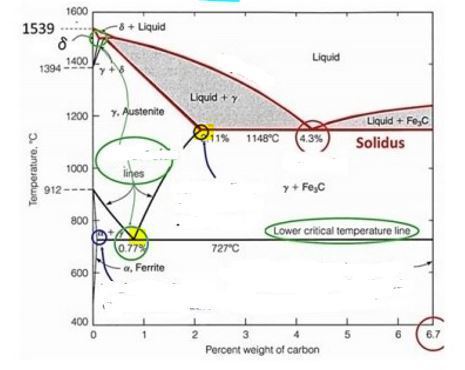
- ATrue
- BFalse
24This point represents carbon-saturated stainless steel.
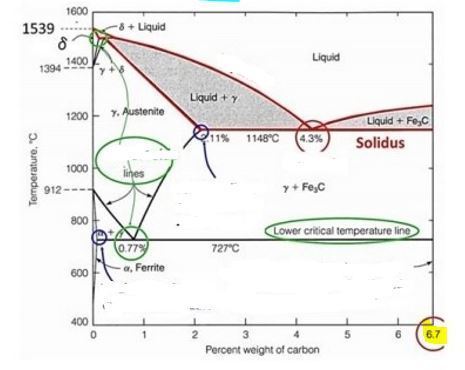
- ATrue
- BFalse
25The objectives of steel annealing are:
- Ato refine crystallite grains and remove gases
- Bto remove internal stresses and soften the metal
- Cto increase ductility and toughness
- Dto change electrical and magnetic properties
- Eall of the above
26Increasing carbon content in steel alloys is at the expense of strength.
- ATrue
- BFalse
27Which of the following is NOT true with respect to the heat treatment of steel?
- AIf heated steel is air-cooled it can destabilize molecular structure, resulting in non-uniform grain boundaries and make it prone to brittle fracture.
- BHeating, then slow cooling at room temperature anneals steels, making it more ductile and tough.
- CSteel treated at high temperature and then quenched in brine makes it harder and brittle, the reason why the metal must then be tempered.
- DIron must be heated in order to bond with carbon to form steel.
28Steels with higher carbon content are stronger but more brittle than structural steels.
- ATrue
- BFalse
29Why does the iron-carbon phase diagram go only to 6.7% carbon?
- Airon carbide is 6.7% carbon by weight so 6.7% carbon correlates to 100% iron
- Biron carbide is 6.7% iron by weight so 6.7% iron correlates directly to 6.7% carbon
- Cbecause that's what people feel like it should be
- Dnone of the above
Information
- Description
- Engineering (CE Materials) Quiz on Chapter 3, created by Kiki Medina on 19/02/2019.
- Author
- Kiki Medina
- Language
- English
- Views
- 0
- Tags
- Rating
- No ratings yet Rate this quiz