
Quiz
PSYC3700 Exam 1
This quiz has question types that open in the usual player.
Questions in this quiz (82)
1[blank_start]Locke[blank_end] argued that our source of certainty lies in our awareness of ourselves as sentient, together with pre-existing thoughts.
- ALocke
2[blank_start]Descartes[blank_end] argued that we cannot know what is real until we know with some certainty what it is that we can know.
- ADescartes
3[blank_start]Declarative[blank_end] knowledge is also known as [blank_start]offline/cold cognition[blank_end], which is knowing THAT something is the case.
- ADeclarative
- Boffline/cold cognition
4[blank_start]Procedural[blank_end] knowledge is also known as [blank_start]online/hot cognition[blank_end], which is knowing HOW to do something.
- AProcedural
- Bonline/hot cognition
5[blank_start]Priori[blank_end] knowledge, supported by Descartes, is the idea that ideas/principles are pre-installed in the human mind by a God.
- APriori
6____________ is to rationalism as ______________ is to empiricism
- ALocke; Descartes
- BDescartes; Locke
7[blank_start]Rationalists[blank_end] are from the general to the specific
- ARationalists
8[blank_start]Empiricists[blank_end] are from the specific to the general
- AEmpiricists
9Darwin had a [blank_start]materialistic[blank_end] view of the mind
- Amaterialistic
10[blank_start]Monophyletic origin[blank_end] can be defined as the descendent from a common evolutionary ancesor
- AMonophyletic origin
11Nature is to __________, and nurture is to _____________.
- ADeclarative Knowledge/Hot & Procedural Knowledge/Cold
- BDeclarative Knowledge/Cold & Procedural Knowledge/Hot
- CProcedural Knowledge/Hot & Declarative/Cold
- DProcedural Knowledge/Cold & Declarative Knowledge/Hot
12Evolution can be defined as [blank_start]descent with modification[blank_end]
- Adescent with modification
13Natural selection is a simple product of the concurrence of 3 requirements: [blank_start]variation, competition, and inheritence[blank_end]
- Avariation, competition, and inheritence
14[blank_start]Stablising selection[blank_end] is when species stop evolving and the average value of traits remains the same. Evolution occurs under [blank_start]driving or disruptive selection.[blank_end]
- AStablising selection
- Bdriving or disruptive selection.
15The European Peppered Moth discussed in class is an example of [blank_start]microevolution[blank_end] rather than [blank_start]speciation[blank_end].
- Amicroevolution
- Bspeciation
16[blank_start]Mutations[blank_end] are the wellspring of evolutionary change.
- AMutations
17Natural selection can only operate on [blank_start]what exists[blank_end].
- Awhat exists
18Natural selection modifying existing attributes to do different things
- AAdaptive radiation
- BDivergent evolution
- CFitness
- DGene pool
19[blank_start]Analogy[blank_end] is when two structures (such as a bat wing and a dragon fly wing) where they are alike, but not the same and do not share the same evolutionary history.
- AAnalogy
20[blank_start]Homology[blank_end] is a set of structures that are shared by a common ancestor (such as the flipper or a walrus and the wing of a bat).
- AHomology
21Why can no adaptation ever be perfect?
- AEnvironmental conditions are not fixed and change over time
- BMutations are the wellspring of evolution
- CNatural selection can only act on what exists
- DAll of the above
- EEnvironmental conditions are not fixed & natural selection can only act on what exists
22[blank_start]Macroevolution or speciation[blank_end], is the emergence of a new species
- AMacroevolution or speciation
23[blank_start]Allopatric speciation[blank_end] is speciation that follows from a population of animals being separated spatially.
- AAllopatric speciation
24As was the case with Darwin's finches, appearance is helpful in identifying species, but it does not define the species: the adherence to this definition is [blank_start]biological species concept[blank_end]
- Abiological species concept
25[blank_start]Hybridization[blank_end] is when the population may re-join without speciation taking place and the 2 gene pools effectively merge
- AHybridization
- BAllopatric speciation
- CDivergent evolution
- DHomoplasy
26To understand the historical or evolutionary context in which specific characteristics arise or disappear, we need to be able to identify the taxa using a [blank_start]phylogeny[blank_end]
- Aphylogeny
27Skeletal material and behaviour are both [blank_start]phenotypes[blank_end]
- Aphenotypes
28A trait that is shared by 2 or more species, but is not present in the common ancestor because it has evolved more recently. This provides a more accurate picture of relatedness, called [blank_start]synapmorphies[blank_end]
- Asynapmorphies
- Bapomorphies
- Chomoplasy
- Dhomology
- Eanalogy
29[blank_start]Convergent evolution[blank_end] or [blank_start]homoplasy[blank_end] is when a trait can carry or disappear within a clade independently of a common ancestor.
- AConvergent evolution
- Bhomoplasy
30A [blank_start]haplotype[blank_end] is a set of adjacent alleles or DNA sequences that is inherited together
- Ahaplotype
31Looking at the graph of oil-droplet evolution in vervetes,
Label 1. Which TWO species evolved independently from one another since the time of separation from the common ancestor
and 2. Which vision was the common ancestor for the bottom group?
and 3.What principle is graph illustrating?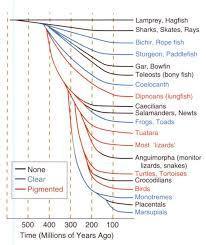
- AFrogs and monotremes
- Bpigmented
- CHomoplasy
32The problem with [blank_start]gene-based phylogenies[blank_end] is that we cannot extract useable genetic material from fossils, and gene clocks may not be properly calibrated. Thus, we must combine phenotypic phylogenies and genotypic phylogenies.
- Agene-based phylogenies
33Darwin promoted the [blank_start]comparative method[blank_end] when he pointed to baboons as a source of information
- Acomparative method
34Chimpanzees are more closely related to humans than they (chimpanzees) are related to gorillas.
- ATrue
- BFalse
35The good thing about gene-based phylogenies is that the number of mutations that have occurred within and across clades can also serve as a molecular clock for dating.
- ATrue
- BFalse
36[blank_start]Gene/Molecular Clocks[blank_end] operate on the assumption that spontaneous errors in nucleotide sequences during replication (mutations) happen at a fixed average rate.
- AGene/Molecular Clocks
37For a gene/molecular clock to be calibrated, a [blank_start]fossil record[blank_end] is conducted
- Afossil record
38The hominoidea group does not include apes and is solely consisting of all homosapians (living and extinct)
- ATrue
- BFalse
39Hominoids are characterized by 3 distinct modes of locomotion.... which ones?
- ABipedalism
- BKnuckle walking
- CBrachiation
- DSwimming
- ESitting
- FSwinging
40Humans are alone among the living primates in habitually walking bipedally. It is a feature only of the hominid lineage.
- ATrue
- BFalse
41Bipedalism evolved from a [blank_start]knuckle walking[blank_end] ancestor
- Aknuckle walking
- Bbrachiating
- Cswimming
- Dquadrapedal
42The good thing about gene-based phylogenies:
- AOperate on the assumption that spontaneous errors in nucleotide sequences during replication (mutations) happen at a fixed average rate, reflecting amount of time has passed since they split off from a common ancestor. Calibrated using a fossil record [how they found dogs were wolves]
- BThey are unbiased and scientifically accurate.
- CHelps identify possible selection pressures.
- DAllows us to infer WHEN attributes first emerged as well as it's functional significance.
- EThey tell us not only WHEN something happened, but also WHERE it did.
43[blank_start]Founder effects[blank_end] can be defined as the loss of genetic variability, through chance alone, that occurs when a small subset of a larger population is reproductively isolated and thus shifts the gene pool accordingly
- AFounder effects
- BAllopatric speciation
- CSynapomorphy
- DAnapomorphy
44[blank_start]Homoplast[blank_end] is a major problem in the construction of phylogenies. But, if we can identify it as such, it can be valuable in the comparative method.
- AHomoplasy
45[blank_start]Phylogenetic intertia[blank_end] is an expression of the same trait by different members of a clade only because it has been carried and hasn't come under selection pressure (if it ain't broke - don't fix it!)
- APhylogenetic intertia
46Even though we have equal numbers of living arboreal and terrestrial species, there is no evidence that the group size of each is a consequence of its ecological niche [analyze by interdependent contrasts]
- ATrue
- BFalse
47[blank_start]Language[blank_end] is a good example of descent with modification in hominin communities.
- ALanguage
48[blank_start]Platyrrhini[blank_end] primates are broad nosed. Their nostrils are far apart and generally open to the side. These are the New World Monkeys [confined to Central and South America] and are typically diurnal.
- APlatyrrhini
- BStrepsirihini
- CHaporhini
- DCatarrhini
49[blank_start]Catarrhini[blank_end] primates are narrow nosed that are flat and downwards. This includes humans and the old world monkeys/apes [Africa/Asia]
- ACatarrhini
- BPlatyrrihini
- CHaplorhini
- DStrepsirhini
50[blank_start]Strepsirhini[blank_end] primates have a bent, inwardly turned nose, and typically wet dog-like noses and are mostly nocturnal.
- AStrepsirhini
- BHaplorhini
- CPlatyrrihni
- DCatarrhini
51[blank_start]Haplorhini[blank_end] primates have simple noses are have 2 subtypes within this group.
- AHaplorhini
- BStrepsirhini
- CPlatyrrihni
- DCatarrhini
52We humans, and other apes of the Platyrrihini, are apart of the Hominoidea group.
- ATrue
- BFalse
53Hominoidea [we + apes of the catarrhine] belong to this group. Phylogenetically, the apes are characterized by the absence of a tail and are generally divided into 2 groups:
- AHylobatidae [lesser apes]
- BHominidae [great apes]
- CHylobatidae [great apes]
- DHominidae [lesser apes]
54The few living apes that were around during the miocene area occupied a variety of ecological niches and probably displayed physical and behavioural diversity that we now associate with the Old World Monkeys that replaced them [baboons, vervet monkeys]
- ATrue
- BFalse
55Not all living apes are ripe fruit eaters.
- ATrue
- BFalse
56The era in which mammals first appeared, or the 'age of the reptiles'.
- AMisocene era
- BMesozoic era
- CCretacious period
57Which 3 clades made it through the cretacious period when dinosaurs died?
- APlatypus
- BMarsupials
- CPlacental mammals
- DMonkeys
58There was a lineage splitting and this diversification is linked to the occupation of different and recently vacated ecological niches. It's likely that the diversification was underpinned by 3 apomorphic adaptations...
- ASensitive hearing made possible by the evolutionary emergence of the detached middle ear from the mandible
- BThe evolution of tribosphenic molars
- CThe emergence of the capacity to regulate body temperature using metabolic heat or shivering
- DThe evolution of bipedalism to maximize transportation efficiency through running
- EThe evolution of speech
59As a general rule, the most important thing to be able to do while up a tree is to avoid predation.
- ATrue
- BFalse
60What 3 adaptations made the ability to move from one food source to another possible?
- AThe evolution of primate grasp: the power grip, and the precision grip
- BThe evolution of binocular vision to aid stereopsis
- CThe emergence of only having 1 offspring at a time as opposed to a litter
- DThe emergence of language
- ESpeed increased by past experience with predators
61Which 3 things were sacrificed for the adaptations to live in the trees?
- ATeeth
- BClaws
- CPanoramic vision
- DSociality
- EQuadrapedalism
- FProblem solving
- GBinocular vision
- HDigit
62[blank_start]Robust[blank_end] australopiths chewed their way out of trouble. Their teeth are large, grinding molars that allowed them to process hard foods. [blank_start]Gracile[blank_end] australopiths had teeth that were less committed to a particular ecological view.
- ARobust
- BGracile
63The first identified member of our species was either [blank_start]homo habilis[blank_end] or [blank_start]homo ergaster[blank_end]
- Ahomo habilis
- Bhomo ergaster
64[blank_start]Homo erectus[blank_end] was the first hominin to leave Africa
- AHomo erectus
65[blank_start]Homo florensiensis[blank_end] was a hominin with small stature and small brain size
- AHomo florensiensis
66The emergence of the hominids is associated with:
- Aliving in the trees
- Bcompetition with apes living alongside humans
- Cthe cooling down and drying out of Africa
- Dpredation driving hominids to expand across the world
67The problems posed by savanna woodlands are of 2 kinds
- AThose associated with getting enough food and water
- BThose associated with increased risk of predation
- CThose associated with staying cool
- DThose associated with needing to communicate
68Primates have a specialized cooling system to cool their brains.
- ATrue
- BFalse
69Our inheritance of small incisors means that we were not dentally pre-adapted to meat eating.
- ATrue
- BFalse
70Lucy, an [blank_start]australopithecus afarensis[blank_end], was readily bipedal. Unlike chimps and more like us, her arms are shortened relative to her legs and her spine is curved and her tarsal bones are less manoeuvrable.
- Aaustralopithecus afarensis
- Bhomo erectus
- Chomo habilis
- Dhomo ergaster
- Eneanderthal
- Fhomo florensiensis
71We see in hominids a reduction in size of incisors and canine teeth and a substantial increase in the size of the molars. We also find an increase in the robustness of the lower jaw.
- ATrue
- BFalse
72Skeletal fossils allow us to infer not only the overall size of an extinct animal but also how it moved.
- ATrue
- BFalse
73Living in a more open country places a premium on the need for [blank_start]locomotion to be energetically efficient[blank_end].
- Alocomotion to be energetically efficient
- Bself-defence against predation
- Ctrees to sprout up to live in
- Dstereopsis vision for finding food
74Running is more energetically demanding than running.
- ATrue
- BFalse
75The smaller you are, it makes no difference in efficiency for walking vs running. If you are bigger, running has more energy costs.
- ATrue
- BFalse
76Chimp walking is very inefficient compared to the cost expected for a quadrupedal mammal of the same weight. Chimpanzees are more efficient when they run.
- ATrue
- BFalse
77Modern humans have an extraordinary capacity for long-distance running. Humans have a suite of adaptation that make the costs of endurance running tolerable....
- AAdaptations that minimize energy demand [balanced head, swivelling neck, long achilles tendons that soak up energy for free, large gluteus maximus for balance]
- BHumans have become taller and leaner [reduces the surface area exposed to direct sunlight and allows us to benefit from laminar air flow & alters body volume/surface ratio to ease heat loss]
- CStereopsis vision [color vision, binocular vision, precision]
- DBipedalism
78The [blank_start]obstetric dilemma[blank_end] is the collision of competing locomotory and reproductive selection pressures.
- Aobstetric dilemma
79Primate fetuses grow faster than those of average mammals.
- ATrue
- BFalse
80Human gestation is evolutionarily conserved.
- ATrue
- BFalse
81If it weren't for our [blank_start]large heads[blank_end], we would all arrive in the world without any real complications.
- Alarge heads
82In order to deal with the problems of large heads in humans, (2 things):
- AWe are born earlier than we should be
- BNatural selection has produced very elastic neonatal skulls that can deform in response to the pressures imposed by a rigid pelvis
- CWe have adapted to sweat in order to 'cool our brains'
- DNatural selection has provided us with language
Information
- Description
- PSYC3700 Exam 1
- Author
- Amy Labossiere
- Language
- English
- Views
- 47
- Tags
- Rating
- No ratings yet Rate this quiz