
Quiz
Dynamic Planet: Oceanography-Q2 05-10-15
Fragen in diesem Quiz (25)
1Which of the following is NOT a property of water?
- AWater has the ability to filter out UV light
- BWater is a solvent, allowing many chemicals to dissolve in it.
- CWhen water freezes into ice, it expands.
- DWater can change its temperature very quickly.
- EAll of the above.
2Global warming can cause all of the following EXCEPT
- AA rise in sea levels
- Bthe lowering of pH of the oceans
- Cincreased temperature stratification in the oceans
- Dincreased volcanic activity
- Eall choices are consequences of global warming
3Areas of low air pressure are typically characterized by _________________ air and move toward areas where the air pressure is ___________________.
- Arising, decreasing
- Bsinking, increasing
- Crising, increasing
- Dsinking, decreasing
- Esinking, not changing
4Which of the following events occur during an El Nino?
I. Ocean surface temperatures along the North and South American coasts become cooler.
II. Upwellings of cold, nutrient-rich water are suppressed.
III. Prevailing easterly winds weaken.- AI only
- BII only
- CIII only
- DI and III
- EI, II and III
5Which of the following is LEAST likely to be an effect of global warming?
- ALoss of fertile delta regions for agriculture
- BChange in global patterns of precipitation
- CExtinction of some species that have narrow temperature requirements
- DDecreased rate of photosynthesis in vegetation
- EIncreased frequency of hurricanes
6On the pH scale, _____________ is neutral.
- A3
- B4
- C5
- D6
- E7
7Which of the following statements about hot spot tracks is correct?
- AAll of the volcanoes making up the track have erupted at roughly the same time.
- BThe youngest volcano of the track occurs at one end of the track.
- CThe track is perpendicular to the direction that the plate is moving.
- DHot spot tracks are parallel to deep ocean trenches.
8In the Atlantic Ocean, where does the youngest oceanic crust occur?
- Aalong coastlines of the continents
- Bparallel to the paleo magnetic poles
- Cadjacent to mid-ocean ridges
- Dno set rule - could be anywhere in the Atlantic
9The oldest seafloor rocks are Jurassic in age (~200 million years), which is much younger than the age of Earth (~4.5 billion years). What are there no seafloor rocks older than Jurassic age?
- Aolder seafloor rocks have all been subducted down trenches
- Bolder seafloor rocks have been converted to continental crust
- Cthe oceans are not very old either
- Dall of the older seafloor rocks have been subducted at transforms
10If the earth had no ocean
- Alife would be more abundant, since life in the oceans is more "dilute" than life on continents
- Bthere would be no atmosphere
- Cthe range of surface temperatures on earth would be much greater than it is now
- Dthere would be no spreading centers
11Plate tectonics influences
- Athe size and shape of the ocean basins
- Bsediment accumulation rates
- Ccirculation in the oceans
- Dmigration of organisms
- Eall of the above
12The deepest parts of the seafloor tend to be the youngest oceanic crust.
- ARichtig
- BFalsch
13The oceanic lithosphere is generated at divergent plate boundaries, whereas
continental lithosphere is generated at convergent plate boundaries.- ARichtig
- BFalsch
14Compared to the Atlantic Ocean, the Pacific has
- A(a) a larger area and greater average depth
- B(b) more trenches and more frequent tsunamis
- C(c) more passive continental margins
- Da&b
- Ea, b & c
15Which of the following results in an increase of nutrients in surface seawater?
- Aincreasing sea surface temperature
- Bthe motion of North Atlantic Deep Water in the vicinity of the Antarctic Divergence
- Cthe motion of Antarctic Bottom Water through the Atlantic Ocean
- Dheavy precipitation directly into the ocean at the equator
- Eformation of Mediterranean Water
16Coriolis Effect forces water into a “hump”, more or less in the middle of each ocean basin, but is countered by the force of gravity which pulls the water down hill. When these two forces are in balance, the flow of water that is established is known as
- Athermohaline circulation
- Bpycnocline
- Ccentrifugal force
- Dgeostrophic flow
- Econvection
17Which of the following is NOT a western boundary current?
- AAgulhas
- BBrazil
- CCalifornia
- DGulf Stream
- EKuroshio
18In eastern equatorial Atlantic (P) you would find
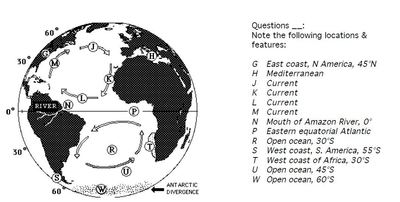
- Ahigh salinity
- Bfrequent hurricanes
- Cupwelling of cold water
- Dhigher sealevel than at N
19To the east of point H in the Mediterranean you'd expect to find ___ productivity due to ___
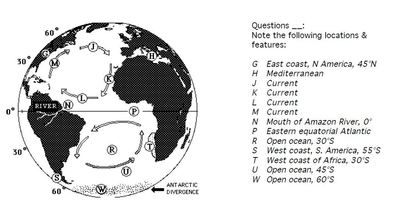
- Alow / downwelling
- Blow / upwelling
- Chigh / downwelling
- Dhigh / upwelling
20Arrange locations H, N, P, R in order from the lowest salinity to the highest salinity.
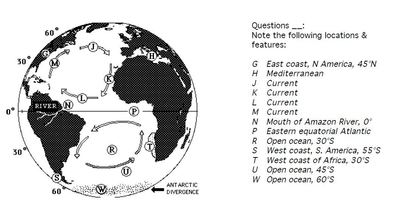
- AH, N, P, R
- BN, R, P, H
- CH, N, R, P
- DN, P, R, H
21Of the following currents, which is strongest, fastest and most intense?
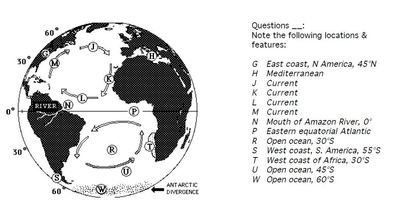
- AJ
- BK
- CL
- DM
22The photic zone
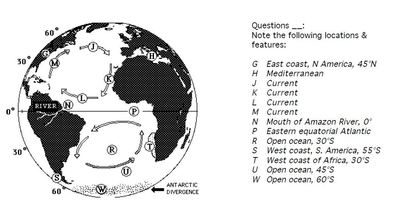
- Areaches greater at R than at N
- Bis the zone in which respiration proceeds faster than photosynthesis
- Cbecomes deeper when there is a big wind storm like the one we had last week.
- Dis the same thing as the pycnocline
- Eall of the above
23At a location, the water column has the temperature and salinity profiles shown to the right. Which surface process could account for these profiles?
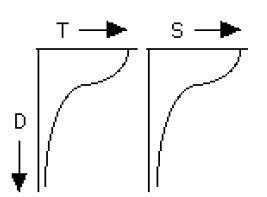
- Afreezing of sea water
- Bevaporation
- Cmelting of glaciers
- Dprecipitation
24The warmer the water is, the
- Aa) more gases will dissolve in it
- Bb) more salts will dissolve in it
- Cc) faster chemical reactions proceed in it
- Da & b
- Eb & c
25Which of the following is a density driven phenomenon?
- Athermohaline circulation
- Bhurricane
- Catmospheric circulation
- Dall of the above
- Enone of the above
Informationen
- Beschreibung
- DP event 2015
- Autor
- p4321p4321
- Sprache
- English
- Aufrufe
- 216
- Schlagwörter
- Bewertung
- Noch keine Bewertungen Bewerte dieses Quiz