
Karteikarten
OCF: Q9
Karten in diesem Stapel (10)
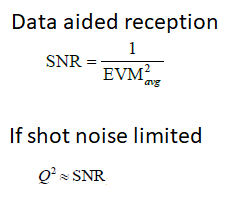
- 1Discuss the relations of SNR, EVM, Q and RIN.If we assume data aided reception we have that:
- 2How are the SNR and the OSNR defined?
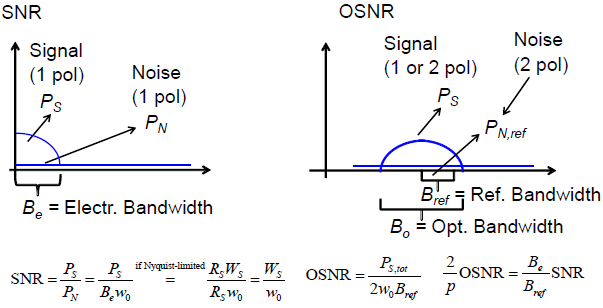
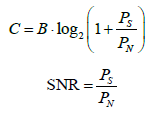
- 3How is the SNR related to the Shannon limit?
- 4Name the different processing steps which need to be done in an optical digital coherent receiver.1. Chromatic Dispersion Compensation
2. Deskew & Orthonormalization
3. Timing Recovery
4. Polarization Division De-Multiplexing
5. Carrier and Phase Recovery
6. Equalizing
7. Demapping - 5How can chromatic dispersion be compensated and what is the characteristic of the compensation filter?A dispersion compensating fiber (DCF) is one example of a filter which can undo chromatic dispersion. The inverse filter is defined as:

- 6Describe the impairments which should be mitigated by de-skewing and orthonormalization.- Timing might be of because of different optical path lengths in the Rx after the splitting into Ix, Qx, Iy, Qy.
- The 90° coherent Rx could have an offset from the ideal 90°. - 7What are the origins of timing errors?Tx and Rx have different clocks which aren't synchronized. Rx typically samples at a slightly higher rate to prohibit data loss (aliasing).
- 8Name different timing recovery algorithms and explain the basic ideas.-Early-Late Gate: 3 samples. If s0=s2 then s1 is at ideal position
-Mueller Müller: weight s[n] and s[n-1] with the expectation and use their difference to estimate the correction.
-Square: Square the signal and look at the spectrum. Peeks should indicate Fourier coefficients from which the the timing can be estimated. - 9Which effect should be equalized by polarization division de-multiplexing? How can this effect be mathematically described?Rotation, Phase-Retardation:
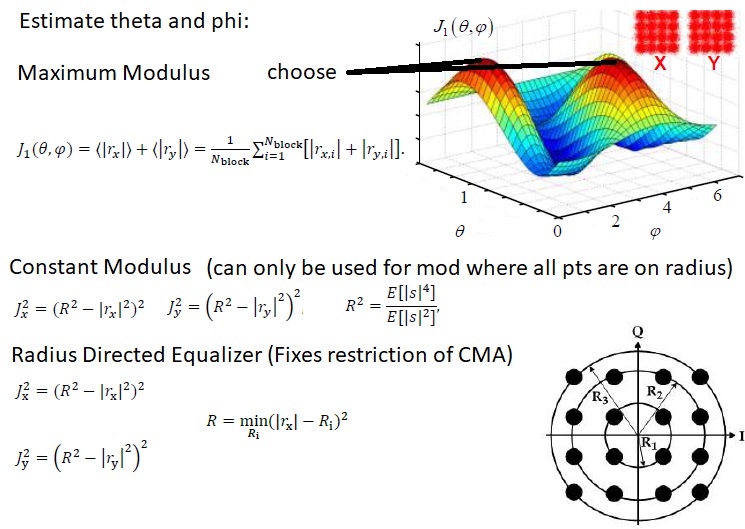
estimate: theta and phi for PDM
- 10Describe the different techniques which are used for polarization division de-multiplexing. How do their cost functions look like?
Informationen
- Beschreibung
- Digital Signal Processing
- Erstellt von
- Dominik Werner
- Aufrufe
- 10
- Tags
- Bewertung