
Signals, Systems and Signal Processing
84 resources created by 67 users
This Signals, Systems and Signal Processing page on GoConqr gathers community-made mind maps, flashcards, quizzes, flowcharts and notes, from basic signal types and Fourier analysis to digital filters and video coding. It's built for university students revising a topic or filling gaps, and teachers after ready-made material. There are over 70 resources here, including more than 10 quizzes, 24 mind maps and 27 flashcard decks. Pick a mind map to get your bearings, then test yourself with a quiz.
Top Signals, Systems and Signal Processing resources
-
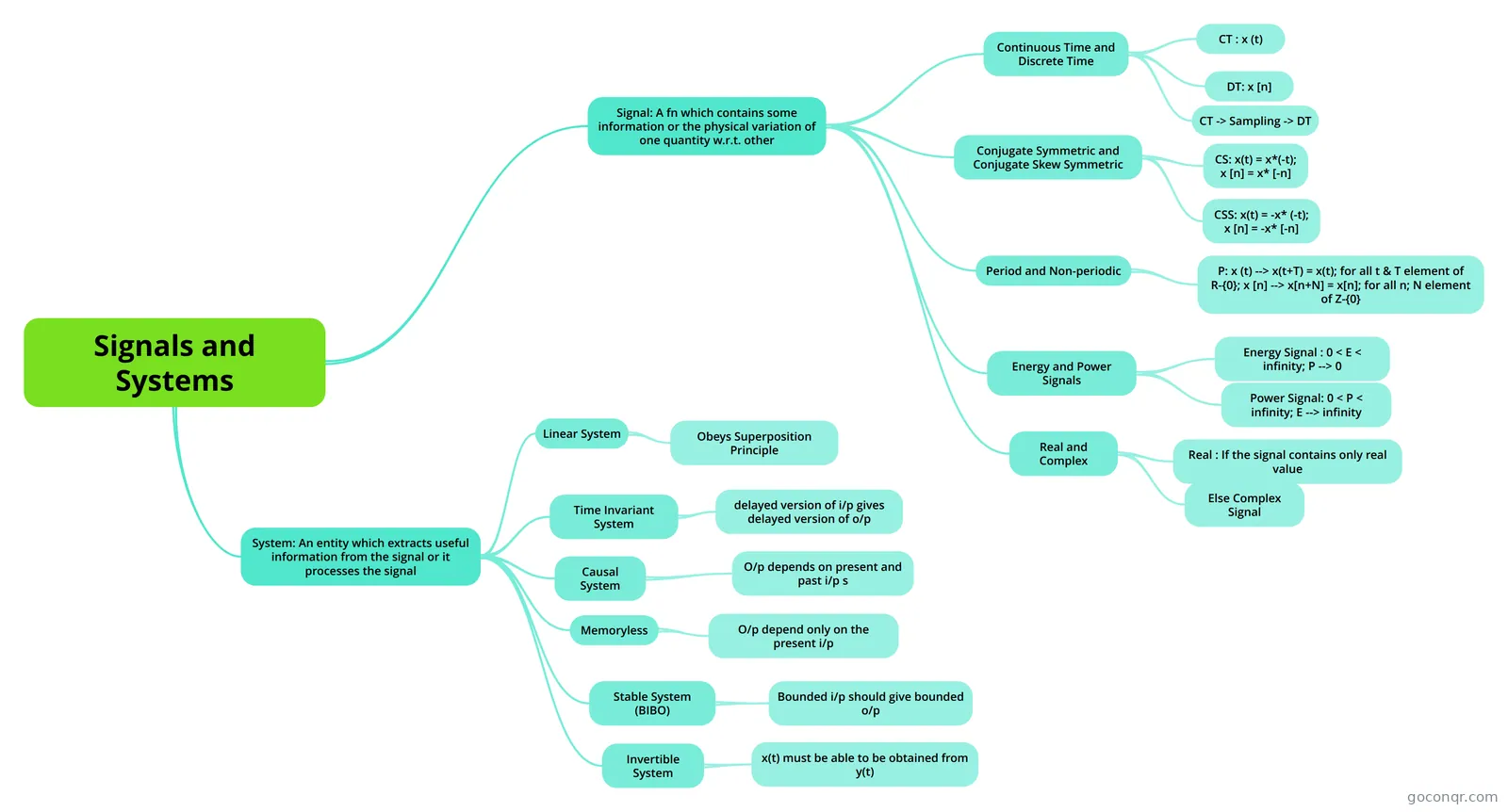 Mind map Signals and Systems
-
75 cardsIVC HVS more sensitive to high contrast image regions than low contrast regions.
-
50 questionsdata compression Which of the following characterizes a quantizer
-
15 questionsIntroduction to Continuous and Discrete-Time Signals and Systems
-
35 questionsDSP
-
40 questionsPrelim Exam DSP (CPE41S4) Tubol na matigas
-
45 cardsDefinitions
-
53 cardsDigital Signal Processing
Quizzes
See all 11 quizzes-
50 questionsdata compression Which of the following characterizes a quantizer
-
15 questionsIntroduction to Continuous and Discrete-Time Signals and Systems
-
35 questionsDSP
-
40 questionsPrelim Exam DSP (CPE41S4) Tubol na matigas
-
5 questionsFourier Series
-
15 questionsDigital Signal Processing Chebyshev Digital Filter
-
15 questionsFilter and Signal Processing In the Frequency Transformations of the analog domain, the transformation is
-
6 questionsUntitled If a system produces frequencies in the output are not present in the input, then the system cannot be
Mind maps
See all 27 mind mapsFlashcards
See all 27 flashcards-
75 cardsIVC HVS more sensitive to high contrast image regions than low contrast regions.
-
45 cardsDefinitions
-
53 cardsDigital Signal Processing
-
33 cards01 Handout represents signals by a sequence of numbers like sampling or analog-to-digital conversions. They perform pr...
-
51 cardsSignals and Communicatipn
-
30 cardsChapter 3 | Analog and Digital Signal Flash Cards What is a method of transmitting information by a continuous, but varying signal?
-
20 cardsEXAM 2 BUCKWARTS If x[n] is real and even, then ak will be real.
-
16 cardsChapter 2 - Signalling Flash Cards Whats the difference between a digital signal and an analogue signal
Flowcharts
See all 10 flowchartsNotes
-
SIGNAL SPACE - creado desde un Mapa Mental INTRODUCTION SIGNAL THEORY TIME-LIMITED SIGNALS
-
Reading Notes 1-1A law that we assume as true in all cases (such as Ohm's Law) and describes the "perfect" scenario. For Ohm's Law, it is almost perfectly true in small systems, but falls short in large ones or systems with noisy c...
-
why choose digital over analogue why choose digital over analogue?both signals pick up random noise; both signals weaken and reduce the quality of the sound analogue signals become weaker as they travel- needs to be amplified at selected intervals di...
-
EE222 - created from Mind Map Signals CT Even functions Odd Functions Systems CT(Analog Clock) DT(Digital Clock) Hybrid both CT & DT Properties Property 1 Property 2 Static(memoryless) Dynamic(memory) Causal Noncausal A system is static (memoryles...
-
Signals and Systems
-
Untitled Signals - kind of physical quantity that coveys informationAnalog - any continuous signal that varying with time represent in sine waveDigital - small fluctuations in signal that only take specific values to represent...
-
Chapter 2: Signal Analysis Chapter 2: Signal Analysis Signal & Time and Frequency Domain Signal Power & Signal Energy Fourier Series Frequency spectrum & Bandwidth Effects of Band-limiting Linear Summing & Non-Linear Mixing Non-linear mixer:1. ...
-
Untitled x[m,n] = pL [m-mo] * pj [n-no] X(F1,F2) = e-j2πF1mo * e-j2πF1(L-1) * sen (πF1L)/sen (πF1) * e-j2πF1mo * e-j2πF2(J-1) * sen (πF2J)/sen (πF2)
Slides
Topics in Signals, Systems and Signal Processing
More Electrical and electronic engineering topics
About Signals, Systems and Signal Processing
GoConqr OriginalWhat the resources cover
The page opens with the foundations. The mind map Signals and Systems defines a signal as a function carrying information, and a system as an entity that extracts useful information from it or processes it. The EE222 mind map goes on to even and odd functions, continuous-time and discrete-time signals, and static and dynamic systems. The Signals mind map covers linearity, time invariance, stability, causality, invertibility, energy and power.
Moving on to transforms and filters
Once the basics are clear, the Digital Filter mind map covers FIR and IIR filters, impulse response, direct, cascaded and polyphase forms, DFT, DTFT and aliasing. The mind map on Fourier analysis covers Fourier series, Fourier coefficients, and amplitude and phase spectra. There are also flashcard decks titled Fourier Transforms, Dirac Delta and LTI.
Beyond the core topics
Some resources reach into applications. The mind map on on-board data processing for downlink optimisation looks at data compression and FPGA implementation. The slide set Video Coding Fundamentals and the mind map MPEG2 vs H.264 deal with video coding. The IVC flashcards cover how human vision responds to contrast, luminance and spatial frequency.
A sensible order
- Start with the mind map Signals and Systems and the EE222_Section1 flashcards for the vocabulary.
- Move to the Signals mind map for system properties.
- Try the quiz Introduction to Continuous and Discrete-Time Signals and Systems.
- Read the Fourier and filter maps, then take the Fourier Series quiz and the Filter and Signal Processing quiz.
Use maps to see how ideas connect, then quizzes to find what hasn't stuck. Return to the map for any topic you miss.
Where it fits
This unit sits in the Signals and Communications strand of Electrical and electronic engineering. Pick one map, try one quiz, and see where your gaps are.
Frequently asked questions
Which resource should I open first?
Start with the mind map Signals and Systems. It defines a signal and a system in plain terms, so the later material makes more sense. The EE222_Section1 flashcards are a good second step, as they drill the basic vocabulary of continuous-time and discrete-time signals.
What do the mind maps cover?
They range from basic signal classification, such as even and odd signals, energy and power, to system properties like linearity, causality and stability. Others cover Fourier analysis, digital filters, data compression and video coding. There are 24 mind maps on the page, made by community contributors.
Which quizzes are available?
There are more than 10 quizzes. Examples include Fourier Series, Introduction to Continuous and Discrete-Time Signals and Systems, Filter and Signal Processing, and two on digital signal processing. Use them after reading a map to see which topics need another look.
Who are these resources for?
They are mostly aimed at university students, who can use them to revise topics and check their understanding. Teachers can also use them as ready-made material. The resources were made by GoConqr users, not by GoConqr itself, so it is worth checking them against your own course notes.
Are the resources free to use?
Yes. Every resource listed here is free to open, study and take, with no account needed. If you want to save quiz scores or make your own quizzes, mind maps, flashcards and notes, you can add a free account.
What if the topic I need is missing?
Look at related titles first, since topics often sit inside broader maps, such as sampling within the digital signal decks. If it still isn't there, you can make your own mind map or flashcards on it, and your own material is easy to build once you have an account.