
Karteikarten
Tutorial 1- Directed Learning Bacteria
Karten in diesem Stapel (38)
- 1What are the bodies first line defences against bacteria?Skin and secretions that bathe and protect exposed areas such as eyes, nose and gut lining.
- 2How can bacteria penetrate the skin?They are transmitted by vectors such as biting insects
- 3What do vaccines consist of?Dead or weakened form of the pathogen that the vaccine is providing immunisation against
- 4How do pathogens evade the body's immune system?1. Mutating rapidly to remain 'one step ahead' of the immune response.
2. Becoming invisible to the immune system by masking the antigens on their surface - 5What methods can be used to control bacterial infections?Immunisation, Selective toxicity and Antibiotics
- 6What is selective toxicity?A drug that is toxic to the pathogenic microbe but relatively harmless to the host
- 7What is an antibiotic?A substance produced by one organism that inhibits the growth of another
- 8What are the modes of action of antibiotics?Inhibition of the synthesis of bacterial cell walls, proteins or RNA
- 9What is the therapeutic index?The ratio of the effectiveness of a drug against its toxicity. A low value is the hallmark of a successful drug.
- 10What is the mode of action of penicillins?It inhibits the activity of peptidoglycan transpeptidase which is a crucial enzyme is the synthesis of peptidoglycan
- 11How are most antibiotics produced?Biologically- using bacteria or fungi
- 12What is a semi-synthetic antibiotic?The basic molecule is produced biologically and then it is modified chemically to produce molecules with desired characteristics
- 13What are chemically produced antibiotics?Antibacterial agents that are produced in a laboratory (they are not 'true' antibiotics.
- 14What is the mode of action of nallidixic acid?Inhibits bacterial topoisomerase
- 15What is the mode of action of sulphonamides?Interfere with bacterial production of folic acid
- 16Examples of beneficial aspects of bacteria-Ruminant animals and herbivores requires symbiotic bacteria to digest cellulose
-Nitrogen Fixation
Antibiotic Production
-Genetic Engineering - 17What usually causes pathogenic bacteria to be harmful?The toxins they produce
- 18What are the two types of toxins secreted by bacteria?Endotoxins and Exotoxins
- 19What are endotoxins?A surface component of the bacteria itself is toxic
- 20What are exotoxic bacteria?The bacterial cell secretes a protein or peptide with specific toxic effects
- 21Example of endotoxic bacteriaBacteria that are members of the genus salmonella
- 22Examples of diesease caused by exotoxic bacteriaBotulism (deadly form of food poisoning) and cholera
- 23Features of protein synthesis in bacteriaSmaller 70s ribosomes because they contain shorter RNAs and fewer proteins. Bacterial ribosomes are capable of stopping and starting translation in the middle of translating mRNA which means that bacterial mRNA are able to encode more than one polypeptide chain.
- 24Features of protein synthesis in eukaryotesLarger 80s ribosomes which means taht antibiotics that inhibit protein synthesis are effective as they block bacterial translation but not translation on the 80s ribosomes in human cells
- 25What are the different mechanisms of resistance?-Production of an enzyme that inactivates the antibiotic
-Reduction in permeability of the bacterial cell membrane
- Mutation of the target in the bacterium - 26What is the process by which resistance is spread?Horizontal gene transfer (HGT)
- 27What are the three mechanisms of horizontal gene transfer?Transformation, transduction and conjugation
- 28What is transformation?The uptake of parts of DNA from the environment which have resulted from the death of other bacterium
- 29What is transduction?When bacteria specific viruses transfer DNA between closely related bacteria
- 30What is conjugation?Direct cell-cell contact between two bacteria occurs and the transfer of small pieces of DNA in the form of plasmids takes place
- 31Which is the main mechanism of antibiotic resistant gene transfer?Conjugation
- 32What is the difference between human cell membranes and bacterial cells membrane?Human Cells: Various functions are distributed among the several membranes of the cell.
Bacterial Cell: The cell membrane is a multi purpose structure that carries out all functions - 33What does the cell wall provide?Great physical strength to the cell
- 34What are the two types of bacterial cell wall?Gram-positive and Gram-negative
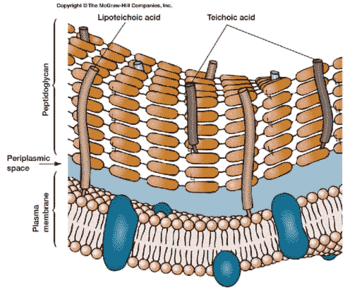
- 35What is the cell wall structure of gram-positive bacteria?The bacteria have a thick layer of peptidoglycan anchored to the cell membrane by lipoteichoic acid
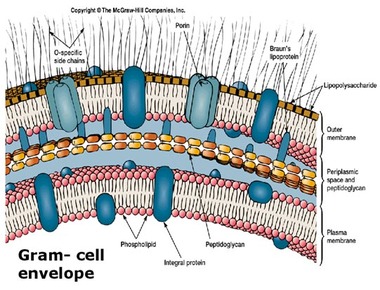
- 36What is the cell wall structure of gram-negative bacteria?The bacteria have a thin layer of peptidoglycan and enclosed by an outer lipid membrane in which lipopolysaccharide is embedded
- 37—Gram-positive bacteria
- 38—Gram-negative bacteria
Informationen
- Beschreibung
- Biology- Semester 1 (Tutorial 1- Directed Learning Bacteria) Karteikarten am Tutorial 1- Directed Learning Bacteria , erstellt von emma_moran am 27/12/2013.
- Erstellt von
- emma_moran
- Aufrufe
- 50
- Tags
- Bewertung