
Mind map
Tutorial 1- Directed Learning Bacteria
Map content
Tutorial 1- Directed Learning Bacteria
Body Defences
- First line defences
- Skin
- Some pathogenic micro-organisms are transmitted by vectors, such as biting insects, which allow them to penetrate the skins barrier
- The areas that are most exposed to infectious agents, such as eyes, ears, nose, mouth and gut lining, are bathed and protected by secretions including tears waxes and mucus
- Skin
- Immune Response
- The most important of the body's defences is the immune system
- The body's resistance to infection may be enhanced by artificial immunisation (vaccine)
- Vaccines are prepared using dead or weakened forms of the pathogen that vaccine is providing immunisation against
- Pathogens Evade the Body's Immune System
- Becoming invisible to immune recognition by masking the antigenic properties of their surface molecules
- Mutating sufficiently rapidly to remain 'one step ahead' of the immune response
- First line defences
Bacterial Infections
- Beneficial Aspects of Bacteria- Many bacterial are relatively harmless
- Ruminant animals- only ruminants and other herbivores are capable of digesting cellulose, this requires the presence of symbiotic bacteria
- Nitrogen Fixation
- The Environment- toxic substance are degraded by bacteria
- Antibiotic Production
- Genetic Engineering- the techniques used in gene manipulation rely on the use of bacteria, their plasmids and enzymes (notably restriction endonucleases)
- Toxins- Pathogenic bacteria are often harmful becuase of the toxins they produce
- Exotoxins- the bacterial cel secretes a protein or peptide with specific toxic effects
- Many of the most harmful bacteria exert their effects by secreting exotoxins, which circulate in the blood and cause disease symptoms. The effect of endotoxins doesn't depend on the bacteria that excrete them. The deadly form of food poisoning (botulism) and cholera are caused in this way.
- Endotoxins- a surface component of the bacterium itself is toxic
- Many Gram- negative bacteria of the gut exert their effect through components of their outer membrane, members of the genus salmonella all act in this way.
- Exotoxins- the bacterial cel secretes a protein or peptide with specific toxic effects
- Beneficial Aspects of Bacteria- Many bacterial are relatively harmless
Bacterial Cell Wall
- Two types
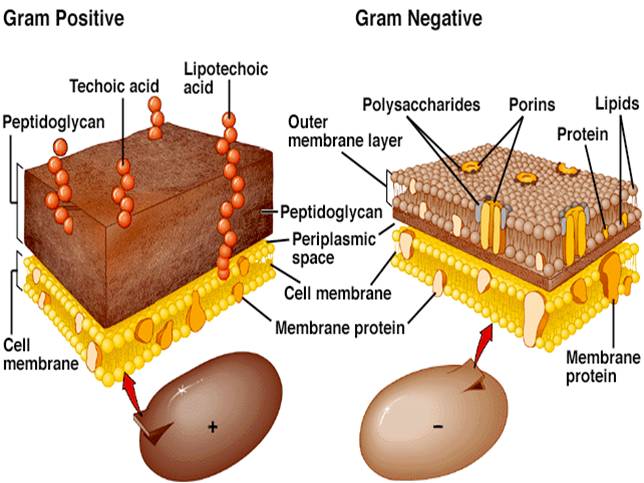
- Gram- positive bacteria have a thick layer of peptidoglycan anchored to the cell membrane by lipoteichoic acid
- Gram- negative bacteria have a thin layer of peptidoglycan, different from the gram-positive strains and enclosed by an out lipid membrane in which lipopolysaccharide is embedded
- Great physical strength, which is vital for the free living lifestyle of bacteria
- Two types
Control of Bacterial Infections
- Immunisation
- Selective Toxicity- A drug that is toxic towards the pathogenic microbe but relatively harmless to the host
- The effectiveness of the drug and the toxicity of the drug is measured. The ratio of the concentrations for these two parameters is a measure of the therapeutic index (effectiveness/toxicity) of the drug, a low value being the hallmark of a successful drug
- Antibiotics- a substance produced by one organism that inhibits the growth of another
- Mode of Action
- Inhibition of synthesis of bacterial cell walls, proteins or RNA
- Penicillins
- Penicilins interfere with bacterial cell wall synthesis. The peptidoglycan of the bacterial cell wall consists of polysaccharide link by short peptide bonds. A crucial step in the in the synthesis of this peptidoglycan is the action of peptidoglycan transpeptidase, which cross links polysaccharide chains via the pentaglycine peptide unit with the loss of the terminal D-alanine. The activity of transpeptidase is inhibited by the penicillins.
- Production for Clinical Use
- Biologically -Most antibiotics are produced by fungi and by bacteria Soem antibiotics are described as 'semi-synthetic' because the basic molecule is produced biological and then modified chemically to produce molecules with desired characteristics
- Chemically- Sulphonamides and nalidixic acid are clinically useful antibacterial agents but are not 'true' antibiotics- they were developed in laboratories.
- Sulphonamides interfere with bacterial production of folic acid
- Nallidixic acid inhibits bacterial topoisomerase
- Mode of Action
Cell Membranes
- Human Cells
- Various functions are distributes among the several membranes of the cell- for example, electron transport on the mitochondrial inner membrane and protein synthesis on membrane bound ribosomes of the RER
- Bacterial Cells
- The bacterial cell membrane is a multi purpose structure that carries out all functions
- Human Cells
Protein Synthesis
- Bacteria
- Smaller ribosomes (70s) because they contain shoted RNAs and fewer proteins. Bacterial ribosomes, unlike their eukaryotic counterparts, are capable of 'starting' and 'stopping' translation in the middle of translation of mRNA; bacterial mRNAs are able to encode more than one polypeptide chain.
- Eukaryotes
- Larger ribosomes (80s) which means that antibiotics that inhibit protein synthesis are effective as they block bacterial translation but not translation on the 80s ribosomes of human cells
- Bacteria
Resistance
- Mechanisms
- Production of an enzyme that inactivates the antibiotic
- Reduction in permeability of the bacterial cell membrane
- Mutation of the target in the bacterium
- Spread of Resistance
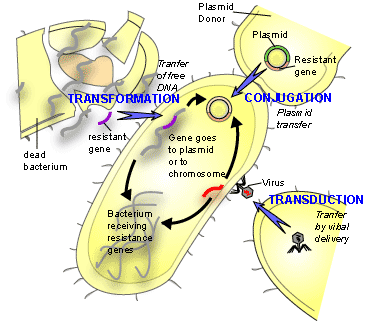
- Horizontal Gene Transfer (3 Types)
- Transduction- when bacteria specific viruses transfer DNA between closely related bacteria,
- Transformation- The uptake of parts of DNA from the environment which have resulted from the death of another bacterium
- Conjugation- where direct cell-cell contact between two bacteria occurs and the transfer of small pieces of DNA in the form of plasmids takes place. This is the main mechanism of antibiotic resistant gene transfer.
- Horizontal Gene Transfer (3 Types)
- Mechanisms
Images and files in the map
Information
- Description
- Biology- Semester 1 (Tutorial 1- Directed Learning Bacteria) Mind Map on Tutorial 1- Directed Learning Bacteria, created by emma_moran on 26/12/2013.
- Created by
- emma_moran
- Views
- 37
- Tags
- Rating