
Karteikarten
Attachment

Karten in diesem Stapel (39)
- 1Definition of attachmentThe relationship between infant and caregiver which is emotional, reciprocal and long lasting
- 2Examples of an infants physical needsFeeding, clothing, warmth, clean and dry
- 3Examples of emotional needsContact, social interaction, cuddles, playing and talking
- 4What did Mary Ainsworth believeThat infants probably have important emotional needs as well as physical needs
- 5What was the aim of the strange situation?To see if caregiver sensitivity affects the type and quality of attachment
- 6What two parts was the SS split into?Natural observations and controlled observations
- 7What 4 behaviours did the SS test?1. Willingness to explore
2. Separation anxiety
3. Stranger anxiety
4. Reunion behaviour - 8What are the 8 episodes of the SS?
- 9What are the three attachments types and the percentage of them found?1. Secure = 70%
2. Insecure avoidant = 20%
3. Insecure resistant = 10% - 10Ethical issues with the SSProtection from harm and fully informed consent
- 11Methodological issues with the SSParents show 'socially desirable behaviour (demand characteristics), it's ethnocentric as other cultures do not necessarily see 'good' attachments in the same way, waters suggests 72% of people change attachment type so therefore she didn't test what she thought she was so lacks internal validity, lack of external validity as its highly controlled
- 12Describe some research into cross-cultural variations in attachmentVan Ijzendoorn and kroonenburg - meta analysis of 32 pieces of research from 8 different countries
- 13What did Van Ijzendoorn and kroonenburg find out?-Secure is most common attachment type
- highest% found in UK and lowest in China
-highest % avoidant = West Germany
-highest% resistant= Israel and Japan
-variations withing cultures is 1.5 times greater than any variation between different cultures - 14Criticisms of research into cross-cultural variations in attachment- lack of control over variable so lacks internal validity
-SS isn't culturally relative so it lacks external validity (we are being ethnocentric)
- not equal number of studies from each country so lacks population validity and external validity - 15What is imprinting?When a species attaches themselves to the first moving object they see, hear or touch in a critical period shortly after they are born
- 16Describe research into imprintingKonrad Lorenz demonstrated on geese
- 17What stages do humans use to develop attachments?-caregiver-infant interactions
-reciprocity
-interactional synchrony - 18What are caregiver-infant interactions?Signals that a baby gives off and how the caregiver responds to these signals will affect the quality and strength of the attachment two of them go on to develop
- 19ReciprocityTaking turns to interact
- 20Interactional synchronyMirroring each others actions
- 21Who developed the stages of attachment?Schaffer and Emerson
- 22What are the 4 stages of attachment?1. Asocial
2. Indiscriminate
3. Specific
4. Multiple - 23Evaluate Schaffer and Emersons theory- has useful practical applications
- socially sensitive
-ethnocentric - 24Explain the role. Of the fatherMore likely to provide opportunities for play and stimulation where as the mother is for nurture however gender does NOT influence who the primary caregiver is
- 25What is the learning theory?LT comes from the behavioral approach, where the focus is on how we are conditioned by our environment that behave in ways which are rewarding. Two types of conditioning are classical and operant
- 26How does classical conditioning explain how attachments are formed
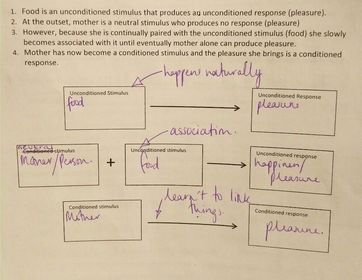
- 27What role does operant conditioninh play in attachment?It positively reinforces the attachment behaviours
- 28Evaluate the learning theory as an explanation of attachmentLT suggests that the most important factor in forming an attachment is food. Schaffer and Emerson found only 50% of infants were most strongly attached to mum (even though all were breastfed). Harlow and Zimmerman also shower that there is also an emotional need
- 29Explain Harlow and Zimmermans studyUsed young monkeys. Exposed them to two artificial mothers, one wrapped in toweling cloth and another made of bare wire with a feeling bottle attached to it. Found monkeys spent 22 hours clung to towel mum and only send to wire one for food
- 30What are the 6 principles Bowlby's monotropic theory is based on- monotropy
- innate
- Social-releasers
- critical period
-internal working model
- adaptive - 31MonotropyNeed for one primary caregiver
- 32InnateComes naturally / instinctive
- 33Social-releasersGive off cues that make adults want to interact with them
- 34Critical periodNeed to have formed an attachment to a primary caregiver before you are 2 and a 1/2
- 35Internal working modelTemplate for how relationships work
- 36AdaptiveImportant for the survival of humans that we form attachments
- 37Evidence of monotropyTronick et al - kids raised in a pygmy culture called the efe were breastfed by different women but still develop central attachments with mum
- 38Challenge the idea of a critical periodConcept of it is perhaps too strong so SENSITIVE PERIOD is used instead. Rutter found that some of the children who were adopted would have been past the critical period and yet they recovered so they do not necessarily have to form in the first 2. 5 years
- 39Hazen and Shaver'love quiz' to assess early attachment experiences affecting later relationships
Secure = happy, trust, can give each other
Informationen
- Beschreibung
- Karteikarten am Attachment, erstellt von phoebewoodhouse am 16/04/2016.
- Erstellt von
- phoebewoodhouse
- Aufrufe
- 0
- Tags
- Bewertung