
Karteikarten
Language - Lecture 7
Karten in diesem Stapel (37)
- 1Name some uses of language in humansCommunication, express emotion, social interaction
- 2Key features of languageUniversal, semanticity, Arbitrariness (words don't sound like they mean, its random)
- 3Name some more universally agreed factors about languagesymbolic, voluntary, not limited to one modality (spoken, text etc) and systematic
- 4What is syntax?The rules a language has for putting words together into phrases and sentences
All about regularity of structure
Ordering of words matters e.g., “a man bites a dog” vs “a dog bites a man” - 5What is a morpheme?Smallest units of language that have a definable meaning or a grammatical function, e.g. 'looming' is loom (base morpheme) and 'ing' (bound morpheme)
- 6What is a phoneme?The shortest segment of speech sounds that we articultate
- 7What is a grapheme?A symbol of a phoneme - letter or group of letters representing a sound
- 8What does psycho-linguistics examine?The interaction between language and thought
- 9What does the term grammar mean when used by linguists?Refers to the sum knowledge that someone has about the structure of their language
- 10What is recursion?Embedding syntactic structures within structures
- 11How did Chomsky argue that babies learnt language?Babies have innate knowledge of universal grammatical structure
Biologically determined predisposition to learn language, triggered by hearing speech
= Language Acquisition Device - 12Similarities of language acquisition accross culturesBabies show preference for mothers voice and native language
All babies start to babble around 7 months
6000 word vocabulary by 5 years - 13Two similarities between all languagesAll have verbs, nouns
All have a way to make things negative, ask questions, refer to past and present - 14What were the two significant differences between Nim, the monkey's, learning of words and a human childVocabulary of 100's rather than 1000's of words
Only produce short utterances - 15What is a lexiconA human adult's hypothetical store of all linguistic information
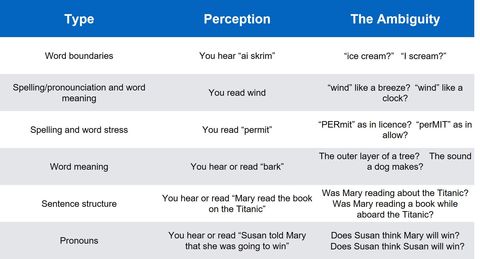
(See eynsenk and keyne for models) - 16Name the 6 types of ambiguity in language
- 17What is prosody?The rhythm and pattern of spoken language
- 18What study did Ashby & Clifton (2005) conduct?Monitored eye movements when adults read sentences with one or two stressed syllables. Words with two stressed syllables took longer to read.
Suggests that readers supplied phonological information during silent reading - 19What have studies shown influences the speed of naming words?The frequency with which the word is encountered (Naming line drawings Oldfield & Wingfield, 1965)
The age at which the word was learnt (earlier = faster) ... but could this be because common words are learnt first? - 20What is the interactive activation model?Model with 3 levels of recognition units
Top down and bottom up processing can occur
Activation at all levels add's weight to the recognition of the stimulus - 21What is one criticism of the interactive activation model?It doesn't take into account other elements of processing such as phonological and semantic
- 22When is a sentence interpreted?While it is being read, interpretation is immediate
- 23What are two types of language comprehension?Deep
Shallow - 24What study did Erickson & Mattson, 1981 carry out?Moses illusion
Detection of ‘the Moses Illusion’ linked to the semantic similarity between the target and the correct item in LTM - 25Who asked the question ''How fast were the cars going when they smashed into/hit/collided with/bumped/contacted each other?''Loftus and Palmer (1974)
They found that memory was semantically distorted by the phrasing of the question - 26What does the Sapir-Whorf Hypothesis state?An individual’s thoughts are affected by the language/s he or she has available to express them
Strong: Language determines thought
Weak: Language influences thought - 27Who studied number abilities in people with languages with reduced number content?Gordon, 2004 studied the Pirahã Amazonian tribe

- 28Danai speakers who only conceptualize colour as light to dark and native English speakers were asked to group red, blue and green counters. What were the results?Heider (1972)
Two populations with widely differing colour vocabularies remembered colours in very similar ways
Performance = not affected by differences in colour naming - 29Is Gordon's 2004 study for or against the strong view of Sapir-Worf hypothesis?For - it says that the Pirahã tribe conceptualized number differently
- 30Is Heider's 1972 study for or against the strong view of Sapir-Worf hypothesis?Against - DIfferences in language between the Danai tribe and English did not effect ability to differentiate colour
- 31Who conducted this study?Boroditsky (2000)
People rated similarity of two images
Indonesians (with no tense markers) considered tense less than English speakers
When tested in English Indonesian bilinguals acted like English speakers
- 32What study did Davies (1998) carry out?Study with Russian speakers who have 3 words for the green/blue colour spectrum. Found that Russian speakers were no more likely than english to separate blue/green colour counters into 3 groups
- 33Is Boroditsky for or against the weak view of the Sapir-Worf Hypothesis?For - Found differences between Indonesian and English speakers
- 34Is Davies (1998) for or against the weak view of the Sapir-Worf Hypothesis?Against - No difference between English and Russian speakers
- 35Name 3 difficulties with testing the effect of language on cognitionAvoid linguistic differences in test materials
Avoid eliciting linguistic responses
Avoid subjectivity - 36What did Boroditsky, 2001 do?English and Mandarin speaking participants primed with either horizontal or vertical questions.
English speakers faster after having just thought about horizontal space.
Mandarin speakers faster after having just thought about vertical space. - 37What did Boroditsky's study tell us about how language influences thought?Mandarin speakers who learned English later in life showed a stronger vertical effect than those who learned it earlier in life. This suggests that learning a new language changes the way one thinks
Informationen
- Beschreibung
- Degree Psychology (Psychology of the Individual) Karteikarten am Language - Lecture 7, erstellt von Georgina Burchell am 26/04/2016.
- Erstellt von
- Georgina Burchell
- Aufrufe
- 39
- Bewertung