
Karteikarten
Chapter 2 - Manufacturing Process Selection
Karten in diesem Stapel (20)
- 1Material properties such as melting point, hardness, and yield strength as a technical reason for manufacturing process selectionMelting point, hardness, and ductility determine the range of manufacturing processes that can be used to make parts from a material.
- 2Melting point as a technical reason for manufacturing process selectionLimits casting technology.
- 3Yield strength as a technical reason for manufacturing process selectionLimits the ability to machine and deform.
- 4Constitution of raw materials as a technical reason for manufacturing process selectionCertain engineering materials are compatible with certain processes; depends on chemistry, reactivity, fluidity, viscosity, etc.
- 5Desired mechanical properties and area of application as a technical reason for manufacturing process selectionWrought products usually have superior properties than cast products.
- 6Size and weight per piece as a technical reason for manufacturing process selectionEach process and material has its own characteristic limits of size.
- 7Form of starting material as a technical reason for manufacturing process selectionThe form of starting material is sometimes important (a hollow shaft can be made best by starting with a tube rather than a solid bar).
- 8Shape and geometric complexity as a technical reason for manufacturing process selectionDictates whether a casting or wrought product will be required. Also dictates whether a product should be from several individual components and then joined.
- 9Required dimensional tolerance and surface finish as a technical reason for manufacturing process selectionEach manufacturing process has the capability of producing a part with certain range of tolerance and surface finish.
- 10Numbers required as an economic reason for manufacturing process selectionLarge production reduces unit product cost and permits the use of more complex machinery and advanced manufacturing methods.
- 11Capital investment as an economic reason for manufacturing process selectionIncludes equipment cost, operating & labor cost, flexibility, etc.
- 12Conversion cost as an economic reason for manufacturing process selectionAffected by the number of process steps, production rate, inventories and space requirement, scrap generation, and handling costs.
- 13Total cost of a batch of a given number of pieces C(batch total) = C(machinery) + n(batch)*C(piece)C(machinery) = cost of tools and equipment
n(batch) = batch size
C(piece) = cost per unit - 14Cost per unit C(piece) = C(material) + C(finish) + C(labor)/rC(material) = unit material cost
C(finish) = unit cost of finishing and rectification
C(labor) = proportion of labor and factory overhead costs borne by each piece
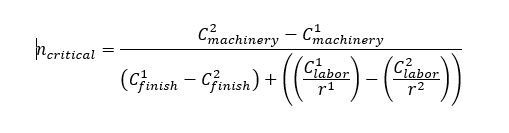
r = rate at which the pieces are produced - 15Minimum batch size to make it worthwhile to replace process 1 with process 2C(machinery) = cost of tools and equipment
C(finish) = unit cost of finishing and rectification
C(labor) = proportion of labor and factory overhead costs borne by each piece
r = rate at which the pieces are produced - 16Environmental reasons for manufacturing process selectionWaste production due to inefficient use of materials, consumption of non-renewable resources, and release of any pollutants that may damage air, water, and land, to name a few.
- 17Miscellaneous reasons for manufacturing process selectionAvailability of materials, time-scale for design and manufacture, expedient business reasons, supply failures, trade disputes, and meeting of deadlines.
- 18PRIMAs(a.k.a. Manufacturing Process Information Maps) Provide detailed data on the characteristics and capabilities of each process.
- 19Components of a PRIMA (7)Process description
Materials
Economic considerations
Typical applications
Design Aspects
Quality issues
Process variations - 20Manufacturing Process Selection Strategy, in orderObtaining an estimate of annual production quantity
Choosing a material type to satisfy the product design specification
Selecting candidate processes based on their PRIMAs
Considering each PRIMA against the engineering and economic requirements, so as to: understand the process and its variation, consider the material compatability, and assess conformance and surface finish requirements with process capability data.
Consider the economic positioning of the process and obtain component cost estimates for alternatives.
Review the selected manufacturing process against business requirements
Informationen
- Beschreibung
- Engineering (EGR 367) Karteikarten am Chapter 2 - Manufacturing Process Selection, erstellt von Jon Jon Jon Campbell am 20/09/2017.
- Erstellt von
- Jon Jon Jon Campbell · Sep 2017
- Aktualisiert
- 20 Sep 2017
- Aufrufe
- 1
- Bewertung