
Karteikarten
Endogenous pacemakers and exogenous zeitgebers
Karten in diesem Stapel (15)
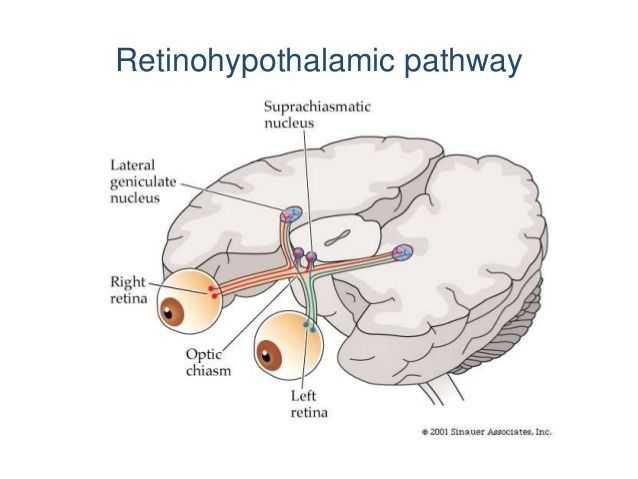
- 1What is a primary endogenous pacemaker?SCN (the suprachiasmatic nucleus) - a tiny bundle of nerve cells in the hypothalamus - helps maintain circadian rhythms (e.g. sleep-wake cycle)
- 2Where is the SCN found and what does it do?Nerve fibres from eyes cross at the optic chiasm on their way to the visual cortex. The SCN is just above the optic chiasm and receives information about light from this.
- 3Decoursey's chipmunks study (research into endogenous pacemakers)Decoursey (2000) destroyed SCN connections in brains of 30 chipmunks, then returned to natural habitat and observed for 80 days. Their sleep-wake cycle dissapperaed and many were killed by predators.
- 4What do Decoursey's Chipmunks demonstrate?The influence of the suprachiasmatic nucleus on the sleep/wake cycle
- 5Why are the pineal gland and melatonin endogenous mechanisms?The SCN gives info about day lenth to the pineal gland which increases melatonin production at night. (Melatonin = hormone that induces sleep and stops in periods of awakeness - causal factor in SAD)
- 6What is the process of resetting our biological clocks known as?Entrainment
- 7What resets the main endogenous pacemaker (SCN) and what else can it affect?Light - can reset the SCN and also indirectly influence body's key processes (hormone secretion etc.)
- 8Campbell and Murphy (research into exogenous zeitgebers)woke 15 participants at various times and shone a light of the back of their knees - producing deviation in sleep wake cycle of up to 3 hours. Light = powerful exogenous zeitgeber detected by skin receptors and does not need eyes to influence SCN.
- 9By what age are most babies entrained by?Six weeks
- 10What influences babies to become entrained?Social cues such as adult determined meal times and bed times
- 11How can we entrain our bodies and combat jet lag when travelling?by adapting to local times for eating and sleeping, not just responding to ones own feelings of hunger and fatigue.
- 12Limitation: endogenous pacemakers and exogenous zeitgebers interact together (Evaluation)only in rare circumstances do pacemakers free-run unaffected by zeitgebers. Total isolation (e.g. siffre) is rare and presents an unrealistic view of how the system works. pacemakers and zeitgebers interact in real life so it makes no sense to seperate them for research.
- 13The influence of exogenous zeitgebers may be overstated: Miles et al's blind man (Evaluation)Miles et al not the case of blind man with circadian rhythm of 24.9 hours. His sleep/wake cycle couldn't adjust to social cues so he took night time sedatives and day time stimulants to align with a 24-hour world.
- 14extra research support for "The influence of exogenous zeitgebers may be overstated (Evaluation)"Studies of individuals who live in arctic regions (where the sun doesn't set in summer months) show normal sleep patterns despite prolonged exposure to light. - exogenous zeitgebers may have little bearing on our internal rhythms.
- 15Limitations of Decoursey's chipmunks (Evaluation)issue generalising findings because cognitive factors may be more significant in humans - also considering it was done in 2000 the ethics are disturbing especially debating whether the value of the research is worth the risk they put the animals in.
Informationen
- Beschreibung
- The effect of endogenous pacemakers and exogenous zeitgebers on the sleep/wake cycle
- Erstellt von
- Sophie Wembridge
- Aufrufe
- 13
- Bewertung