
Karteikarten
chapter 3: sensation and perception
Karten in diesem Stapel (87)
- 1TransductionPhysical stimuli converted into nerve impulses
- 2PsychophysicsRelationship between physical stimuli and senSory CAPABILITIES
- 3There are ___major branches of psychophysics.2
- 42 branches of psychophysics?Limits of sensitivity
Difference between sensitivity - 52 Branches of psychophysics?Absolute limits: softest sound or weakest salt conc'n humans can detect; level of intensity a human can detect in a certain amt, of time
Difference: "magnitude of the smallest difference between two stimuli of differing intensities that the participant is able to detect."
http://en.wikipedia.org/wiki/Psychophysics - 6Absolute thresholdLowest intensity at which a stimuli can be detected 50 percent of time.
- 7Lower the threshold, ___the sensitivityGreater
- 8STUDYAbsolute threshold for the major senses
- 9standard of how certain they must be that a stimulus is present before they will say they detect itDecision criterion
- 10Signal detection theoryConcerned with the factors that influence sensory judgement; rewards, punishments, expectations, and motivational rewards
- 11Affected by characteristics of the participants and nature of the situationStimulus present? Yes or no
Participants response? Yes or no
4 case scenarios - 12Difference thresholdSmallest difference BETWEEN TWO STIMULI perceived 50 percent of the time
- 13Compare difference and absolute threshold.Difference threshold: the smallest difference between two stimuli perceived 50 percent of the time
Absolute threshold: The smallest intensity of stimulus that can be perceived 50 percent of the time - 14WEBER'S LAW ****STUDY****
- 15Subliminal stimulusReceived by senses but NOT perceived correctly. Weak and brief
-Subconscious mind - 16diminishing sensitivity to an unchanging stimulus with the passage of time as sensory neurons habituate to the stimulationSensory adaptation
- 17Sensation refers to the activities by which our sense organs receive and transmit information, whereas perception involves the brain's processing and interpretation of the information.Sensation vs perception
- 18Normal stimulus for vision?EMR
- 19The portion of the visual stimuli that we perceive is?Colour: visible portion of EMR
- 20How does red compare to blue?Red: higher wavelength, lower frequency
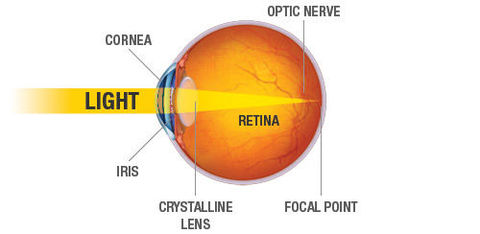
Blue: Lower wavelength, higher frequency - 21CorneaTransparent protective structure at front of the eye
- 22Behind cornea?Pupil; adjustable; dilates and constricts to let more or less light through
- 23IrisRegulates size of the pupil
- 24Ciliary muscles STUDYRegulate shape of lens
- 25Image entering eye is ____ by the lens and then ____on the retina, which contains ______cells.reversed; cast; photoreceptor
- 26Thinner to focus on distant objects; thicker to focus on nearby objects;lens
- 27behind pupil; reverses image and focuses it on the retinalens
- 28near-sightedness; light focused before retina; eyeball longer than normalMyopia
- 29HyperopiaFar-sightedness; short eyeball; light focuses to far from retina; lens does not thicken enough
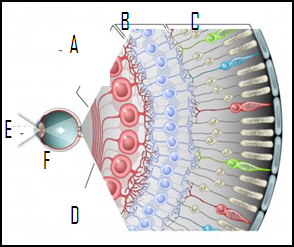
Common among older people - 30Label?A-Ganglion cells
B- Bipolar cells
C-Rod and Cone cells
D-Optic nerve
F-Eye
E-Light - 31STUDY: PARTS OF THE EYESTUDY
- 32STUDY: PATHWAY THROUGH RETINASTUDY
- 33STUDYCONCAVE VS CONVEX
- 34RODS-Brightness
-Black and white
- 500 times more sensitive to light than cones
-Function best in dim light
-120 million rods (MUCH more rods than cones) - 35cones6 million cones (not nearly as much as rods)
Function best in bright settings
Less sensitive to light than cones - 36Cones ___ in concentration? Rods?No rods in fovea.
Periphery of retina contains mostly rods
Cones decrease in conc'n farther away from retina - 37Bipolar cellsConnections between rods and cones
- 38Ganglion cellsSynapse with bipolar cells; axons form optic nerve
- 39Visual acuityAbility to see finer detail; better when light focused on the fovea
- 40Rods and cones translate light waves into nerve impulses through the action of protein molecules calledPhotopigments
- 41is the progressive improvement in brightness sensitivity that occurs over time under conditions of low illuminationDark adaptation
- 42Trichromatic theorythe colour vision theory originally advanced by Young and Helmholtz that there are three types of colour receptors in the retina and that combinations of activation of these receptors can produce perception of any hue in the visible spectrum
- 43the theory proposed by Hering that the retina contains three sets of colour receptors that respond differentially to red-green, blue-yellow, and black-white; the opponent processes that result can produce a perception of any hueOpponent-process theory
- 44Dual-process theoryhe modern colour vision theory that posits cones that are sensitive to red, blue, and green, and opponent processes at the level of ganglion cells and beyond
- 45Colour blindness?study
- 46the area of the occipital lobe which receives impulses generated from the retina via the thalamus and analyzes visual input by using its feature detectorsPrimary visual cortex
- 47sensory neurons that respond to particular features of a stimulus, such as its shape, angle, or colourFeature detectors
- 48Parallel processingour ability to use our senses to take in a variety of information about an object and construct a unified image of its properties
- 49cortical areas in the occipital, parietal, and temporal lobes that analyze visual stimuli sent to the primary visual cortex in relation to stored knowledge and that establish the “meaning” of the stimuliVisual association cortex
- 50is the technical measure of cycles per secondHertz (Hz)
- 51the number of sound waves, or cycles, per secondFrequency
- 52refers to the vertical size of the sound waves—that is, to the amount of compression and expansion of the molecules in the conducting medium.Amplitude
- 53The sound wave's ______ is the primary determinant of the sound's perceived loudnessAmplitude
- 54Differences in amplitude are expressed as_____ , a measure of the physical pressures that occur at the eardrumdecibels (db)
- 55a small coil-shaped structure of the inner ear that contains the receptors for soundCochlea
- 56a membrane that runs the length of the cochlea and contains the organ of Corti and its sound receptor hair cellsBasilar membrane
- 57studyparts and functions of the ear
- 58studypathway of sound through ear
- 59structure embedded in the basilar membrane that contains the hair cell receptors for soundorgan of Corti
- 60the theory of pitch perception that holds that the number of nerve impulses sent to the brain by the hair cells of the cochlea corresponds to the frequency of the sound wave; this theory is accurate at low frequenciesFrequency theory
- 61the theory of pitch perception that holds that sound frequencies are coded in terms of the portion of the basilar membrane where the fluid wave in the cochlea peaks; this theory accounts for perception of frequencies above 4000 HzPlace theory
- 62Conduction deafnesshearing loss caused by damage to the mechanical system that conducts sound waves to the cochlea
- 63hearing loss caused by damage to the cochlear receptor cells or the auditory nerveNerve deafness
- 64Gustationthe sense of taste
- 65OlfactionSense of smell
- 66are chemical senses because their receptors are sensitive to chemical molecules rather than to some form of energyGustation and olfaction
- 67the receptors for taste in the tongue and in the roof and back of the mouth that are sensitive to the qualities of sweet, sour, salty, and bitterTaste buds
- 68Olfactory bulba forebrain structure immediately above the nasal cavity
- 69chemical signals found in natural body scentsPheromones
- 70The tendency for some women who live together over time to become more similar to one another in the timing of their menstrual cyclesMenstrual synchrony
- 71theory that proposes that the experience of pain results from the opening and closing of “gating mechanisms” in the nervous systemGate-control theory
- 72Endorphinnatural opiate-like substances that are involved in pain reduction
- 73the body sense that provides feedback on the position and movements of our body partsKinesthesis
- 74the sense of body orientation or equilibriumVestibular sense
- 75devices that provide sensory input that can, to some extent, substitute for what blind and deaf people are not supplied by their sensory receptorsSensory prosthetic devices
- 76Bottom-up processing.The system takes in individual elements of the stimulus and combines them in a unified perception
- 77Top-down processingSensory information interpreted in the light of existing knowledge, concepts, ideas, and expectations
- 78Perception is selective . People are givenShadowing
- 79ShadowingPerception is selective. People given two messages at only time can only resay one.
- 80Unattentional blindness.The failure of unattended stimuli to register in consciousness
- 81Unattentionsl blindnessWhen someone has poor attention to stimuli and cannot see some stimuli
- 82Figure ground relationsWhen there is a focus stimulus perceived as being in front of a background stimulus.
- 83Gestalt lawsLaws of perceptual organization advanced by gestalt psychologists. Similarity, closure, continuity, proximity
- 84—The pathway of light through the eye
- 85—
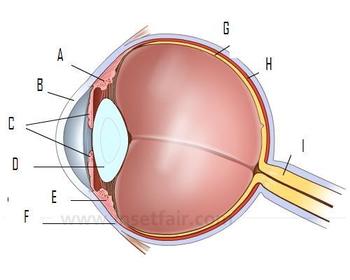
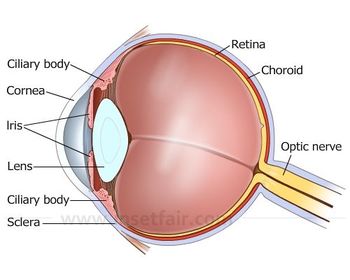
- 86—Label eye and retina layers
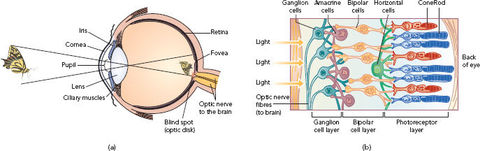
- 87STUDY:Retina processing of light
Informationen
- Beschreibung
- Psychology Frontiers and Applications by Passer
- Erstellt von
- Susannah Mackenz
- Aufrufe
- 233
- Bewertung