
Karteikarten
Theory and methods
Karten in diesem Stapel (91)
- 1What is functionalism?Functionalists believe society is a 'thing' - its a structural htoeyr. Everything and everyone in society bhas a role to play (oir functions). They are concerned about the health of society.
- 2What are the 4 types of functionalism?Durkheim - exists before functionalism breaks up into different ideas.
Structural functionalism - based on Parson's interporetation of Durkheim's work (conservative).
Neo-functionalism - based on Merton's interpretation of Durkheims work - modernised and not conservative.
New Right - believe we live in a society that parsons wants to avoid. - 3What is Durkheims functionalism?Adapts the organic analogy (Spencer). This is the idea that society is a body and the 'organs' are different functions and if one fails its unhealthy. E.g. religion fulfills a role and strengthens the collective conscience (the idea that everyone in society understands their place/role) as we all believe the same thing so have the same values (value consensus). E.g. bible says not to murder and to respect elders. Totemism is where tribes pick their own religious symbols+worship is, essentially worshipping society and themselves + strengthens CC. But this organ is failing as less ppl are religious + leads to anomie (where society is not functioning proplery - abscence of integration and regulation) and ppl dont undertsand their place in society.
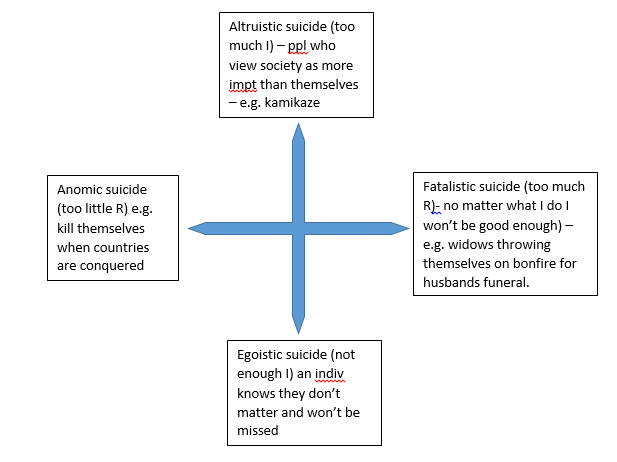
- 4What is integration and regulation according to Durkheim?(could be a second para in a func. essay)Integration-do we feel a part of society? can we impact what happens? Regulation-how much you share and understand society's values and fit in and know whats expected of us. Studied suicide and drew up a model explaining why some ppl commit suicide (due to too much or too little r and i).
- 5How can Durkheim be evaluated?Coinflict theory: marxism would argue that this collective conscience isnt working as society is structured around class conflct.n the values we're given are those by the powerful so we dont hold this value consensus + actually religion acts to keep exploitation occuring. Feminisms- patriarchy measn theres no consensus.
Obscurant - terms like anomie are poorly defined to the point it obscures the meaning + are defined with mroe confusing terms. - 6What is structural functionalism?They wanty to keep society how it is/return it to an earlier era. Parsons- expressive vs intrumental roles. As women are entering thr workforce, he argues that we need to return to traditional roles bcz women are needed at home for socialising children into the collective conscioence and men dont do this bcz they arent emotional. (talk abt his ideas in fam too). Also edu acts to preserve society by passing on value consensus (universalistic values in edu and society).
- 7How can we evaluate structural functionalism?Postmodernism: values donmt matter as ppl can choose what they want (beck pick and mix approach).
Liberal feminisim : society hasnt collapsed wehn these roles changed when women entered the workforce like parsons predicted, so actually this isnt needed.
Doesnt explain why value consensus has chnage but not collapsed - doesnt tell us about modern society. anomuie for parsons is the absence of values that keep society functioning. - 8What is neo functionalism?Merton- strain theory (when an indivs measn and societys goals dont match up) - thios is anomie. E.g. everyone cant be their own boss or own their own home despite these being in the american dream. Responses to strain (conformisits, innovators, ritualists, retreatists, rebels. Anomie is an idiv thing and a society with a big gap is dysfunctional. Manifest and latent functions - m is the intended outcome, l is the unintended outcomes (and e.g.s)
- 9How can we evaluate neo functionalism?Subjective and hard to measure- the american dream is poorly defined, and it may not mean the same thing for everyone. It fgails its own methodological tests - the functionalist test of offering measureabke outcomes (Popper). The terms are all similar and the difference between them is subjectiuve.
- 10What do the New Right say (still functionalism)?Concerned with the health of society and believs institutions need to fulfill their roles adequately to keep society going. Focus on getting hralth back to society. E.g. Murray- welfare are preverse incentives leading to values breaking down and illegitimacy. Argues the gov is failing. Dennis and Erdos- fmas w/o fathers-children need discipline but dont get it bcz fams (as insititution) have failed us. Section 28(Thatcher)-cant talk abt gay rels in schools, she sadi edu teaches values that will get us back to a healthy soicety.
- 11How can we evaluate the new right?Rad fem: argue that theyre trying to embed pat values rto keep women oppressed. children woulc be better raised by single mums as women arent biologically aggressuve like men are..
It also victim blames (Merton would say the "underclass"are simpooly those experiencing the wrost strain. - 12What is Marxism?A conflict and structural theory as it believes society has a sturcture around conflict.
- 13WHat is one of MArx's contributions to MArxism?Sayas there is a base ("the heart of sicoety") where everything is structured around. This is the economy. The superstructure are insititions that allow the base to continue and orevent revolt. E.g. relgiion is one, and according to marx it acts as the 'opium of the people'.. To max, capitalism is the economic exploitation of the proletariat by the bourgeoisie. (Aleienation and pauperisation - keep us from class consciousness).
- 14What is MArx's model of development?Marx adapts Hegel's dialectic. His version explains how history moves thriugh different stages and how itll eventually move on to a communist state (post capitalism).
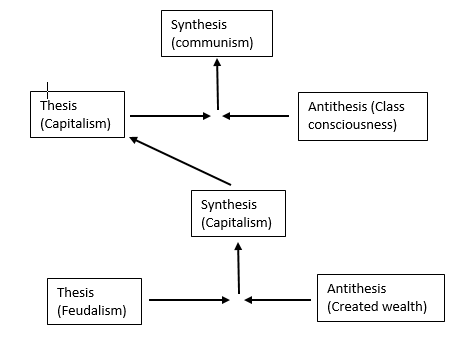
- 15How can we evaluate MArx?Economic determinsim: suggests exploitation is didctyated to you and is out of your control. The workers suffer this but gives no explanation of hwo to get free will.
Economic reductionism: takes complex matter (society) and says everything has an economic cause. All instititutions exist tot further the economy according to MArx. But actually things like family are seen as being for the sociialistion of children (func). - 16What is Gramsci's contribution to MArxism?Humanistic marxism. Argues we choose to continue to live under capitalism but this isnt an entirely free choice as we have no awareness of an alts. Uses a centaur as an analogy for how the state convinces us that capitalism is the best system. The human 1/2 represents state institutions(media.e.g.) that convince us that capitalism is the onyl legit systems (consent). The horse 1/2 represents the force that can be used to make us accept this system (coercion)
- 17How can we evaluate Gramsci?Focuses excessively on ideas rather than research - he was in prison when writing this so couldn't see any of this.
- 18What does Althusser contribute to marxism?Scientific marxism - he resists attempts to change Marx's original meaning. Believes choice is an illusion. The ISA (institutions that exist to teach us abt cap and to continue exploitation) and RSA (police etc to stop uprisoing) prevent ppl from making a choice. This is his attempt at explaining marx's superstructure. He believes well always have this as long as we have cap (until we get class consciousness).
- 19How can we evaluate Althusser?Disregards the w/c - here the w/c play no role they merely exist to be exploited and always will be. Assumes they can't make choices. It also preserves the flaws of Marx - deterministic.
- 20What does the Frankfurt school contruibute to MArxism?This is the 'classic' version of neo-marxism. Adorno sgtudied facism and why ppl support fascists. He argued theres an 'authoritarian personality' where ppl are 'tunred' towards facism even wehn its not in their interest. So ppl agree with capitalist opporessive system even thiough theres no benefit to us. Habermas argued that in our capitalist society, we've become convinced that we need thihgs. This has created a split between 'real needs' (e.g. need to develop class consciousness) + 'false needs' (need for authoritarian leaders to keepour society safe). So capitalism feeds us false needs. (sim to marxs commoditiy fetishsm wehre ppl imagiune smth has more importance than it does).
- 21How can we evalute th frankfurt schooil?Unclear of how siciety progresses through these false needs. marx offers a clear path of movin gthrough capitalism but this doesnt How do you get ppl to resist facism/use real needs? by clarifying the superstructure (thriugh false needs and auth. personality) but it fails show us a way tyhrough this bcz they dont believe there is a solution to cap.
- 22What is psot structural marxism?Zizek - argues that cap has effectively created a world so full of symbokls that everything is meanignless. Ppl have no ability to understad the world or decode its meanings dcue to these cap symboks telling us to buy stuff etc. so cap has completely cut us off from our nature, other ppl and our work (the symbolic).. this has led to a desire to retun to a more animalistci, uncivilised era (the real) wehre symbols meant smth. This is reflected in our att to viuoolence (e.g. slowing down to see a car crash).
- 23What backs up Zizek?David Harvey: modern olife appears to have mroe choices bu most beenift the rich and disadvantage the poor. he focusses on the labour market and the appearance that you can accumulate wealth flexibly in modern era (flexible accumulation). E.g. 0hrs contreact, many part time jobs. the appearance of choice through this is designed to hrut workers as it means they have to have many jobs so dont progress or in unis have to choose between 10montsh pay and career progress or 12 montsh and no progress.
- 24How can we evaluate post structural marxism?Postmodernisrs would argue that they ignore the freedom that some ppl have and enjoy. Having a 0 hours contract may be enjoyable for some.
- 25What do liberal feminsits argue is the cause of patriarchy?Dont bekieve theres one cause - its a leftover from a more historical time of men being in charge.
- 26What do liberal feminists argue the symptoms of patriarchy are?cultural lag-there is legal eqyuality for women but not in culture;e.g. legallty have to be opaiud the same but arent; feminist film theory argues that this behav. is normalised through the 'male gaze' - where bcz cinema is doninated by men, even films that focus on women tend to linger on female bodies (Mulvey).; (sue sharpe in edu too). Dual burden is a reflection of this - how when women entered the workforce they had to housework still as well. MAterial and legal developments in the status of wome (e.g. equal pay act 1970 but oay gap still ~16%)
- 27What are lib fems solutions to patriarchy and hwo can we evaluate it?sol- socialise ppl to have dif atts.
eval- doesnt explain the cause very clarly so cant explain the symptoms. they assume history developed pat and that it gets more equal but they dont explain the start or the transition, wehreas RF and MF do. - 28WHat di radical feminists argue the cause of patriarchal oppresion is?the fundamental inequality is pat + believe the abolition of it will require a radical restructuring ofd society. many believe the root casue of pat is biology.
- 29What do radical feminsists see as the symptoms of patriarchal oppresion?DOmestic abuse- Dobash and Dobash say trhis happens when mens authority is challenged and so they use domestic abuse to assert authority.
- 30What do rad fems argue as the solutions to patriarchal oppresion?Female separatism (frye). they assume that women are socialsied into heterosexuality and reversing this is one way of overthrowing the pat. ! project that does this is "womyns land" seen in US, Europe, NZ and Australia.
- 31How can we evaluate rad fems?assumes all women share common interests, unlike difference femoinsism, RF's believe qall women suffer equally so will benefit equally from pat. overthrow. So they ignore issues like race and class that means a dif. experience. Also ignores the social progress that has occured.
- 32WHat do marxist fems argue the cause of pat. oppression?capitalism comes first and pat deveops from this. engels calls this the histroic defeat of the female sex as cap benefits from women being at home as it allows the man to just focus of work. Elias Zaretsky argues the cause of oppression for women comes from how they are triply exploited as woves, mothers and as a reserve army of labour.
- 33What do marx fems argue as the symptoms of patriarchal oppression?Fran Ansley - womens housebound role in trad. householkds leads to them being the 'takers of shit' - domestic abuse occurs wehn the men take out their legit frustration from exploitation of illegit targes (wives) men are suffereing too but beliueve radical sol is needed.
- 34WHat do amrx fems argue the solution to pat oppresion is and how can it be evaluated?Sol - ppl having class consciousness will allow for the overthrow of a cap society an therefore patriarchy.
eval - economic determinist - no free will and reductionist as it takes complex ideas and explains it as "men are oppressed by other men" - cant explain why pat is universal and predates cap. - 35What does difference feminsism argue is the cause of pat. oppression?no single cause - there are dif exp of pat for dif women. e.g. non white women exp pat dif to white women and m/c dif to w/c.
- 36What does dif fem argue the symptoms of pat oppression are?bell hoosk (leading black fem) says women are oppressed in dif ways and black US woomen are the msot oppressed. Black women are taught to hate themselves (e.g. taught to be mroe white by straightening hair and lightening their skin).
- 37What does dif fem argue the solution to pat oppression is and hwo cna it be evaluated?sol - educate black women that they are worth more than theyre been taught.
eval - LF/RF argue that by focussing on the dif between women rather than shared exp, they make iut harder for social orgress. - 38What does discourse fem argue the cause of pat oppression is?pat exists bcz of gender - which we are taught how to perform.
- 39What are the symptoms of pat oppression according to discourse fem.Butler argues gender doesnt really exist ( its a discourse) and is peromative - not smth that excists but smth we do. Gender used to exist but its no longer fixed - its abt how you act. e.g. thjings you like, how you dress (spo the symptom is that you are performing gender even thiugh it doesnt exist). argues bcz were socialised into performing gender in this a certain way, we continue this unhelpful idea.
- 40WHat is the solution to pat oppression according to discourse fem and how can we evaluate it?Sol- to challenge trad. performances of gender in order to blur the lines - it should be a spectrum = 'gender trouble' - e.g. dress in nontrad. ways.
eval - obscurant and hard to measure - 41What is postmodernism?Abt the change in society from modernity to late modernity. in modernity, your life course is dictated from birth, but in postmodernism we have choice bcz class and gender (traditional barriers) no longer exist.
- 42What does Lyotard argue (a postmodernist)?Argues that the key aspect of moving a society from modernism to pm is the rejection of metanarratives. Metanarratives are big stories that explain society and the world. He views the structural theories as reductionist. E.g. we reject religion + any idea that thinks things have 1 purpose. His idea of enlightenment- where we moved from religion to scientific ideas. PPl still reject these (like global warming). we reject these even though we know they're true. This led to relativism-through our choices we literally construct oir own world. our worlds are dif to each others, bcz theyre shaped by our experiences and understandings and choices. so there is no point in doing large scale research bcz everyones exp is dif.
- 43How can we evaluate Lyotard?Marxists would argue he is overly optimistic and ignores the key conflict of capitalism. They'd argue we haven't moved into PM bcz of capitalism. We'll move into communism next not PM (Hegel's dialectic). They'd argue the illusion of choice is a way to keep the proletariat working (Althusser).
- 44What does Baudrillard argue? (A PM)Our ability to interpret symbols in dif ways (simulacra) means that society is 'speeding up' - this is hyper reality. so the dominance of simulacra leads to this. E.g. in religion - religious symbols meanings are increasingly up for interpretation. Crucifix is a symbol w/o status. ppl find religion more personal bcz religious messages are interpreted in other ways. E.g Gulf war(1991) Iraq invaded Kuwait + UK + US invaded. Baudrillard said this is a simulacra as it appears to be a war but isnt: was very 1 sided as 10s of thousands of Iraqs died but very few US +UK died; it was reported live so was like a movie for us citz. + US army controlled from screens as if in an arcade. So the media creates this simulacra of war where its dif for dif ppl
- 45How can we evaluate Baudrillard?Habermas- argues PM is obscurant - it obscures the truth and makes it harder to understand situs. This matters bcz we need clarity.
Berger-argues religion gives us a safety net (sacred canopy), but bcz its becoming weaker due to unrealistic symbols so ppl act as if religion no longer exists. - 46What does Beck argue? (late mdoernist)Suggests there's a new age w/ greater choice but this leads to greater anxiety. Risk Society: as we live in an increasingly global age but and increasingly safe age we live in an atmosphere of risk. In the past there were lots of things wrong and worrying but ppl werent so anxious bcz it was dismissed as "acts of god". But we are now more anxious bcz we have greater awareness. we feel increasingly helpless as we cant do anything abt these risks bcz theyre global. e.g. global warming, nuclear war. we therefore need new theories to explain the anx. of late modernity.
- 47What does Castells argue? (a late modernist)Connectedness thesis: in late modern life we are increasingly connected to everyone. technology and increased choice over identity means we feel connected to ppl in a way we haven't before. it means that traditional connections (family, religion etc) mean less and now we have dif. support netwroks. e.g. religion once fixed anxiety through cionfession but now social media does this.
- 48What does Giddens argue? (a late modernist)Structuration theory: individuals recreate society and society shapes us. E.g. govt gives us policies and we shape it through elections. media shapes us but if we dont like smth we stop buying it and so shape it.
- 49How can we evaluate late modernism?New Right - argue the shift in PM to a lack of consensus values is leading to societal problems. actually values are impt, but ppl dont feel them anymore. Values we need are: trad. gender roles, nuclear fam., work for money, dads to raise kids for discipline, etc. PM's ideas of dif interpretations creates too much tolerance.
- 50What is discourse feminism? (Part of PM)Butler - gender was once a rigid concept but is now smth you do not smth you are (performative). Patriarchy exists bcz we perform trad. roles. gender is a discourse - we're constantly changing based on whats happening in society. eventually, we',ll update to where its a spectrum - no longer binary.
- 51how can we evaluate discourse feminsism?Rad. fems: pat. is how men are, its biological no a performance. men will always be like this. society will never change whilst men are it. Dobash and Dobash argue men are violent in domestic abuse bcz its part of their nature (not a performance).
- 52What do Marxist postmodernists argue?Agree with PM's as they see that change has occured w/ regards to increased power of the media. Cap. has created a bombardment of symbols which is mostly coming from the media. Sees this as smth thats actively happening bcz of media. Cap. has creatd a "hyper-reality" so we cant see what the reality is (exploitation). Zizek argues the world has become "symbolic" and we hve a desire to return to "the real" even though we know its worse. this is reflected by our desire to see more violent things (slowing down to see a car crash).
- 53How can we evaluate marxist PMs?- Unduly pessimistic - fails to explain our new PM era bcz its full of choices and the old system's are falling apart, etc.
- althusser- actually nothing about cap. has changed, its always used media and ISA to exploit ppl. only thing thats changed is the format (e.g. religion has been swapped out for social media). - 54What are social action theories?Theories that believe we're shaped by actions (our own or those around us).
- 55What does Weber argue? (social action theory)Social actions shape us. It involves you (the "actor") and others. theres a "cause and effect" relationship - our actions cause other actions and so on, altering society. he says this causes social changes, sich as the shift to capitalism (Protestant Ethic). This is a social action that led to a social change. social actions cause a shift towards rationalisation, away from 'enchantment', leading us to a bureaucratic and less passionate society. he calls this the "iron cage" of cap. society is rational but boring bcz of our actions. all we do is think rationally "whats the easiest action" - e.g. car breaks down - call mechanic.
- 56How can we evaluate Weber?Marxism: we're gonna move onto commuinism, we're not gonna ratinalise, we'll get class consciousness.
Durkheim sees this as good - creates consensus bcz we have a complex division of labour (not bureaucratic). - 57What does Goffman argue? (Social action theory)Performativity - we play dof. roles depending on the situ. you're in - identity is dif. we're literally dif ppl in dif circumstances. E.g. we have a dif. identity at home than at work. No such thing as "you" only our current presentations (performative). We have an "onstage persona" - when ppl are viewing us.+ an "offstage" one wehre we think abt the day + our identity during our interactions today - based on ppl's reactions to our performances. We chaneg them based on ppls reactions "performance management". "disruption" is where the audience disrupts your performance+chanegs it. (Mortification: prisoners will "kill off" the characters you play that are bafd for society+teach you new ones.
- 58How can we evaluate Goffman?Cnat prove it - unfalsifiable (Popper)- all internal. Its obscurant and makes it harder to understand. Assumes theres no reality - just a series of performances. Circumstances being tested will vary from poerson to person.
- 59WHat theories of labelling can be used in social action theories?1.Becker and Rosenthal and Jacobsen
2. Willis and Rist and Harvey and Slatin (Ways to keep ppl down) - 60Hoew can we evaluate labelling theory?Doesnt explain where moral entepupeneur comes from and why it exists. deterministic + ignores the role of capitalism (Marxists).
Positivists would argue that we cant study this stuff through quanti. data as its untestable and therefore not a meaningful theory. - 61What is phenomenology? (social action theory)Study of how we understand whats going on. We view our exp. through the lens of past exp. "this event is like this other event, so it means this". We're not shaped by moral entrepreneurs but by our own unique exp. and interpretations of these. "Typifications" - categories based on past exp. Schutz creates this concept.
- 62What is ethnomethodology? (social action theory)The context you're in dictates what smth is + creates these for us. We exist in a culture of interacting indivs that decides what smth is. Atkinson looks at ppl who jump in front of trains on the London overground+Copenhagen metro. Says the action has no inherent meaning-cant explain the motives etc. instead looks at the coroners reports as the meaning dies w/ the person, so its abt how we categorise it based on culture.Finds in C-ppl are strongly religiously opposed to suicide+life insurance companies dont have to pay it for ppl who die this way, but this is dif in london.So, in C coroners are more likely to file it as accidental death but in L - filed as suicide He says coroners are making these cats. based on cultural exp.(religion and law shapes how they view events).
- 63How can we evaluate ethnomethodology and phenomonology?Durkheim: his work on suicide shows that it occurs bcz of the abscence of regulationand integration not based on culture. He says we can understand the meaning but actions arent meaningless.
Giddens: structuration- we shape society and it shapes us (we're not entirely shaped by past exp.) - 64What is social policy?Gov. policies that affect the domestic lives of citizens of a country. e.g. welfare, edu, working rights, fam law, healthcare, property law.
- 65What are the four key points for how sociology affects social policy?1. sociology provides a theoretical framework on which policies can be built.
2.sociology helps us identify social problems.
3. sociology provides professional knowledge which ppl can judge.
4. social policy should be based on social research bcz research should inform our views. - 66How does social policy provide a theoretical framework for social policy?E.g. Murray creates a theory on perverse incentives (welfare) that continue the "underclass" and their cycle of dependency so ppl dont work. This leads to illegitimacy, etc. He proposes a theory, tests it and suggests ways the gov can improve - specifically for Thatcher (he paved the way for the NR, such as section 28 which continued nuclear fam to prevent this "underclass") Giddens shows that its also done by the political left +provides the theory behind Blair's success. Structuration- sasy indivs have to be given the ability to make decisions and institutions allow this. E.g edu. policies and minimum wage. If everyone has minimum wage then everyone has the ability to make decisions. So soc. provides info gove may not have w/o campaigning.
- 67How can we evaluate the idea that sociology provides a theoretical framework for social policy?PM: society is open to interpretation. they applied their own interpretation but this only reflects their own views and not the actual exp. of ppl. Baudrillard would say everything is relative - so their ideas are relative to them but not all of society. There could also be dif interpretations.
- 68How does sociology help us to identify social problems and how does this help influence social poloicy?Govs only look at things from their "pale, male, stale" viewpoint and sociology can widen that view and bring social issues to their attention. E.g Dennis and Erdos in 92- riots in south shields were bcz boys had no dad so lack discipline, they also note poverty, unemployment and addiction was high here. Hall in 70s identifies a moral panic over black muggers. says the media picks on young black men to distract from the failing economy. its not influential until 90s when the macpherson report came out which was influenced by Halls' work. So, soc. helps provide info that pols may not be looking at.
- 69How can we evaluate the idea that sociology helps identify social problems that then influences social policy?Conflict theories would say that actually policies just reflect the views of the powerful and the fact that Halls work is ignored for so long reflects that.. E.g. crime policies reflect this - Badger baiting (w/c activity) was banned much earlier than fox hunting (m/c activity). Suggests that it only reflects the powerful until they absolutely have to reflect the w/c too.
- 70How does sociology provide professional knowledge which ppl can judge and use in social policy?Sociologists are pros and exist to provide knowledge. They generate ideas + provide it to ppl from which others can make judgements. Policy is then based on this. E.g Centre for social justice was set up in Iain Duncan Smith in 2005, and was a "think tank" that collects research + creates research promoting austerity. In 2010 he became secretary of work and pensions and cuts everything bcz of the CFSJ. Joseph Rowntree Foundation - UK's largest poverty think tank, studying poverty in N England. Very influential under labour gov and suggests lit hour and minimum wage for alleviating poverty. Such policies may not have happened w/o these think tanks.
- 71How can we evaluate the idea that sociology provides pro knowledge, from which social policies can be made?Weber- argues that research can never truly be value free (never truly objective). Its always influenced by researchers even if its just by the selection of topics to research. We should strive to be value free but we will never get that as ppl have opinions that cant be removed. So, sociology shouldn't inform social policy.
- 72What is the idea that social policy should be based on social research bcz social research should inform our views?Marx says that ev should inform our views. Policy should come form the view which comes from the research. If the view doesn't come from research it isn't legit., and therefore, social policy wont be either. Also, Durkheim says that social research establishes testable facts, so is falsifiable, making it a good foundation for social policy.
- 73How can we evaluate the idea that social policy should be based on social research bcz social research should inform our views?Critics would argue that policy isnt an area for sociologists. Policy should be made by elected govs not by sociologists as politicians have a mandate bcz they are chose by the ppl. Sociologists should stick to sociology. In a democracy we shouldn't use social research bcz we voted for the gov. not the sociologists.
- 74What are the four main views on socilogy as a science?1. Positivists - socio is a sci
2. Popper - socio should aim to be scientific
3. Kuhn - it's not and should not be
4.realists - it is a sci but only if using realistic hypothesis. - 75What is the positivist view on sociology as a science?It is a science. They focus on quanti data and trends and seek social facts ( a thing that has a law like quality). We can test these repeatedly and get the same results, meaning it is reliable - so scientific. Durkheim id a key positivist and said that some social facts are; when ppl lack I and R they'll always be more at risk of killing themselves; suicide is a phenomenon that has law like qualities + protestants are less integrated than catholics and men less than women.
- 76How can we evaluate the positivst view on socilogy as a science?Interpretivism - weber, don't believe in social facts as that is one interpretation. For Durkheim's work on suicide- we should pay attention to the fact that a French man is saying that the french are more integrated. So socio isnt a sci as it is all abt dif interpretations. Sci is facts and we dont have facts insocio.
- 77What does Popper argue about sociology as a science?Argues for unity between all the sciences (natural and social). All should use the same methods. Research should: create hypotheses, test them in a way that leaves it open to being proven wrong (falsification). Says that things can appear to be a fact based on current ev but can be proved wrong. E.g. the hypothesis "all swans are white" isnt proved correct by seeing one group of them, but at the time it appears to be. But if you see a black swan it is disproved. So all should be up for empirical testing. so socio is a science if it follows this.
- 78How can we evaluate Poppers idea?PM- not only can you not establish facts based on current ev, there's no such thing as facts - everything is relative so not a sci. Lyotard - if at the moment all you can see is white swans then for you all swans are white. so its not based on current ev, its based on what the indiv sees (relative).
- 79What does Kuhn argue about whether sociology is a science?Its not and should not be a science - sociology and the social scis must be viewed dif to other scis. Says other scis share a paradigm (a single world view or idea that underpins them). Sci belief is based on weight of evidence, which when disproved is discarded. But sociology has many competing paradigms (e.g. Marxism is one but feminism is another), all have dif world views based on dif evs. so not a sci and shouldnt be bcz it wouldn't be desirable to be as it would close down debate.
- 80How can we evaluate Kuhn?Kaplan - Kuhn assumes that nat scis always follow correct procedures and he paradigm informs future research but he argues this isn't the case, Scientists "cheat" by taking shortcuts and make assumptions,. They then write up the reports in a way that reflects the paradigm, this is the "social construction of sci". E.g. scis repeatedly complete the same experiment until they get the desired results and write up and discard failed data.
- 81What do realists say about whether sociology is a science?Takes a realistic app+argue that social+nat sciences test complex systems+both involve creating hypotheses that may not immediately be able to be tested. E.g black holes were hypothesised long before they were ever proven. so, scis must be realistic in expressing the limitations of the research. So, socio can be a sci so long as it is done responsibly - hyps have to be plausible. E.g. crime rates increase and decrease for many reasons - sociologists shouldnt make huge statements, but look at data+consider what could be a cause. Kerr+Urry- sci requires realistic hypotheses-we should avoid making "grandiose statements" bcz theyre hard to prove. so just like its imposs to create a sci theory that explains all aspects of our world, we should avoid doing so in the social world. So, socio can be a sci if done responsibly.
- 82How can we evaluate the realists stance?Baudrillard - nothing is real and all statements are grandiose. Any research only reflects the researcher.
- 83What are the four key factors that sociologists would consider when choosing a research method?1. practicality (cost time, access+ why certain methods are better or worse based on this)
2. Ethics (harm, consent, anonymity + any methods that are better or worse on each
3. Theoretical approach (positivist/interpretivist (which methods they would use)
4. Social theories ( feminism, interactionism, marxists, etc + which method they would use and why)
- any evals would argue that some research has to be expensive/ unethical in order to get best results + many researchers triangulate so their approach doesnt matter and their theory doesn't matter massively. - 84What does value free mean?This is research where the researchers opinions dont affect the theory., Values are beliefs that shape our world view. The central debate is between positivists and interpretivists.
- 85What would modern positivists argue on whether sociology can be value free?View that values should be kept pout of socilogical research. Theyy aim o sud society in the most scientific way possible. This involves testing hypotheses using Poppers idea of falsification and as objectively as possible. They see socio as a sci concerned w/ social facts. They use quanti methods like closed q's that means the researchers keep their distance. Their research is often based on where the money is (market research) rather than views., the money is in bi business - finding out who to sell to etc. Involves strict operationalisation + avoiding vagueness or interpretation. E.g. great british class survey (Savage) - q's are rigorously planned to be value free. as a result, the researcher were able to compare dif groups of ppl effectively
- 86How can we evaluate modern positivism?-Phenomenology- they often reflect their own typifications (Schultz) rather than what MP's claim to study so the data claims to be value free but it tells us more abt the collectors than the data. doesn't tell us abt the exp.
-Gouldner(interactionist) - describes MP as "spiritless technicians", all they are are sociological versions of factory workers, no soul/heart - putting facts into motion. - 87What do Marx and Durkheim argue abt whether sociology can be value free(Positivists)?Reserahc should inform our values - based on the enlightenment when we ,moved to a sci. period. V;ies should be based on research and not the other way around Durkheim - always uses secondary data (e.g. totemism I and R). These ideas came from research and not the other way around. Marx- believe communism is inevitable once class consciousness comes abt, also believes in pauperisation as a result of his research.
- 88How can we evaluate marx and durkheim?There views weren't actually based on evidence. Their research reflects their views, e.g. marx's 1st book was based on no research, the research came later and reflects his earlier view. Durkheim came up with the collective conscience 20 years before his research on totemism.
- 89What does Weber (interpretivist) argue on whether sociology can be value free?Values will always play a role in research - we should try to be value free in order to get the most representative research but we'll never be successful bcz as humans we cant ignore our values. Values will influence our topic selection and method selection, but must be kept out of data collection or it will reflect the researcher and so wont be valid. E.g. hes german where protestantism began and this influenced his research on the protestant ethic.
- 90What does Goffman and Gouldner and mydall (interpretivists) argue abt whether socio can be value free?Values must be a part of research - socio has a purpose and that is to present a voice to marginalised ppl. Goffman studied prisoners and ppl who've been institutionalised. Says socios purpose is to "defend the underdog". His idea of mortification shows this as ppl want honesty - he talks abt "total institutions" that control every aspect of our life. Gouldner and Myudall - no onl do we have To provide the voice but also "challenge the paymasters" - need to challenge the ppl who pays for the research and the power structures. and we can only do his through our values in our research.
- 91How can we evaluate goffman and gouldner and mydall?PM- al things are relative, including values. Does Not represent any concept of truth, all that is happening is these sociologists reflecting own view.
Informationen
- Beschreibung
- A level Sociology Karteikarten am Theory and methods, erstellt von Maddie Wright am 06/02/2020.
- Erstellt von
- Maddie Wright
- Aufrufe
- 1
- Tags
- Bewertung