
Karteikarten
Relationships
Karten in diesem Stapel (35)
- 1Partner preference - Sexual selection"survival of the sexiest"
Suggests that characteristics that show reproductive advantages will make you more likely to have a partner and pass on your genes and therefore pass on these traits - 2Partner preference - Intersexual selectionMainly a female characteristic
Suggests a focus on selecting a partner that can provide for your children
Quality over quantity - 3Partner preference - Intrasexual selectionMainly a male characteristic
Suggest a focus on competing with other males to get young and fertile partners
Quantity over quality - 4Partner preference - AnisogamyThe differences between male and female sexual cells (egg and sperm)
These differences influence partner preference - eg. limited number of eggs, therefore try and get the best quality out of them, whereas near infinite sperm cells therefore spread as much as possible - 5Partner preference - Human reproductive behaviourClarke and Hatfield (1989) found:
Males - will have sex with a person they do not know as they just want to "spread" their genes
Females - will not have sex with a person they do not know as they want resources for the children out of the relationship - 6Romantic attraction theories - Self-disclosureThe idea that in a relationship that you would slowly start to reveal deeper and deeper parts of your personal life to your partner to form trust
Both depth and breadth is important in this process - 7Romantic attraction theories - Physical attractivenessThe idea you choose your partner based on the physical attraction you feel towards them
- 8Romantic attraction theories - Physical attractiveness - Matching hypothesisWalster (1966) proposed that:
We know our own attractiveness
We know we cannot go for too far above or below that
So we go for people around the same "attractiveness" as ourselves are - 9Romantic attraction theories - Physical attractiveness - Halo effectThe idea that someone's physical attractiveness can "hide" other parts of them
For example you may ignore some of the "red flags" in someone because you find them really attractive - 10Romantic attraction theories - Filter theoryKerckhoff and David (1962) proposed that:
To find a partner they must be both in the "field of available" and go through the "field of desirables" 3 filters:
Social demography, Similarity of attitudes, and Complimentariness - 11Romantic attraction theories - Filter theory - Social demographyA wide range of factors that are very surface level:
Geographical location, Education, Social class, Ethnic grouping, Religion, and many other things along those lines - 12Romantic attraction theories - Filter theory - Similarity in attitudesSharing views about important issues that would pose a problem if they did not
eg. Marriage, Children, Politics
Encourages deeper connections and more self-disclosure - 13Romantic attraction theories - Filter theory - ComplimentaryA contrast that helps each other develop
eg. One likes to laugh and the other likes to make people laugh, therefore different but helps each other
It can allow for deeper feelings of being "in it together" to develop - 14Romantic relationship theories - Social exchange theory (SET)The idea that a relationship can be boiled down to rewards, costs, and profit
You will want to minimise costs while maximising rewards to get the greatest profit
Better the profit the more likely you are to stay in the relationship - 15Romantic relationship theories - Equity theoryThe idea that to have a fulfilling relationship you need to have equity in the rewards you get out from the costs you put in
Means that if you put in lots you get out lots, and vice versa
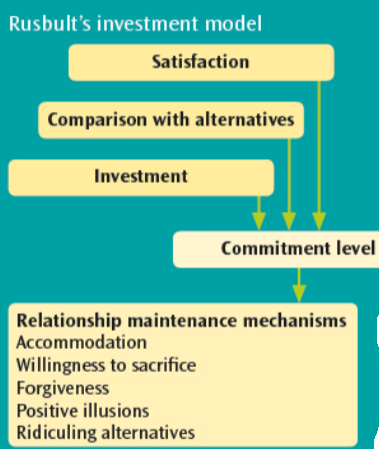
No one person can under or over benefit for a fulfilling relationship - 16Romantic relationship theories - Rustbult's investment model
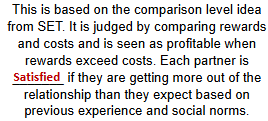
- 17Romantic relationship theories - Rustbult's investment model - Satisfaction
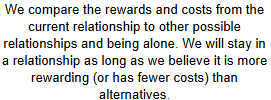
- 18Romantic relationship theories - Rustbult's investment model, (SET) - Comparison to alternatives (CTA)
- 19Romantic relationship theories - Rustbult's investment model - InvestmentTangible and intangible things put into a relationship
Tangible - money, children
Intangible - shared memories - 20Romantic relationship theories - Rustbult's investment model - CommitmentThe idea that you stay in a relationship because you are committed to it not your just satisfied in it, but it can play a role in that commitment
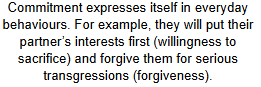
Can explain why people stay in abusive relationships therefore (high investment) - 21Romantic relationship theories - Rustbult's investment model - Relationship maintenance mechanisms
- 22Romantic relationship theories - Duck's phase model of relationship breakdown2007 - Proposed model on how relationships breakdown and fail
Originally proposed that once you go from one stage to another you cannot go back, but later versions have seen that as not accurate - 23Romantic relationship theories - Duck's phase model of relationship breakdown - Intra-psychic phase
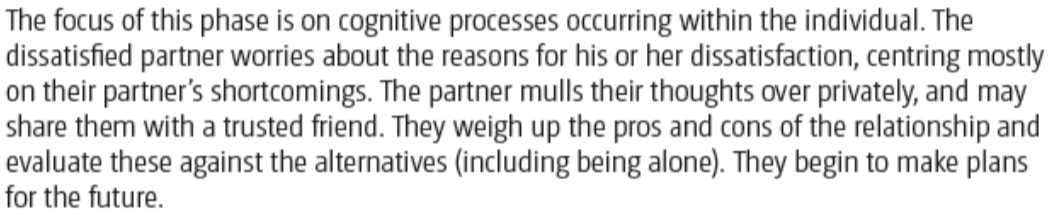
- 24Romantic relationship theories - Duck's phase model of relationship breakdown - Dyadic phase
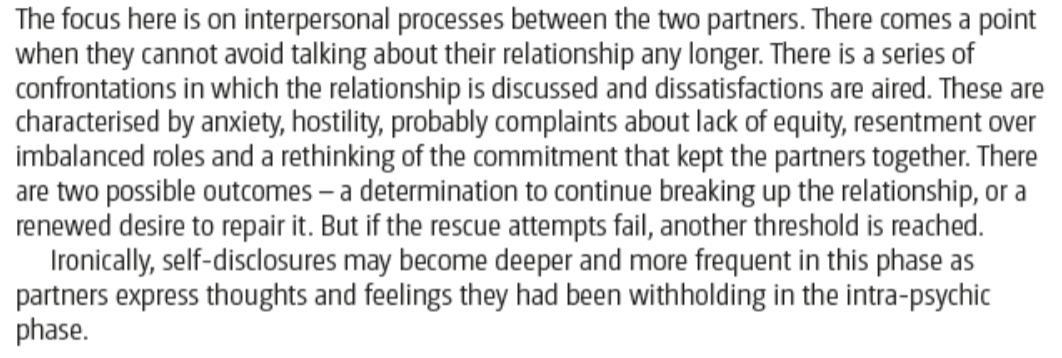
- 25Romantic relationship theories - Duck's phase model of relationship breakdown - Social phase
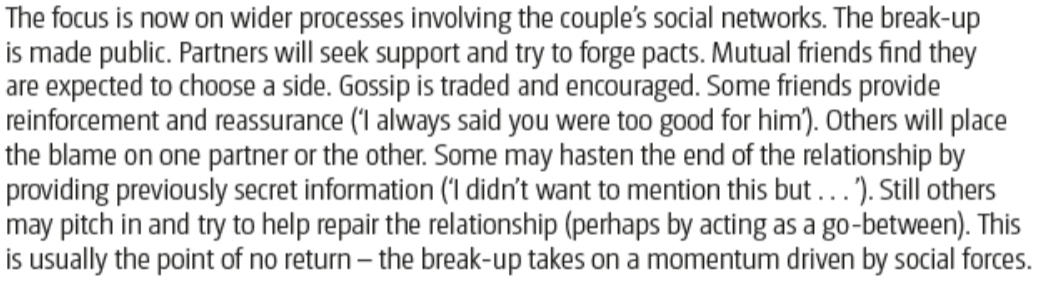
- 26Romantic relationship theories - Duck's phase model of relationship breakdown - Grave-dressing phase
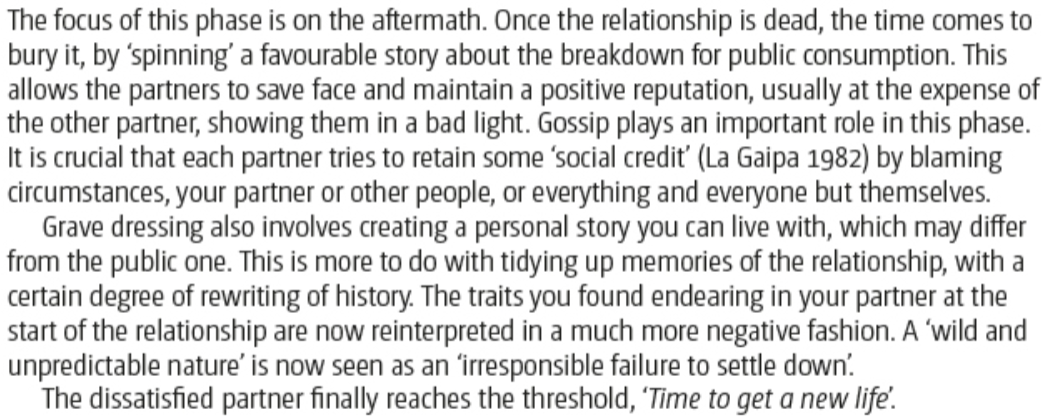
- 27Virtual relationshipsAn online relationship, where a number of electronic communication methods are used to contact each other and to maintain the relationship.
- 28Virtual relationships - Self-disclosureSelf-disclosure changes in virtual relationships
Two main theories on how and why they change:
- Reduced Cues Theory
- Hyperpersonal Model - 29Virtual relationships - Self-disclosure - Reduced cues theoryCues that are present face to face are not online, causes a process of deindividuation
This can cause people to change their attitudes from real life - eg. being more blunt
This can cause people not to want to self-disclose as trust is not formed - 30Virtual relationships - Self-disclosure - Hyperpersonal modelAnonymity prompts self-disclosure in two ways:
1. as it is all anonyms people do not know each other therefore self-disclosure can help get to know each other
2. online allows you to only put out certain bits of your life, therefore you can craft yourself to be different from real life, so you want to self-disclose to express that
Both of these cause earlier and deeper self-disclosure than a real life relationship - 31Virtual relationships - Absence of gatingUnlike real life lots of the barriers to entry in a relationship are not there online - social anxiety can be reduced, looks may be less of a thing that people get rejected over, physical disabilities are not preventative
Therefore more people can get into a relationship via a virtual relationship - 32Parasocial relationships (PSR)An intense one sided relationship where a fan becomes infatuated with a celebrity
This can range in intensity so has 3 levels to it (see next card) - 33Parasocial relationships - Levels of parasocial relationships
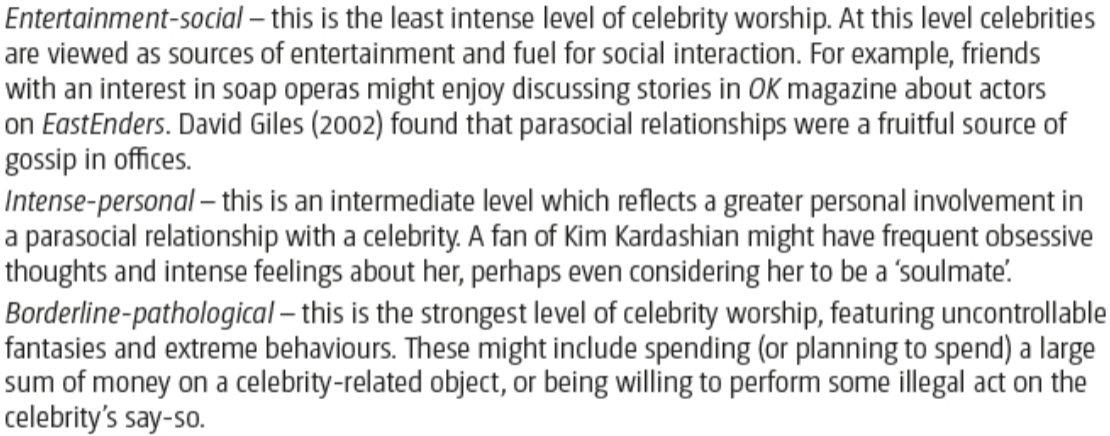
- 34Parasocial relationships - Absorption-addiction modelPSR start with a person who is seeking fulfilment that they do not get normally
Absorption - this person gets fulfilment from a celebrity and starts to be motivated to be preoccupied with them and not their life and starts to identify with them
Addiction - they start to want to increase their "dose" of the celebrity, so may turn to illegal actions (eg. stalking) to do it - 35Parasocial relationships - Attachment theory explanationDepending on your attachment type (see attachment cards) you are more or less likely to form an PSR
Insecure-avoidant - very unlikely as they do not want to be rejected in any form
Secure - unlikely as they are seen as "emotionally healthy"
Insecure-resistant - most likely to as they want their needs fulfilled but with low chance of rejection, which PSRs are able to do
Informationen
- Beschreibung
- A level Psychology (Relationships) Karteikarten am Relationships, erstellt von Mrjiggles 17 am 06/03/2025.
- Erstellt von
- Mrjiggles 17
- Aufrufe
- 0
- Bewertung