
Karteikarten
A Level AQA Biology: Unit 5 (Energy transfers in and between organisms)
Karten in diesem Stapel (69)
- 13.5 Energy transfers in and between organismsN/A
- 23.5.1 PhotosynthesisN/A
- 3What are the raw materials of photosynthesis?- Carbon dioxide
- Water
- Light energy - 4How is the leaf adapted to absorb these materials?- Large surface area to volume ratio, air gaps, thin leaves
- Transpiration stream through stomata
- Transparent cuticle to absorb light, large surface area to volume ratio - 5What are the stages of photosynthesis?- Light-dependent reaction
- Light-independent reaction - 6Where does the light-dependent reaction take place?Thylakoid membrane, within chloroplasts
- 7What are the stages of the light-dependent reaction?- Making of ATP
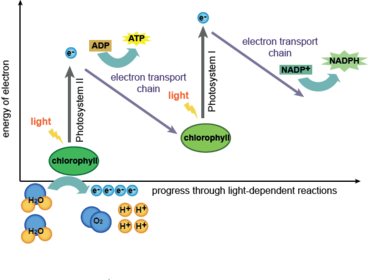
- Photolysis of water - 8What are the stages of the making of ATP?- Light energy is absorbed by chlorophyll
- A pair of electrons within chlorophyll are raised to a higher energy level
- Energised electrons leave chlorophyll (oxidising it, photo-ionisation) and are picked up by electron carriers (reducing them)
- Electrons are now passed along multiple carriers in oxidation-reduction reactions, transferring energy at each stage
- Transferred energy used to make ATP from ADP and Pi (photo-phosphorylation) - Chemiosmotic theory - 9What is chemiosmotic theory?- Mechanism by which ATP produced in photosynthesis
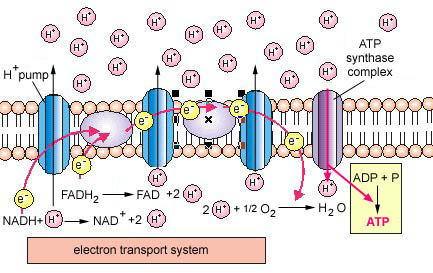
- 10What are the stages of chemiosmotic theory?- Energy released from electron carrier used to actively transport H+ ions (protons) from the stroma into the thylakoid against conc. gradient
- Thylakoid membran impermeable to H+ ions but these can move through a special channel protein (ATP synthase)
- H+ ions moving through ATP synthase causes the enzyme to take two substrates (ADP and Pi) and condense them into ATP - 11Diagram of chemiosmotic theory
- 12What are the stages of the photolysis of water?- Chlorophyll must replace lost electrons, replacements come from photolysis of water
- Water is broken down into hydrogen ions (protons), oxygen and electrons
- Hydrogen ions are taken up by electron carriers called NADP (reducing them) - 13What are the products of the light-independent reaction?- reduced NADP
- ATP
- oxygen gas - 14Diagram of the light-independent reaction
- 15Where does the light-independent reaction take place?- stroma, within chloroplast
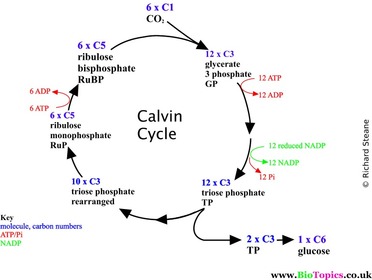
- 16What are the stages of the light-independent reaction?- Calvin cycle
- carbon dioxide from air diffuses into leaf through stomata
- in the stroma, CO2 combines with 5-carbon compound Ribulose Biphosphate (RuBP) using RuBP carboxylase enzyme, producing two molecules of 3-carbon Glycerate 3-phosphate (GP)
- ATP and reduced NADP are used to reduce GP to 3-carbon sugar Triose phosphate (TP)
- Most TP molecules are used to regenerate RuBP using ATP from LDR
- Some TP is converted into useful substances, such as glucose, using energy from ATP
- NADP is reformed and returns to thylakoid membrane, being now oxidised - 17What are the products of the light-independent reaction?- Useful sugars e.g. glucose
- oxidised NADP - 18Diagram of the light-independent reaction
- 19What is the Law of Limiting Factors?At any given moment, the rate of a physiological process is limited by the factor that is at its least favourable value
- 20What are the limiting factors for photosynthesis?- CO2
- Light
- Temperature
- Water - 21What is the Light Compensation Point?Point at which CO2 released during respiration equals that taken up during photosynthesis - no net loss or gain of CO2
- 223.5.2 Respiration (A-level only)N/A
- 23What is the desired product of respiration?ATP (for use in muscle contraction, active transport etc)
- 24What are the stages in aerobic respiration?- Glycolysis
- Link reaction
- Krebs cycle
- Electron transport chain - 25Where in the cell does Glycolysis take place?Cytoplasm
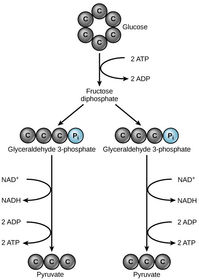
- 26What are the stages of glycolysis?- Phosphorylation of glucose to glucose phosphate, consuming a phosphate group from ATP
- Production of triose phosphate
- Oxidation of triose phosphate to pyruvate, producing 2 x ATP and reduced NAD - 27Diagram of glycolysis
- 28What are the net products of glycolysis?- 1x ATP (as one is used in the phosphorylation of glucose)
- Reduced NAD - 29What happens in anaerobic respiration following glycolysis?- Pyruvate converted into: Lactacte (in animals) or ethanol (in plants/yeast) using reduced NAD (oxidised NAD used in further respiration)
- 30What is the oxygen debt?The oxygen that must be used following the end of anaerobic respiration to oxidise the waste products
- 31Why is anaerobic respiration inefficient?- Produces only the ATP made in glycolysis, much less than in the electron transport chain in aerobic respiration.
- Build up of waste products - 32What happens in aerobic respiration following glycolysis?Pyruvate actively transported into matrix of mitochondria
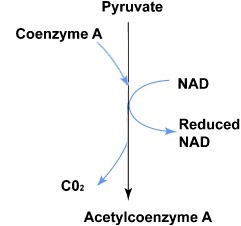
- 33What are the stages of the link reaction?- 3-carbon Pyruvate enters a series of link reactions, combining it with coenzyme A to form 2-carbon Acetyl (acetate) coenzyme
- 2H released during reaction, used to reduce NAD
- C02 released as waste - 34Diagram of link reaction
- 35What are the stages of the Krebs cycle?- Acectyl coenzyme A binds with a 4-carbon molecule, forming a 6-carbon molecule
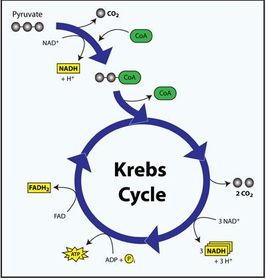
- 6 carbon molecule passes through a series of reactions, producing 2H to reduce NAD, C02 as waste, 2H to reduce FAD, some ATP is synthesised. substrate-level phosphorylation
- Loss of CO2 molecules returns 6-carbon molecule to a 4 carbon molecule able to bind with more Acetyle coenzyme A - 36Diagram of the Krebs cycle
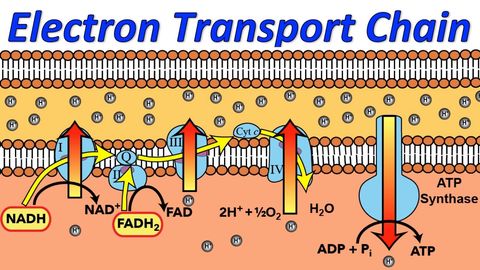
- 37What are the stages of the electron transport chain?- reduced NAD & FAD give up 2H molecules, which split into protons and high-energy electrons
- high-energy e- transported by electron carriers along inner mitochondrial membrane, series of oxidation-reduction reactions pass them along, releasing energy. - oxidative phosphorylation
- Some energy is used to power active transport
- Protons (H+) actively transported into inner mitochondrial membrane, at the end of the chain they diffuse through protein channels (ATP synthase enzyme), the movement of which causes ADP & Pi to condense into ATP
- H+ rejoin e- to form Hydrogen atoms, two of which join with oxygen to form water, which is exhaled. - 38Diagram of electron transport chain
- 39What are some alternative respiratory substances?- Fat
- Protein - 40How is fat broken down for energy?- Fat breaks down into fatty acids & glycerol
- Fatty acid loses 2x 2c units to form Acetyl coenzyme A for use in the Krebs cycle
- Glycerol converts into 3-carbon sugars, which break down into starch/glycogen and pyruvic acid - 41How is protein broken down for energy- Protein breaks down into amino acids
- Amino acids convert to acetyl coenzyme A for use in the Krebs cycle, and deaminates (-NH2) to form ammonia (excreted as urea) - 423.5.3 Energy and ecosystemsN/A
- 43How do plants synthesise organic compounds?From carbon dioxide
- 44How are sugars used by plants?- respiratory substrates
- other biological molecules (making biomass) - 45How is biomass measured?- dry mass (grams per sq metre gm^-2)
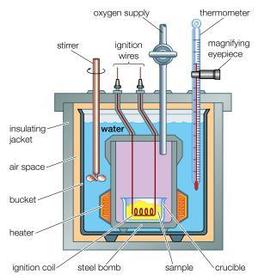
- mass of carbon (grams per sq metre gm^-2) - 46How can chemical energy storage in mass be calculated?Calorimetry - e.g. using a bomb calorimeter to burn a sample and measure how much the temperate of surrounding water is raised
- 47Diagram of a bomb calorimeter
- 48What is Gross Primary Production?Chemical energy store in plant biomass, in a given area of volume
- 49What is Net Primary Production?Chemical energy store in plant biomass, minus energy lost into the environment through respiration
- available for plant growth and reproduction, can be consumed by consumers in higher trophic levels (& decomposers)
NPP = GPP - R - 50What is primary & secondary productivity?Rate of primary/secondary production
- measured in biomass in a given area in a given time (kj ha-1 year-1) - 51What are some agricultural methods for increasing the efficiency of energy transfer?- Factory farming of animals to reduce energy lost in movement
- Using all of a plant/animal for a range of purposes
- Eliminating some trophic levels e.g. eating crops rather than animals that eat them - 523.5.4 Nutrient cyclesN/a
- 53What are saprobionts?Microorganisms that break down and absorb dead matter (decomposers)
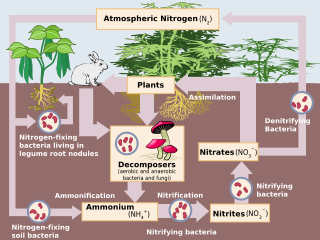
- 54What is the nitrogen cycle?Cycle of absorption of nitrogen in the air by bacteria in the soil and plants, and its return to the atmosphere
- two possible routes: fixation by free living bacteria or by mutualistic bacteria - 55What are the stages of the nitrogen cycle? - fixation by free living bacteria routeNitrogen in atmosphere (N₂)
- fixation by free living bacteria to ammonium ions (NH₃)
- nitrification to nitrite ions (NO₂) by nitrifying bacteria
- further nitrification to nitrate ions (NO₃) nitrifying bacteria
- can be absorbed by mutualistic bacteria to ammonium-containing molecules e.g. proteins in producers OR denitrification back to N₂ in atmosphere by denitrifying bacteria - 56What are the stages of the nitrogen cycle? - fixation by mutualistic bacteria routeNitrogen in atmosphere (N₂)
- fixation by mutualistic bacteria in plants to ammonium-containing molecules e.g. proteins in producers
- passes to amine groups in amino acids when producers are consumed, and then ammonium-containing molecules e.g. proteins in saprobionts when they break down dead consumers OR straight to saprobionts when they break down dead producers
- ammonification to ammonium ions (NH₃) by saprobionts
- nitrification to nitrite ions (NO₂)
- nitrification again to nitrate ions (NO₃)
- can be absorbed by mutualistic bacteria to ammonium-containing molecules e.g. proteins in producers OR denitrification back to N₂ in atmosphere - 57What is nitrogen fixation?Nitrogen gas is converted into nitrogen compounds in the presence of lightning
- Carried out by free-living bacteria, which convert nitrogen into ammonia and use it to make amino acids. nitrogen is released in nitrogen rich compounds when they die
- Carried out by mutualistic bacteria (bacteria in nodules of legumes. Provide amino acids containing ammonia) in exchange for carbohydrates from the plant. - 58What is nitrification?Carried out by nitrifying bacteria in the soil, which take in ammonium ions released from dead free-living bacteria
- oxidation of ammonium ions into nitrite ions
- further oxidation nitrite ions into nitrate ions - 59What is denitrification?Carried out by anaerobic denitrifying bacteria in the soil, which take in nitrite ions released from dead nitrifying bacteria
- converts nitrate conpounds into nitrogen gas
- results in less nitrogen in the soil for plants - 60What is ammonification?Carried out by saprobiontic microorganisms, which decompose dead plants & animals, break down their molecules and release nutrients in their simple form
- production of ammonia from nitrogen containing compounds such as urea, protein, nucleic acids, vitamins - 61Diagram of the nitrogen cycle?
- 62What is the phosphorus cycle?Cycle of phosphorus moving through various biological and environmental states
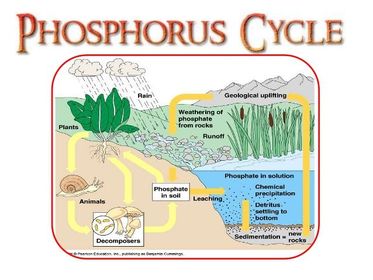
- phosphorus is important as it is used in ATP, phospholipids, DNA - 63What are the stages of the phosphorus cycle?Phosphorus exists mainly as phosphate ions (PO4^3-) in sedimentary rock deposits, rise to the surface by geological uplifting
- erosion & use of fertilisers dissolves phosphate ions in lakes, oceans, soils
- dissolved ions absorbed by plants and incorporated into biomass OR return to rock deposits by sedimentation
- phosphate ions pass into animals when they consume plants
- phosphate ions excreted as waste that is broken down by saprobionts are dissolved in oceans, lakes, soils OR are released during decomposition of dead animals where they dissolve in oceans, lakes, soils OR remain in parts of animals that are slow to break down e.g bones, shells
- phosphate ions in slowly-decomposing parts of animals are deposited as part of sedimentation, forming rock deposits - 64Diagram of the phosphorus cycle?
- 65What is the role of mycorrhizae in nutrient cycles?Mycorrizhae area mutualistic associations between types of fungi and the roots of the majority of plants, fungi receives organic compounds
- fungi act like extensions of the root system, increasing the surface area for absorption of water and minerals
- holds water and minerals allowing better resistance to drought and better uptake of inorganic ions
- involved in nutrient cycles by improving the uptake of relatively scarce ions e.g. phosphate ions - 66What are fertilisers?Soil treatments
- Used to replace nutrients e.g. nitrogen and phosphorus lost by the harvesting of plants and removing livestock
- Can be natural consisting of organic decaying remains (e.g. manure) or artificial consisting of chemicals containing balances of ions (e.g. potash) - 67What are some environmental issues that can arise from the use of fertilisers?Increases productivity in agriculture as plants develop faster, however they can cause:
- reduced species diversity (as nitrogen rich soils favour rapid-growing plants
- Leaching
- Eutrophication - 68What is leaching?Process by which nutrients are removed by the soil. Rainwater dissolves soluble nutrients such as nitrate ions and carries them deep into the soil where they cannot be reached by plant roots and enter water courses
- high nitrate concentrations in babies can prevent efficient oxygen transport & is linked to stomach cancer in all humans
- can cause eutrophication - 69What is eutrophication?Process by which nutrient concentrations increase in bodies of water
- most lakes and rivers have a low concentration of nitrate, thus it is a limiting factor for plant and algal growth
- leaching (& other deposits of nitrates e.g. animal waste) causes increase in nitrate ion concentration in the water, causing plants and algae to grow much faster
- mass growth of algae on the surface of the water (algal bloom) blocks sunlight to the habitat below
- lack of sunlight causes plants at lower depths to die and be broken down by saprobionts, absorbing much oxygen and releasing methane
- lack of oxygen and high methane concentration makes water toxic to animals such as fish, which die and are broken down
- environment becomes increasingly toxic and suited only to adapted organisms, turning it putrid
Informationen
- Beschreibung
- AS - Level Biology (Unit 5 (A Level)) Karteikarten am A Level AQA Biology: Unit 5 (Energy transfers in and between organisms), erstellt von Big Dave am 10/09/2016.
- Erstellt von
- Big Dave
- Aufrufe
- 449
- Tags
- Bewertung