
Karteikarten
A Level AQA Biology: Unit 7 (Genetics, populations, evolution and ecosystems)
Karten in diesem Stapel (70)
- 13.7 Genetics, populations, evolution and ecosystemsN/A
- 23.7.1 InheritanceN/A
- 3What is genotype?The genetic constitution of an animal
- the alleles that are expressed
e.g. bb (for blue eyes) - 4What is phenotype?The expression of this genetic constitution and its interaction with the environment
- the characteristics caused by expression of alleles
e.g. blue eyes - 5What is an allele?Variation of a gene, found in pairs; there may be multiple alleles of one gene
- 6What are the types of allele?- Dominant (always expressed)
- Recessive (only expressed if homozygous)
- Co-dominant (expressed in conjunction with another co-dominant allele) - 7How can the pairs of alleles be expressed?- Homozygous (genotype features two of the same allele)
- Heterozygous (genotype features two different alleles, thus the dominant one will be expressed) - 8How can co-dominant alleles be expressed?- expression of a combined phenotype e.g. white & red co-dominant alleles giving pink phenotype
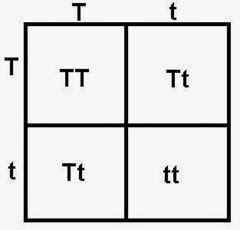
- 9What are monohybrid crosses?Crosses between gametes determining one characteristic
- ratio of 1:2:1 of homozygous: heterozygous: homozygous - 10Inheritance table for a monohybrid cross
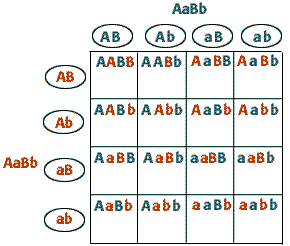
- 11What are dihybrid crosses? FINISHCrosses between gametes determining two characteristics
- ratio of 9:3:3:1 FINISH - 12Inheritance table for a dihybrid cross
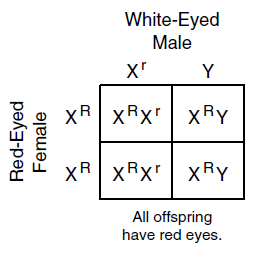
- 13What is sex-linkage?Alleles that fall on the section of the chromosome not present in the male 'Y' chromosome are sex-linked
- these alleles are thus expressed if only one is present in a male, as the Y chromosome lacks any allele that could override it
- some genetic conditions are more common in males because of this - 14Inheritance table for a monohybrid cross with sex-linked genes
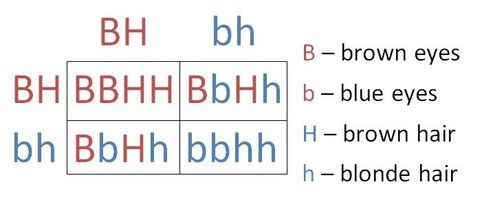
- 15What is autosomal linkage?Alleles for two separate genes fall on the same section of the chromosome, thus are always paired (even after crossing over & recombination)
- results in gametes containing paired genes
- Different alleles always inherited together - 16Inheritance table for a dihybrid cross with autosomally linked alleles
- 17What are multiple alleles?One allele has multiple variations, but only two can be expressed at once
- e.g. three alleles for blood type, only two can be present. Together these two determine blood type - 18Inheritance table for a monohybrid cross with multiple alleles
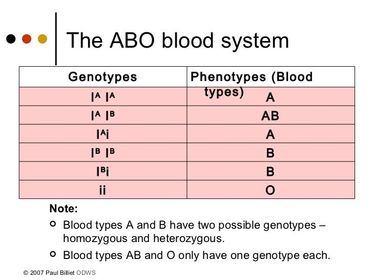
- 19What is epistasis?Expression of one allele is dependent on the expression of another
- e.g. eye colour affected by one allele, but unless the allele to produce pigment is expressed, there will be no pigment - 20Inheritance table for a monohybrid cross with epistasis
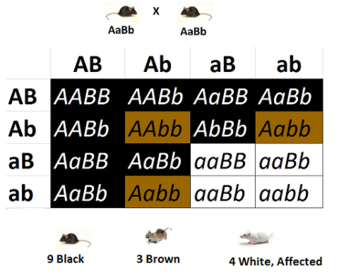
- 21What is the chi-squared (X^2) test?Test to determine the likelihood that results are down to chance
- null hypothesis is tested (e.g. x has no statistically significant impact on y)
X^2 = ∑(0-E)^2/E
O = observed result
E = expected result
Result must be found in x^2 table to determine if the probability is due to chance
- e.g. 0.711 on a test with four degrees of freedom means 95% chance that they are significant - 223.7.2 PopulationsN/a
- 23What is a species?Group of genetically similar organisms able to interbreed
- exist as one or more populations - 24What is a population?Group of organisms of the same species occupying a particular space at the same time, able to interbreed
- 25What is the gene pool?All of the alleles present in a population
- 26What is allelic frequency?The frequency of alleles in the gene pool
- 27What is the Hardy-Weinberg principle?States that allele and genotype frequencies in a population will remain constant from generation to generation in the absence of other evolutionary influences. These influences include mate choice, mutation, selection, genetic drift.
- 28How can the Hardy-Weinberg principle be used?Used to calculate the allelic frequency based on the frequency of various genotypes.
p^2 + 2pq + q^2 = 1
p = dominant, q = recessive - 293.7.3 Evolution may lead to speciationN/a
- 30Why may individuals in a population show a wide range of variations in phenotype?- Genetic factors
- Environmental factors - 31What are the causes of variation in genetic factors?- Mutation
- Crossing over & recombination during meiosis
- Random fertilisation of gametes during sexual reproduction - 32What factors cause differential survival of organisms in a population?Selection pressures
- Predation
- Disease
- Competition - 33What is the influence of differential survival of organisms in a population?Differential survival leads to differential reproduction - Natural selection
- individuals better able to survive are more likely to reproduce and pass on their genes - 34How does natural selection influence allelic frequency?Organisms with phenotypes providing selective advantages are more likely to survive & reproduce successfully, passing favourable characteristics onto future generations
- over time, alleles that give favourable characteristics become more common - 35What is stabilising selection?Selection that favours individuals with an average phenotype
- caused by selection pressures that favour the average e.g. average fur length of wolves favoured over too short/long
- extreme individuals suffer and die out, average individuals flourish - 36Graph of stabilising selection
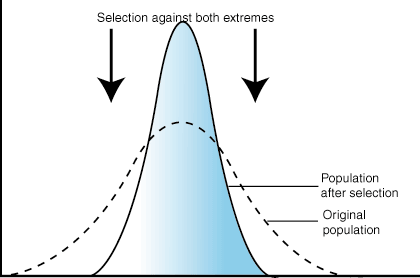
- 37What is directional selection?Selection that favours individuals with a phenotype to one extreme
- caused by selection pressures that favour extremes in one direction e.g. black moths better able to camoflague on sooty trees than white moths
- individuals towards one extreme flourish, individuals towards the other extreme suffer. Shift of the average towards the extreme - 38Graph of directional selection
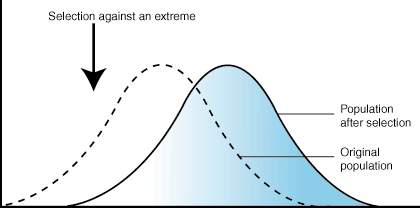
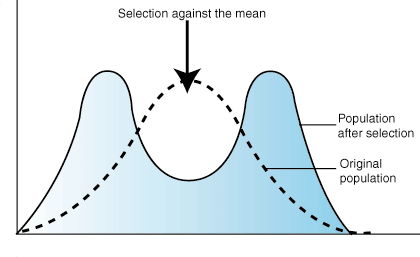
- 39What is disruptive selection?Selection that favours individuals with phenotypes to either extreme
- caused by selection pressures that favour extremes over the average, often because of a dramatic change in selection pressures e.g. black & grey rabbits favoured over the average white one as they are specialised to hiding in areas with black rocks and grey rocks respective, whereas the white is not
- extreme individuals at either side flourish, average individuals suffer. Often results in speciation - 40Graph of disruptive selection
- 41What is the influence of allelic frequency on evolution?Change to allelic frequency over time results in evolution as a population changes to adapt to selection pressures
- 42What is speciation?Development of new species from old ones
- reproductive separation of organisms can result in exposure to dfferent selection pressures and thus eventually genetic differences
- when genetic differences become so great that individuals in a population can no longer breed to produce fertile offspring, they are no longer the same species, and one or both has become a new species - 43What is allopatric speciation?Speciation caused by geographical separation of populations of the same species
- populations separated by an insurmountable barrier e.g. mountains for terrestrial animals
- different selection pressures in the different environments e.g. different temperatures causes populations to develop differently, as natural selection will favour different characteristics
- after a sufficient length of time, the populations will be genetically different to the extent that they cannot interbreed. Thus they have speciated - 44What is sympatric speciation?Speciation caused by reproductive separation within a population
- individuals may choose to breed with only some individuals of their species e.g. apple maggot flies tend to breed with partners that grew up on the same type of fruit as them
- selective breeding means that genes are only passed on to some individuals and there is not random variation in a population. This causes groups within the population to develop independently and will have different allelic frequency to others
- after a sufficient length of time, the populations will be genetically different to the extent that they cannot interbreed. Thus they have speciated - 45What is genetic drift?Alleles favoured in a population become more common over time (greater allelic frequency)
- can lead to speciation as individuals with favoured alleles develop separately to others
- only significant in small populations as a smaller gene pool is affected by favouring of alleles more quickly - 463.7.4 Populations in ecosystemsN/a
- 47What is a community?Population of various different species living in one area
- 48What is an ecosystem?Environment consisting of a community and relevant non-living factors
- abiotic and biotic factors
- can vary in size from small to very large - 49What are some examples of abiotic factors?Different species are adapted to different abiotic conditions. Species flourish when abiotic conditions suit them for reasons such as enzyme action, resource availability
- temperature
- light
- PH
- water & humidity - 50What are some examples of biotic factors?- competition
- predation
- disease - 51What is a niche?An organism's role in the environment, related to its adaptation to abiotic and biotic factors
- no two species occupy the exact same niche
- this reduces interspecific competition for resources, as species do not compete for exactly the same things - 52What is the carrying capacity of an ecosystem?The maximum size of population that an ecosystem can support
Varies as a result of
- effect of abiotic factors e.g. limited resources
- interactions between organisms, intraspecific and interspecific competition, predation - 53What is intraspecific competition?Competition between individuals of the same species
- greater the availability of resources, the larger the population - 54What is interspecific competition?Competition between individuals of different species
- successful species will increase in number whilst populations of outcompeted species dwindle and become extinct - 55How can predation influence population size?Greater numbers of predators reduces the population size of prey
- with few prey available, the population size of predators decreases as there is less food to compete over
- as the predator population falls, prey population increases as there is less predation and more are able to survive to reproduce
- an abundance of prey causes an increase in predator population
- the cycle continues as prey populations fall due to large predator populations - 56How can the size of a population be estimated?- randomly placed quadrats, or quadrats along a transect for slow moving/non-motile (can't move or be moved) organisms
- mark-release-recapture method for motile organisms - 57How can quadrats be used to estimate the size of a population?- Quadrats placed randomly on a sampling area by laying out two tape measures at right angles and obtain random co-ordinates from a table/computer and placing quadrats at these co-ordinates
- Quadrats placed at regular distance intervals along a transect, useful for observing transitions
- abundance of a species can be estimated by observing frequency in quadrats, or by estimating % cover of quadrats - 58How can the mark-release-recapture method be used to estimate the size of a population?- a sample of a population is captured and marked in a way that will not influence the individuals' survival, and then released
- the population is left for a given time
- a same size sample of the population is captured, and the number of individuals that are marked is counted
- the proportion of marked individuals to the sample is used to estimate the total population size
estimated population size = (Sample 1 x Sample 2)/ no. of marked individuals in sample 2
Assumptions:
- population isn't increasing/decreasing in size, individuals are not moving far, - 59What kind of system are ecosystems?Dynamic systems
- conditions can change over time - 60What is succession?Changes to the populations in an ecosystem over time e.g. colonisation of bare rock over time resulting in a diverse ecosystem
- can be rapid or gradual
- new species may alter the environment to make it less suitable for existing species, but more suitable for other species with different adaptations. Thus new species may out-compete existing ones - 61What are the stages in succession?- colonisation of inhospitable environment by PIONEER SPECIES e.g. lichens, making a pioneer community
- pioneer species are adapted to hostile environments as they: reproduce asexually rapidly, produce a lot of wind-dispersed seeds/spores which rapidly germinate, photosynthesis, fix nitrogen, tolerant to extreme conditions
- pioneer species alter abiotic conditions (e.g. producing oxygen so oxygen-dependent organisms can survive) so that over time the environment becomes hospitable to new species
- new communities develop and abiotic conditions continue to change over time, changing the environment to suit new species that arrive
- at each stage of succession, new species arrive and may out-compete old ones, as well as changing abiotic conditions (such as increasingly large plants changing light intensity below)
- eventually a CLIMAX COMMUNITY is reached, which is a stable environment that exists for a long period of time and involves animals & plants - 62What are some common features of succession?- abiotic conditions become less hostile over time
- a greater number of habitats and niches develop
- increased biodiversity (peaks mid-succession and decreases to climax community as species compete for resources and many become extinct)
- more complex food webs
- increased biomass - 63How can organisms influence their environment?Change abiotic conditions
- can result in less hostile conditions e.g. lichens create soil and fix nutrients, when they die these are usable by other plants to grow
- can create new habitats and niches e.g. large trees create separate under-canopy, upper canopy etc. habitats with their own microecosystems - 64What is secondary succession?Succession occurring in an environment that has had its ecosystem destroyed/severely altered e.g. forest fire
- succession is much faster, as many of the abiotic conditions remain and spores/seeds may have survived - 65How does succession progress in a woodland?Barren land
- pioneer species - lichen
- secondary colonisers - mosses
- tertiary colonisers - grasses
- scrubland - shrubs, small trees
- climax community - woodland
Land altered due to fire, disease, land clearance
- recolonisation - 66How does succession influence conservation efforts?Management of succession is often necessary to preserve habitats/prevent changes
- succession may be prevented from progressing to preserve habitats e.g. sheep grazing prevents young tree saplings from growing and moorland becoming woodland - 67What are some human needs of natural resources?- wood from trees for construction
- cleared land for agriculture
- coal for power generation - 68What are the reasons for conservation?- Personal - desire to preserve the environment
- Ethical - respect for the environment
- Economic - preservation of gene pools for potential future use
- Cultural & Aesthetic - preserving habitats and organisms for their enrichment of human life - 69What are some conservation efforts to maintain sustainability of resources?- reduction in deforestation
- renewable energy sources
- alternate food sources to reduce grazing of herd animals - 70How can human needs conflict with conservation efforts to maintain sustainability of resources?- there are often financial reasons for unsustainable practices, and businesses may not be inclined to be more sustainable in their use of resources
- mining, woodcutting, agriculture all provide employment for many people and changing practices could cost jobs
Informationen
- Beschreibung
- AS - Level Biology (Unit 7 (A Level)) Karteikarten am A Level AQA Biology: Unit 7 (Genetics, populations, evolution and ecosystems), erstellt von Big Dave am 10/09/2016.
- Erstellt von
- Big Dave
- Aufrufe
- 273
- Tags
- Bewertung