
Karteikarten
Loftus and Palmer (1974)

Karten in diesem Stapel (24)
- 1What was the aim of Loftus and Palmer experiment 1?To investigate whether leading questions used in eye witness testimony can alter a participant's memory of an event.
- 2Who were the participants of Loftus and Palmer's first experiment?45 American Students. They were collected using an opportunity sample.
- 3What type of experiment and which type of design was used for Loftus and Palmer's first experiment?It was a laboratory experiment and had an independent measures design (different participants used in each condition).
- 4What was the independent variable of Loftus and Palmer's first experiment?The leading word used in the question "How fast was the car going when it _____ into the other car?" The choices of words used to fill the gap were 'smashed', 'collided', 'bumped', 'hit' and 'contacted'.
- 5What was the dependant variable of Loftus and Palmer's first experiment?The participants estimates of the speed at which the car was travelling.
- 6Why were the participants only shown staged crashed? (7 clips of them to be precise)A real life car crash would likely cause trauma to the participant, breaking the BPS guideline of responsibility as the patient may suffer long term, for example, they may acquire PTSD.
- 7Where were the 7 movie clips gathered from in Loftus and Palmer's first experiment?They were driver's education films gathered from the safety council and the Seattle Police Department. They were around 5-30 seconds in length.
- 8What were participants asked to do after they watched the clip in Loftus and Palmer's first experiment?They were given a questionnaire which firstly asked them to give an account of what they had just watched. This was followed by a few more specific questions until finally they were asked their group's variant of the leading question.
- 9How many groups of participants were formed in Loftus and Palmer's first experiment?5 groups of 9 participants.
- 10What were the results of Loftus and Palmer's first experiment?
- 11How did distortion effect participant's recall of events in Loftus and Palmer's first experiment?The leading question led to participants cognitively reevaluating and changing their memories due to the prompt of the leading question.
- 12How did response-bias effect the results of the participants in Loftus and Palmer's first experiment?If a participant isn't entirely sure of the speed of the cars they will guess. They will hence use the words of the examiner to get to their answer, so, if the examiner says 'smashed' the participant will trust them and presume the car was going fast.
- 13What was the aim of Loftus and Palmer's second experiment?To investigate if leading questions could effect an eye witnesses memories of an event.
- 14What was the method of Loftus and Palmer's second experiment?Same as the first study, only that they used two leading words (smashed and hit) instead of five. After a week, the participants were also gathered again and asked whether they saw any broken glass.
- 15How many participants took part in Loftus and Palmer's second experiment?150. 50 in the 'smashed' condition, 50 in the 'hit' condition and 50 control.
- 16How long were the video clips used in Loftus and Palmer's second experiment?They were less than a minute long and the car crash itself was shorter than 4 seconds.
- 17What were the results of Loftus and Palmer's second experiment regarding speed estimates?The 'smashed' group predicted a higher speed (10mph) whilst the 'hit' condition predicted 8 mph.
- 18What were the results of Loftus and Palmer's second experiment regarding whether they saw broken glass or not? (Ps, there was no broken glass at the scene of the incident).
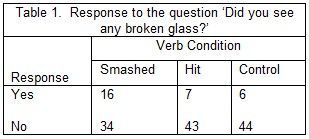
- 19What did the results show in Loftus and Palmer's second experiment?Participants who had the leading question asked using the word 'smashed' were overall twice as likely to say they saw broken glass even though were was none. The group with the verb 'hit' had nearly the same amount of participants saying they saw the glass to those of the control group.
- 20Discuss the generalisability of this experiment?All participants were American so this study is ethnocentric and culturally biased. All participants were also students from the University of Washington so they are ungeneralisable to all age groups. Also, 45 participants isn't a very large sample. However, 150 was (experiment 2).
- 21Discuss the reliability of this experiment?Was a laboratory experiment so had very high control over the variables which can be seen as a good and a bad thing, as it means data is unaffected by extraneous variables but also does not reflect on reality. However, there was a standardised procedure so it is repeatable.
- 22Discuss the applications of this experiment?It has large impacts on eye witness testimony as it showed memories can be easily manipulated hence it led to the development of the cognitive interview.
- 23Discuss the validity of the experiment?High control as lab experiment, hence valid results. Low mundane realism low task validity due to lab. High internal validity and Low external validity due to it being a laboratory experiment.
- 24Discuss the ethics of the experiment?Not much deception as the leading questions weren't necessarily directing participants away from the truth. Also, no harm to participants unless some were feeble minded and effected by a staged car crash. If so, this would break the code of responsibility in the BPS guidelines.
Informationen
- Beschreibung
- A level Psychology (Criminology) Karteikarten am Loftus and Palmer (1974) , erstellt von Emma Lloyd am 12/10/2016.
- Erstellt von
- Emma Lloyd
- Aufrufe
- 211
- Tags
- Bewertung