
Karteikarten
Biology Unit 2 - DNA, meiosis, mitosis, cell cycle
Karten in diesem Stapel (45)
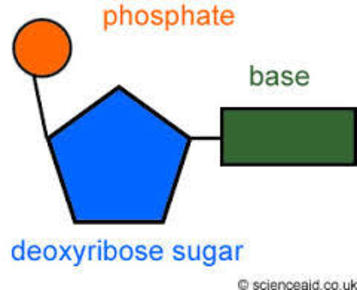
- 1What are the components of DNA?Deoxyribose sugar, Phosphate and bases (A,C,T,G)
- 2How is a nucleotide structured?
- 3How are the two sugar-phosphate backbones held together?Hydrogen bonding between base pairs
- 4How does specific base pairing work?A+T : 2 H bonds
C+G: 3 H bonds - 5Describe the structure of bases in DNASingle ring bases: C+T
Double-ring bases: A+G - 6How does the structure of DNA make it adapted for its function?Double-helix structure enables it act as a stable info-carrying molecule. By having the base pairs within helical cylinder of the deoxyribose-phosphate, the genetic info is protected from being corrupted by outside chemical and physical forces to some extent
- 7What is a locus?A fixed position occupied by a gene on a particular strand of DNA
- 8What are genes?Sections of DNA found on chromosomes that contain coded info as a specific sequence of bases.
- 9What is the function of a gene?To code for polypeptides (proteins) that determine the nature and development of organisms
- 10What is the triplet code?The sequence of three bases that code for a specific amino acid
- 11Why is the base sequence of a gene important?It determines the amino acid sequence in a polypetide (which determine the nature and development of organisms). The AA sequence is the primary structure of a protein which gives rise to the tertiary structure and hence the shape of the protein. So the DNA codes indirectly for the shape of proteins including enzymes.
- 12Give examples of non-coding nuclear DNA found in eukaryotesIntrons within genes, Multiple repeats, Stops
- 13How do genes code for polypeptides?Using the triplet code
- 14What are alleles?Different forms of the same gene that cause variations in a characteristic due to slightly different order of bases
- 15What might differences in base sequence of alleles lead to?Non-functional proteins. Difference in base sequence leads to diff AA sequence which leads to production of diff protein which may not be functional, have a diff shape (which in the case of an enzyme will no longer fit the substrate molecule) - bad as enzymes control metabolic pathways
- 16How does DNA differ in eukaryotic and prokaryotic organisms?Eukaryotes: DNA linear, associated with proteins
Prokaryotes: DNA smaller,circular and not associated with proteins - 17What is a chromosome? Describe its structureThread-like structures make of DNA tightly coiled around proteins called histones by which hereditary info is physically passed from one generation to another. Chromosomes appear as two threads, joined at a single point (centromere). Each thread is called a chromatid
- 18What are homologous chromosomes?Pairs of chromosomes (one from mum and one from dad) which are the same size and have the same genes although they could have diff alleles
- 19Why is meiosis necessary?Ensures that the no of chromosomes doesn't double every generation - maintains a constant no. of chromosomes in the adults of a species. This is done by halving the no. of chromosomes
- 20What's the difference between haploid and diploid cells?Diploid cells - body cells have two PAIRS of chromosomes (one set from each parent).
Haploid cells found in gametes - have only ONE chromosome from each pair so that when they join they form diploid cells - 21Describe the process of meiosis1) DNA unravels and replicates so there are 2 copies of each chromosome
2) DNA condenses to form double-armed chromosomes made from sister chromatids
3) Chromosomes line up in the middle in homologous pairs
4) M1 - homologous pairs are pulled apart (after crossing over and recombination) and separate halving the chromosome number, two cells
5) M2 - chromatids move apart, 4 genetically diff haploid cells formed each with 23 chromatids - 22What is independent segregation of homologous chromosomes?The different combinations of maternal and paternal chromosomes that goes into daughter cells as a result of random arrangement and crossing over of homologous pairs in meiosis 1
- 23What is recombination by crossing over?When chromatids twist around each other and swap part of each other - they now have a different combination of alleles. The crossing over of the chromatids allow 4 daughter cells each with different alleles to be formed. This increases genetic variation.
- 24What happens during DNA replication?1) Enzyme helicase breaks 2 polynucleotide DNA strands which causes helix to unzip
2) Each original single strand acts as a template for a new strand - free floating nucleotides join exposed bases using specific base pairing
3) DNA polymerase join nucleotides on new strands - H bonds form between bases on original and new strand
4) Each new molecule contains 1 strand from original - 25Why is the process of DNA replication called semi-conservative?Half of the new DNA molecules are from the original piece of DNA
- 26What happens during mitosis and why is it important?The parent cell divides to produce 2 daughter cells, each containing an exact copy of DNA of the parent cell (genetically identical to original). Mitosis increases the cell number in this way in growth and tissue repair
- 27What happens during prophase?1) PROPHASE - chromosomes condense, centrioles(bundles of protein) move to opposite ends of the cell forming spindle fibre (protein fibres). The nuclear envelope breaks down and chromosomes lie free in the cytoplasm
- 28What happens during metaphase?Chromosomes (each with 2 chromatids) line up along the middle and attach to the spindle fibres by their centromeres
- 29What happens during anaphase?The centromeres divide separating each pair of sister chromatids. The spindle fibres contract pulling the sister chromatids to opposite ends of the cell.
- 30What happens during telophase?Chromatids reach opposite poles, uncoil and become indistinct (long and thin) - now called chromosomes again. Nuclear envelope reforms so there are 2 nuclei. Cytoplasm divides and now there are two daughter cells that are genetically identical.
- 31Outline the stages of mitosis in order1) Prophase
2) Metaphase
3)Anaphase
4) Telophase - 32Why is mitosis important?Cell diffrentiation - cells divide to give specialised cells which have to be identical to produce tissue with the same function
Repair - when cells die new ones have to have the same function - 33When does DNA replication take place?Interphase
- 34What is the difference between interphase and mitosis?Interphase: Cell growth and DNA replication
Mitosis: CELL replication - 35What happens during interphase?DNA unravels, replicates, genetic content is doubled, organelles are replicated, ATP production increases to provide the energy for cell division (in mitosis which occurs next)
- 36Outline the stages of interphase1) Gap phase 1
2) Synthesis
3) Gap phase 2 - 37How is the cell cycle affected in cancer patients?Due to a mutation in a gene that controls cell division, the cell divides uncontrollably (tumour)
- 38How do cancer treatments kill cancer cells?They aim to disrupt it and although they can't distinguish between cancer cells and body cells, tumour cells divide more frequently so the treatment is more likely to kill cancer cells
- 39How do cancer treatments affect the cell cycle?Prevent synthesis stage (DNA replication) so cell kills itself
Inhibit metaphase which interrupts spindle fibre formation - 40What is the problem with cancer treatment in relevance to normal cells?They kill normal cells that divide rapidly (e.g hair cells) - can lead to hair loss
- 41Why are repeated doses of cancer treatment given with short breaks in between?Allows body cells to recover but the break is short so cancer doesn't grow back to the same size.
- 42What is cell differentiation?When each cell becomes specialized in structure to suit the role that it will carry out.
- 43What is tissue in terms of cells?An aggregation of similar cells
- 44What are organs in terms of tissue?An aggregation of tissues
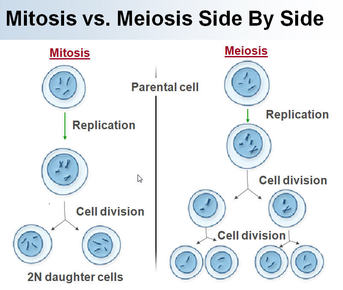
- 45What is the difference between mitosis and meiosis?
Informationen
- Beschreibung
- Structure and replication of DNA, Triplet Code, DNA and chromosomes, Meiosis and genetic variation, Mitosis, Cell cycle, cell diffrentiation
- Erstellt von
- DauntlessAlpha
- Aufrufe
- 3.435
- Tags
- Bewertung