
Karteikarten
Attachment
Karten in diesem Stapel (164)
- 1Attachment?strong 2-way emotional and reciprocal bond between 2 people
will lead to separation anxiety - 2Name 2 caregiver-infant interactions-reciprocity
-interactional synchrony - 3Reciprocity?infant and caregiver respond to each others signals to elicit responses from each other
-verbal or facial
-either can initiate
-take turns creating responses - 4Study into Reciprocity?TRONICK
(turn away) - 5TRONICK: Did-asked mothers to initially have a 'normal' conversation with their child
-then asked to turn away and turn back around with a still face
-infants reactions recorded - 6TRONICK: Found-infants used smiling and pointing to try and produce a response from mothers
-became increasingly distressed when did not respond - 7TRONICK: Showsinfants expect their actions to be reciprocated
- 8Interactional Synchrony?caregiver and infant's interactions mirror each other -> actions are simultaneous and usually has a rhythm
- 9Who studied interactional synchronyBRAZELTON -> Frozen Face
- 10BRAZELTON: Did-mothers interactions videoed with infants
-sat face to face
-mothers asked to make different facial expressions before making a 'frozen face'
-infants reactions were noted - 11BRAZELTON: Found-imitated each others movements
-took turns initiating new movement
-when ignored infant's signals = became concerned
-some curled up motionless - 12BRAZELTON: Shows-demonstrates how interactional synchrony works to maintain and strengthen attachment bond
- 13Evaluation: hard to know what is happening when observing infants-many studies have shown same patterns of behaviour BUT how do we know these aren't just movements
-difficult to be sure what is happening from infant's perspective *is imitation conscious?
- cannot be certain interaction have a special meaning - 14Evaluation: highly controlled procedure-interactions videoed -> fine details of behaviour can be analysed later
-also infants don't know being observed so behaviour does not change in response to observation
-good validity - 15Evaluation: research does not show us purpose of synchrony and reciprocity-synchrony only describes behaviour that happens at the same time
-can be reliably observed but not useful as does not tell us their purpose
-BUT evidence is helpful in development of attachment, stress responses, empathy, language + moral development - 16Evaluation: mother-infant interactions = socially sensitive-suggests children could be disadvantaged by particular parenting techniques
-*mothers who return to work after child is born restrict opportunities for synchrony
-suggests mothers should not return to work so soon -> could interfere with equal rights - 17Evaluation: interactional synchrony = beneficial to society-10 min Parent-Child Interaction Therapy improved synchrony in 20 low-income mothers and nursery infants compared to control
-suggests research could be used to improve mother-infant attachments in at risk groups - 18SCHAFFER + EMERSON: Role of the Father-although majority attached to mother 1st
-BUT in 27% of cases father was joint first attachment
-found 75% of babies had attachment with father by 18 months -> indicated by separation anxiety - 19GROSSMAN: Role of the Father-father's interactions are different
-quality of attachment less important for attachment type of teens that quality with mother BUT the quality of play was
-suggests fathers have different role -> less nurture and more play stimulation - 20RUTTER: Role of the Father-model of multiple attachments
-all attachments are of equal importance
-they all join together to form working internal model
-attachment to father of equal importance to attachment to mother - 21Fathers can be Primary Caregivers-filmed 4-month-old babies
-primary caregiver fathers spent more time smiling, imitating and holding than secondary caregivers
-suggests when father primary caregiver they adopt behaviours more typical of mothers - 22Evaluation: children with same-sex or single parents-they do not develop differently than children with heterosexual married parents
-suggests role of father is not important - 23Evaluation: research fails to provide a clear answer-traditional gender roles =women expected to be more nurturing than men => fathers feel don't feel they should act in a nurturing way
-could be higher oestrogen in females creates high levels of nurturing => biologically predisposed to primary caregiving - 24Evaluation: Social Bias prevents objective observations-preconceptions about fathers parenting styles from stereotypes
-fathers = more playful => unconscious observer bias where 'see' what expect rather than reality
-conclusions hard to dis-tangle from social biases - 25Evaluation: Economic Implications-mothers feel pressured to stay at home as research suggests are vital for healthy development
-may not be best economic solution for all families
-research may be of comfort to mothers who feel have to makae hard choices about returning to work - 26Who identified the stages of attachment?SHAFFER + EMERSON
- 27What are the 4 stages of attachment?- Pre-Attachment/Asocial Stage
-Indiscriminate Attachment Phase
-Specific Attachment Phase
-Multiple Attachments - 28Pre-Attachment/Asocial Phase-1st few weeks
-cannot distinguish between humans + objects
-no apparent recognition of individuals - 29Indiscriminate Phase-2 to 7 months
-general sociability towards people + can distinguish from objects
-prefer familiar adults
-do not show stranger/separation anxiety - 30Specific Attachment Phase-7 months
-start to show stranger/separation anxiety
-strong attachment to primary attachment figure (most sensitive to infants needs) - 31Multiple Attachments-by 1 yr
-form secondary attachments to other major caregivers - 32SHAFFER + EMERSON: Ps-60 Scottish babies
-majority = working-class
-between 5 and 23 weeks old - 33SHAFFER + EMERSON: Did-infants + mothers were visited every month for a yr and again at 18 months
-measured separation anxiety -> asked mothers behaviour in everyday separation
-measure stranger anxiety through observing responses to strangers - 34SCHAFFER + EMERSON: Found-25 - 32 weeks = 50% showed separation anxiety from primary caregiver (usually the mother)
-attachment formed with caregiver most sensitive to infant's signals and not who spent the most time with - 35Evaluation: has high external validity-most observations made by parents in normal environment doing everyday activities
-behaviour unlike to be effected by observers and behaved naturally - 36Evaluation: Longitudinal Study-same children were followed up and observed regularly
-better internal validity as do not have confounding variable of individual differences in Ps
-BUT more time consuming - 37Evaluation: problem with how multiple attachments is assessed-just because get distressed when person leaves the room does not show 'true' attachment figure
-BOWLBY stated may be distressed when playmates leave the room
-does not distinguish between behaviour shown towards playmates and secondary attachment figures - 38Evaluation: problem with studying asocial stage-young babies have poor coordination + fairly immobile
-difficult to make judgments based on observed behaviour
-may be the babies quite social but cannot show this though movements - 39Evaluation: Conflicting Evidence for Multiple Attachments-BOWLBY states must form primary attachment before can form multiple attachments
-BUT in collectivist cultures multiple attachments are the norm
-families work jointly together to raise children - 40Imprinting?born readiness to develop bond
must happen in a specific time period - 41who studying attachment in geese?LORENZ
- 42LORENZ: Did-12 eggs split in half
-some incubated and LORENZ was 1st ting they saw when hatched
-others hatched naturally with mother
-marked so could tell the difference
-put under upturned box + released
-monitored behaviour - 43LORENZ: Found-naturally hatched followed mother
-incubated followed LORENZ
-happened between 4 and 25 hrs after birth - 44LORENZ: Showsattachment is innate and has a critical period
- 45Evaluation LORENZ: geese are precocial animals-independent from birth unlike a human baby
-important for geese to make attachment instantly so do not wander off into a dangerous situation *walking off a cliff
-cannot generalise to human babies - 46Evaluation LORENZ: Nature VS Nurture-support nature side of the debate
-attachment is not a learned response but is innately programmed in order to assist survival - 47Who investigated the importance of contact comfort and what animals did they test on?HARLOW
monkeys - 48HARLOW: Did-baby monkeys raised in isolation with 2 mother
-one wire mother with food
-one cloth mother without food - 49HARLOW: Found-23/24hrs spent with cloth mother
-used cloth mother as a safebase
-monkeys who had grown up in isolation rejected + even abused their young -> maternal deprivation - 50HARLOW: Shows-contact comfort is more important than food
-without early attachment figure = no template for ralationships - 51Evaluation HARLOW: ethical issues-monkeys are intelligent social animals who live in groups
-isolation = particularly upsetting
-caused LT harm as could not live normal lives as could not form social relationships -> euthanised - 52Evaluation HARLOW: highly controlled lab experiment-able to see specific effects of the IV
-all monkeys had same experiences except from mother provided
*same frightening toys put into cages
-can be replicated = reliable - 53Generalised Pros of Animal Studies-fewer ethical contracts (can deprive attachment)
-shorter life span -> can see LT effects
-no demand characteristics - 54Generalised Cons of Animal Studies-cannot generalise to humans -> humans more complex and high level of processing
-have to guess why show behaviour -> cannot communicate - 55Who came up with the Monotropy Theory of Attachment?Bowlby
- 56Evolutionary Theory + How is a Survival Advantage-attachment = innate -> evolutionary advantage
-provides safe base for exploration -> important for cognitive development
-stranger/separation anxiety encourages proximity -> more likely to survive - 57Monotropy?infants have an innate instinct to form one special attachment to one primary caregiver
-more important than other attachments
-hierarchy of attachments
-usually biological mother - 58Law of Continuity?more consistent care = higher quality of attachment
- 59Law of Accumulated Separation?-effects of separation add up
-more time separated = lower quality of attachment - 60Critical Period?-2yrs -> child more sensitive to forming attachment
-if infant does not form an attachment in this time period = developmental problems - 61Internal Working Model?-mental template for future relationships, determined by attachment to primary caregiver
-also effects ability to parent themselves = continuity hypothesis - 62Example of Internal Working Model*if had loving attachment expect others to be loving and bring love into the relationship themselves
- 63Social Releasers?-innate 'cute' behaviours
-used to make adults love and look after them
*smiling - 64Evaluation: SHAFFER + EMERSON-found most infants made multiple attachments by 18 months -> contradicts idea that they form one special attachment
- 65Evaluation: LORENZ-imprinting = innate attachment to survive and had a critical period of 4 - 25 hrs after birth
- 66Evaluation: HARLOW-isolated monkeys have difficulty with mating and abused/rejected their young -> supports working internal model
- 67TRONICK ET AL (Tribes): Did-studied Efe forages tribe
-found although had multiple feeders, still had primary attachment to their mothers who they slept with at night
-supports monotropy - 68Evaluation TRONICK ET AL (Tribes): naturalistic observation-gain info on real behaviour as take place in infants natural environment
- observed in tribe setting so witness real behaviour as it really was rather than in an artificial setting -> felt pressured to view behaviours differently
-good ecological validity - 69Evaluation TRONICK ET AL (Tribes): Supports Nature-innate instinct in order to aid survival
-biologically determined
-not something you are taught to do - 70What does the Learning Theory of Attachment state an Attachment is?-is a learnt behaviour
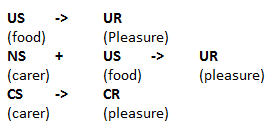
-key stimulus = food ('cupboard love') - 71How is attachment learnt through Classical Conditioning?-learn to associate food-giver with pleasurable outcome
- 72How is attachment learnt through operant conditioning?-learn to repeat behaviour through consequences
-Positively reinforce when receive positive consequences for behaviour -> cry = caregiver responds
-negatively reinforces when unpleasant consequence has been avoided -> when provide comfort = crying stops - 73Evaluation: HARLOW- spent 23/24 hrs with cloth mother without food compared to wire mother with food
-shows contact comfort more important than food - 74Evaluation: SHAFFER + EMERSON-babies formed multiple attachments, most of which did not feed the infant
-other = mother primary attachment figure even though she did not feed them - 75Evaluation: TRONICK ET AL (Tribes)-fed by multiple caregivers but still formed primary attachment to mother
- 76Evaluation: BOWLBYattachment is not a learnt behaviour but an innate behaviour which increases survival chances
-produce behaviour without stimuli - 77Evaluation: new explanation of social learning theory-suggest parents teach child love through modelling attachment behaviours
-also, reward with approval when display own attachment behaviours
-fits with research on interactional synchrony and reciprocity - 78Who Investigated Types of Attachments?AINSWORTH'S STRANGE SITUATION
- 79AINSWORTH: What type of study was it?a controlled observation
- 80AINSWORTH: Ps-100 middle class US infants
- 81AINSWORTH: Did-used grid pattern to make sure room set up the same way
-noted willingness to explore, separation anxiety and reunion behaviour - 82AINSWORTH: Stages-mother, baby, experimenter
-mother, baby
-mother, baby, stranger
-stranger, baby
-mother, baby
-baby
-stranger, baby
-mother, baby - 83AINSWORTH: Found -> TYPE A-Insecure-Avoidant = 22%
-did not use mother as a safe base
-no stranger/separation anxiety
-reunion = little interest in mother
-mothers were not sensitive to child's signals - 84AINSWORTH: Found -> TYPE B-securely attached = 66%
-used mother as a safe base
-showed stranger/separation anxiety
-easily comforted by mother
-mother sensitive to child's signals - 85AINSWORTH: Found -> TYPE C-Insecure-Resistant = 12%
-clingy to mother
-extreme separation/stranger anxiety
-difficult to soothe
-mother sometimes sensitive to child's signals - 86AINSWORTH: Shows-most common attachment = secure
-association between mothers actions and attachment type suggests mother's behaviour determines the attachment type - 87Evaluation: MAIN + SOLOMAN-discovered Type D -> Disorganised
-children may have been wrongly classified
-proportions of children in each category incorrect
-lacks validity -> may not be a useful method of identifying attachment types - 88Evaluation: behaviour of mothers could be affected by deman characteristics-knew they were being observed
-may have been more attentive to child than would usually be
-more classed as securely attached
-lack external validity as secure attachment may not be as common as results suggest - 89Evaluation: Only measures Attachment Type with One Person-child may have multiple attachments to father + other caregivers
-child may have insecure attachment to mother, but a secure attachment to father
-could not say child was 'insecure type' as would not be true - 90Evaluation: Nuture-attachment type dependent on behaviour of the mother
-BUT has been challenged by Temperament Hypothesis -> child's innate personality
-may mean more difficult for mother to cope with so affects behaviour towards the child -> affects attachment type - 91Evaluation: Culture Bound- test might not mean same things in countries outside western Europe + the USA
-cultural differences mean child responds + caregivers behave differently
*Japan = insecure-resistant BUT because rarely separated from mothers - 92Who investigated cultural variations in attachment types?VAN IJZENDOORN + KROONENBERG
- 93VAN IJZENDOORN + KROONENBERG:: Did-meta-analysis of 32 studies using the strange situation
-reanalysed data from previous studies = secondary data - 94VAN IJZENDOORN + KROONENBERG: What was the most common attachment type across all cultures-type b securely attached
- 95VAN IJZENDOORN + KROONENBERG: What did they find about variation?Variation WITHIN cultures was 150% more than variation BETWEEN cultures
- 96VAN IJZENDOORN + KROONENBERG: What did they find in Japan?highest rate of insecure-resistant 27% and low levels of insecure-avoidant 5% -> babies rarely separated and taught to be polite
- 97VAN IJZENDOORN + KROONENBERG: what did they find in West Germany?-35% avoidant -> independence highly valued + encouraged
- 98VAN IJZENDOORN + KROONENBERG: Shows-false to think different cultures will have same proportions of each attachment
-single western culture = oversimplification
-idea of cross-cultural comparisons lacks validity - 99Evaluation VAN IJZENDOORN + KROONENBERG: meta-analysis-different experiments use slightly different procedures -> not standardised => different results
-15/32 studies were from the USA -> not valid to compare results of one study with only a few children to a country with a large number of studies - 100Evaluation VAN IJZENDOORN + KROONENBERG: Supports both nature and Nurture-all countries had secure attachment as most common -> universal preference for sensitive response to care-giving as it aid survival
-different countries had different levels of avoidant + resistant attachments -> attachment type can be influenced by parenting norms - 101Evaluation VAN IJZENDOORN + KROONENBERG: Temperament may be a confounding variable-assumes stranger/separation anxiety indicates the quality of attachment
-temperament (genetic personality) may be a more important influence on the behaviour
-strange situation in measuring genetic differences rather than attachment types -> lacks internal validity - 102Evaluation VAN IJZENDOORN + KROONENBERG: Alternative Explanation for Secure Attachment being the most common-argued secure is most common as aids survival
-BUT may reflect the effects of mass media
-books + TV broadcast around the world = create same parenting norms => similarities in child-rearing and attachment more common - 103Evaluation VAN IJZENDOORN + KROONENBERG: lacks temporal validity-cultures have changes since 1988
*West Germany is now Germany
-may be more or less variation in attachment type between cultures today
-cannot generalise results to today's world - 104Who came up with the theory of Maternal Deprivation?BOWLBY
- 105Deprivation?separation/loss of the mother or a failure to form an attachment
- 106Critical Period-if attachment is disrupted or not formed in 2.5 yr sensitive period => irreversible, long-term developmental problems
-risk continues to the age of 5 - 107Maternal Deprivation Hypothesis?persistent disruption of primary attachment = long term cognitive, social and emotional difficulties for the infant
- 108Examples of developmental problems-IQ lower
-Affectionless Psychopathy
-Higher levels of aggression
-delinquency
-deppression - 109Affectionless Psychopathy?-inability to show affection or concern for others
-act on impulse - 110Study into Maternal Deprivation?BOWLBY'S 44 Juvenile Theives
- 111BOWLBY: Ps?-44 delinquent teenagers accused of stealing
- 112BOWLBY: Did-families of thieves interviewed to establish if separated from mothers during infancy
- 113BOWLBY: Found (affectionless psychopaths)-14/44 were affectionless psychopaths
-12 of these experience maternal deprivation in 1st 2 yrs of their lives - 114BOWLBY: Found (control group)-only 2 from control group had experienced maternal deprivation
- 115BOWLBY: Shows-supports maternal deprivation
-correlation between maternal deprivation and emotional maladjustment
-sever maternal deprivation = affectionless psychopathy
-less sever = anti-social behaviour - 116Evaluation: Study is correlational-cannot show that deprivation causes anti-social behaviour and leads to affectionless psychopathy, only a link
-may be other, hidden variables caused it
*maternal illness = separation + stranger anxiety => emotional difficulties - 117Evaluation: Data used = retrospective-asking families about experience from many years ago
-memory is fluid = inaccurate
-separations may have been forgotten in individuals in control group
-results inaccurate + maybe no link between maternal deprivation + anti-social behaviour - 118Evaluation: Bowlby carried out interviews and diagnosis-conflict of interest = too subjective
-unconsciously identified children he knew had experienced maternal deprivation as affectionless psychopaths because was the theory he was testing
-lowers validity of finding as another psychologist may not have the same results - 119Evaluation: Practical Application (socially sensitive research)-implications for child care
-more should be done so that mothers can spend more time with their children early on to prevent developmental damage
*child benefit paid directly to mother to help mothers stay at home
*maternity leave - 120Evaluation: LEWIS-replicated study on 500 children
-found maternal deprivation did not predict criminal behaviour
-must be other factors involves *trauma in early childhood (*child abuse) - 121Who investigated the effects of Institutionalisation on orphans?RUTTER
- 122Privation?not forming attachment at all
- 123Institutionalisation?living in an institution for long periods of time
*hospital
*orphanage - 124RUTTER: Aimstudy the effect of privation in institutionalisation on children from Romanian Oraphanages
- 125RUTTER: Ps?- 165 orphans adopted before 3.5 yrs old
-experienced sever physical and emotional neglect in the orphanges - 126RUTTER: did-followed the orphans -> longitudinal study
-weighed, head circumference was measured and developmental milestones recorded
-development assessed - 127RUTTER: Did: When was development assessed in the children?At ages 4, 6, 11 and 15
- 128RUTTER: Did: Control?52 British adoptees
- 129RUTTER: Found when arrived in the UK-half showed mental retardation
- 130RUTTER: Found: at 11-recovery rates related to age that they were adopted
-before 6 months = IQ of 102
-after 6 months = IQ of 86 - 131RUTTER: Found: difficulties if adopted after 6 months?-disinhibited attachments
-clinginess, attention-seeking and indiscriminate affection - 132RUTTER: Found: compared to control-at age of 4 had caught up with control in physical and developmental measures
- 133RUTTER: Found: biological explanation-problems result of early attachment experiences which affect the development of neural pathways
- 134RUTTER: Shows-supports sensitive period of attachment
-Long-term effects of privation may not be as sever if adopted before 6 months - 135Evaluation RUTTER: socially sensitive research-huge impact on social policy
-changed policy to encourage children to be adopted before 6 months old
-therefore have opportunity to form an attachment
-reduces sever effect of privation in adoptees - 136Evaluation RUTTER: Nature and Nurture-early experiences of sensitive responsiveness from mother + lack of early attachment = develop different neural pathways => specific behaviour patterns as an adult
- lead to social and emotional issues at a later age - 137Evaluation RUTTER: issues with generalising-conditions of orphanages so bad that results may not be applied to other institutions
-particularly poor standards of care e.s.p. when forming attachments with children
-situational variables => lack external validity - 138Evaluation RUTTER: Children were not randomly assigned-those adopted may have been more sociable ones
-methodologically better to randomly assign children as removes the confounding variable
-Later adopted did not develop as well due to being less socialable - 139Evaluation RUTTER: Long-term experiences not yet clear-too soon to say for certain is suffered short-term or long-term effects
-children who currently lag behind may 'catch-up' during adulthood
-OR children who appear to have no issues may develop emotional problems in adulthood - 140Who carried out the Early Intervention ProjectZEANAH ET AL
- 141ZEANAH ET AL: Ps95 children aged between 12-31 months who had lived in a institution
- 142ZEANAH ET AL: Control?-50 children who had never lived in an instituition
- 143ZEANAH ET AL: Did-assessed attachment types using the strange situation
-carers interviewed to see if showed signs of disinhibited attachment - 144ZEANAH ET AL: Found: Secure attachments-control = 74 %
-Institutionalised = 19% - 145ZEANAH ET AL: Found: Disinhibited Attachments-control = less than 20%
-institutionalised = 44% - 146ZEANAH ET AL: ShowsThat disinhibited attachments more common and secure less common in children who have been institutionalised
- 147Evaluation ZEANAH ET AL: random allocation-children were randomly allocated to institutional care group and foster group
-removes confounding variable of participant variables - 148Who investigated the effect of attachment type on relationships with other children?MYRON-WILSON + SMITH
- 149MYRON-WILSON + SMITH: Did-assessed attachment type and bullying in London
-aged between 7 and 11 - 150MYRON-WILSON + SMITH: Found-insecure-avoidant most likely to be victims
-insecure-resistant most likely to be bullies - 151Who investigated the effect of attachment type on future romantic relationships?HAZAN + SHAFFER
Love Quiz - 152HAZAN + SHAFFER: Did-analysed 620 replies to a love quiz in a local newspaper
- 153HAZAN + SHAFFER: What did they asses?-current, most important relationship
-general love experiences
-attachment type - 154HAZAN + SHAFFER: Found: Secure attachments-56%
-had longer, more stable relationships - 155HAZAN + SHAFFER: Found: Insecure-Avoidant-25%
-did not believe needed love to be happy - 156HAZAN + SHAFFER: Found: Insecure-resistant-19%
-shorter, more volitile relationships - 157HAZAN + SHAFFER: Shows-attachment type effects how we behave and our attitudes towards romantic relationships
- 158Evaluation HAZAN + SHAFFER: retrospective data-asked about early experiences as a child = answered inaccurately
-recalled incorrectly, or recalled based on what others have told them not what they recall themselves - 159Evaluation HAZAN + SHAFFER: Volunteer Sample-likely to be a biased sample
-only people who were interested would respond
-may be many securely attached people that did not respond but who had difficulty with relationships
-lacks external validity - 160Evaluation HAZAN + SHAFFER: Nature + Nurture-early experiences of sensitive responsiveness leads to formation of particular attachment type => different neural pathways produced => specific behaviour patterns in relationships as an adult
- 161Evaluation HAZAN + SHAFFER: Gave socially desirable answers-responses not always truthful
-respond to present themselves in a positive light
-social desirability bias
*said relationships were more stable than they were - 162What does BOWLBY'S Continuity Hypothesis sate?-infants develop an internal-working model based on their attachment to primary caregiver
-acts as a mental template for what we expect in future relationships
-early experiences = develop different neural pathways - 163Evaluation BOWLBY: Other explanations-child temperament may influence both attachment type and quality of future relationships
-counters Bowlby's view that it is determined by internal working model - 164Evaluation BOWLBY: Supporting research-HARLOW'S monkeys
Informationen
- Beschreibung
- A level Psychology Karteikarten am Attachment, erstellt von Jemima Glazin am 15/02/2017.
- Erstellt von
- Jemima Glazin
- Aufrufe
- 0
- Bewertung