
Karteikarten
the eye
Karten in diesem Stapel (16)
- 1State the function of the retinathe light sensitive cells around the inside of the eye
- 2State the function of the lensfocuses light onto the retina
- 3State the function of the corneatransparent layer that protects the eye and helps to focus light onto the retina
- 4State the function of the pupil/irispupil: the central hole formed by the iris. Light enters the eye through the pupil
iris: coloured ring of muscle that controls the amount of light entering the eye - 5State the function of the ciliary muscleattached to the lens by suspensory ligaments. the muscles change the thickness of the eye lens
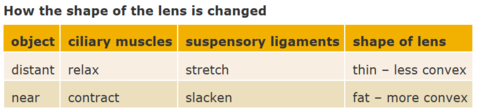
- 6How is the shape of the lens changed
- 7what causes long sightedness and how is it correctedlong sight, caused by the eyeball being too short, so rays of light are focussed behind the retina. We use a converging lens to correct it
- 8what causes short sightedness and how is it correctedshort sight, caused by the eyeball being too long, so rays of light are focussed in front of the retina .we use a diverging lens to correct it
- 9What is the range of visionfrom 25cm to infinity
- 10how does refractive index of the glass effect the shape of a correcting lensthe higher the refractive index of the glass used to make a corrective lens the flatter and thinner the lens can be
- 11state 2 factors the effect the focal length of a lensThe focal length of a lens is determined by:
■ the refractive index of the material from which the lens is made, and
■ the curvature of the two surfaces of the lens. - 12compare the structure of the eye and a cameraLike the eye, the image produced by a camera is diminished, inverted and real.One key difference between a camera and the eye is that a camera does not focus light onto the photosensitive surface by adjusting the shape of the lens. Instead, the focusing screws move the lens forwards or backwards in order to focus the image onto the photosensitive surface.
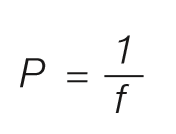
- 13How do you calculate the power of a lens and state the difference between the power of a converging lens and diverging lensP is power in dioptres, D
f is focal length in metres, m
the power of a converging lens is positive and the power of a diverging lens is negative - 14what in a camera is the equivalent of the retina in the eyethe film in a camera or the CCDs in a digital camera is the equivalent of the retina in the eye
- 15how does the eye adapt in bright lightthe circular muscles of the iris contract
making the pupil smaller - 16how does the eye adapt in darknessthe circular muscles of the iris relax
making the pupil larger
Informationen
- Beschreibung
- Karteikarten am the eye, erstellt von david doran am 01/04/2017.
- Erstellt von
- david doran
- Aufrufe
- 221
- Tags
- Bewertung
Mehr zu Nervous System and Senses